

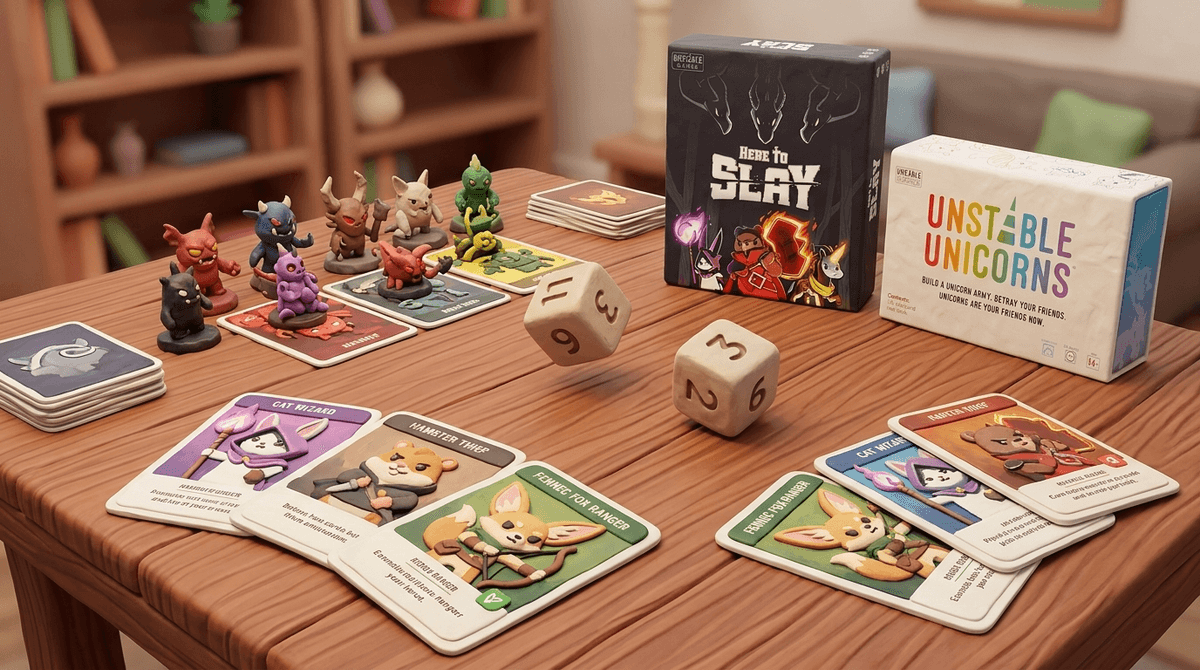
Here to Slay is what happens when you take a ruthless, cutthroat dungeon crawler and wrap it in the skin of a Saturday morning cartoon. It’s a "take that" card game where the goal is to build a party of adorable animal adventurers, slay massive monsters, and—most importantly—viciously sabotage everyone else at the table. If your family game nights are usually peaceful affairs involving cooperative puzzles, this game is going to feel like a bucket of cold water to the face. It’s excellent, fast-paced, and surprisingly deep, but it is a litmus test for your kid’s sportsmanship.
TL;DR
Here to Slay is a competitive fantasy card game for 2-6 players that combines hero-building with aggressive sabotage. Players win by being the first to slay three monsters or assemble a full party of six different classes. It’s a perfect "gateway" game for kids interested in the vibes of Dungeons & Dragons but who want something faster and more visual. Expect high tension, frequent "Challenge" cards that cancel out moves, and a lot of playful (or not-so-playful) table talk.
The first thing you’ll notice about Here to Slay is the art. Created by the same team behind Unstable Unicorns, the characters are objectively precious. You’ve got squirrels in plate armor, cat wizards, and hamsters with daggers.
But don't let the "kawaii" aesthetic fool you. This isn't a "nice" game. In many modern board games, you’re mostly focused on your own little engine—building your farm or gathering your resources. In Here to Slay, half of your strategy is actively preventing your opponents from doing anything cool. You will spend cards to force them to discard their best heroes. You will play "Challenge" cards to stop them from ever casting that game-winning spell. You will, effectively, ruin their turn.
For an intentional parent, this is the "content" to be aware of. It’s not about gore or language; it’s about the emotional resilience required to have your hard work wiped out by a younger sibling with a well-timed "Modifier" card.
The box says ages 10+, but if your kid has played Exploding Kittens or Uno, they can probably handle this by age 8 or 9. The mechanics are straightforward:
- Draw and Play: You have three action points per turn. You can spend them to draw cards, play a hero, or attempt to slay a monster.
- Roll the Dice: Success usually depends on a 2D6 roll. If you roll high, you slay the monster. If you roll low, the monster hits you back.
- The "Challenge": This is the core of the game. When a player tries to play a card, anyone else can play a "Challenge" card. Both players roll dice, and the high roller wins. If the challenger wins, the original card is discarded and the action point is wasted.
The learning curve isn't the rules—it's the iconography. Each hero card has a specific ability that triggers on a dice roll. Keeping track of "If I roll an 8+, I get to steal a card" across five different heroes takes some mental bandwidth. It’s great for building focus and basic math skills, but the first two games will involve a lot of "Wait, what does this one do again?"
If you have a kid who is curious about fantasy tropes—classes like Bard, Fighter, Guardian, Thief, Ranger, and Wizard—this is the best possible introduction. It distills the complicated math of a tabletop RPG into a deck of cards.
- The Thief is all about stealing cards and being a nuisance.
- The Guardian is about protecting your party from sabotage.
- The Bard helps you manipulate your dice rolls.
It teaches the "holy trinity" of gaming roles (tank, healer/buffer, damage dealer) without requiring a 300-page rulebook. If they love the world-building here, they’re a prime candidate for the best fantasy books for kids or eventually moving into more complex strategy titles.
This is where you need to know your kid. Here to Slay is a "salty" game. Because there are two ways to win, the end of the game usually involves "leader bashing." If Mom has five of the six classes needed to win, everyone else at the table is going to spend every single turn trying to destroy her party.
If your kid is highly sensitive to "unfairness" or gets genuinely upset when they are targeted by others, this game will be a struggle. However, if you want to teach them how to lose (and win) with grace, this is a masterclass. The rounds are short enough (20-40 minutes) that a devastating loss doesn't feel like a wasted afternoon. You just shuffle and go again.
- House Rule the "Challenge": If you’re playing with younger kids who are getting frustrated, you can limit the number of "Challenge" cards each person can play per round. It keeps the game moving and lowers the salt levels.
- Narrate the Slaying: The monster cards have names like "The Orthus" or "Rex Major." Encourage your kids to describe how their hamster thief actually takes down a giant fire-breathing dragon. It turns a math exercise into a story.
- Expansion Packs: If the game clicks, there are Dragon and Monster expansions that add new classes (like Druids and Berserkers). They don't change the rules much, but they keep the variety high.
The "Take That" mechanic is the friction point. In Catan, the worst thing you can do is block a road. In Here to Slay, you can literally reach across the table (metaphorically) and snatch a player's favorite card out of their hand. If your family dynamic can handle a little "I’m doing this because I love you, but also I need to win," you're golden. If not, maybe stick to Ticket to Ride.
Q: Is Here to Slay appropriate for a 7 or 8-year-old? Yes, provided they are confident readers. The text on the cards is essential to gameplay. If they can read "Discard a card to pull a Hero card from the discard pile," they can play. Just be prepared to help them manage the frustration of being "challenged."
Q: How long does a typical game of Here to Slay last? Usually 30 to 45 minutes. It can go faster if someone gets lucky with their dice rolls, or longer if everyone is aggressively sabotaging the leader. It’s a great "one more game" type of experience.
Q: Is there any "inappropriate" content in the art? Not really. It’s fantasy violence, but it’s very sanitized. A character might be holding a sword or a staff, but there’s no blood, gore, or suggestive themes. It’s very much in the "PG" lane of animated adventure.
Q: Is Here to Slay better than Unstable Unicorns? Generally, yes. Here to Slay has a bit more strategic depth because of the Monster slaying mechanic and the Class system. Unstable Unicorns is a bit more chaotic and luck-based. If your kid wants to feel like they "outplayed" you, Here to Slay is the better pick.
Here to Slay is a fantastic, high-energy addition to a family game shelf. It’s visually engaging, strategically rewarding, and just "mean" enough to keep things interesting. It’s an ideal bridge between "baby" card games and "serious" tabletop gaming. Just make sure everyone knows that when the "Challenge" cards start flying, it’s not personal—it’s just business.
- For more tabletop ideas, check out our best games for kids list.
- If your kid loves the fantasy vibes, look into the best podcasts for kids for some great storytelling options.
- Find more games like Here to Slay
