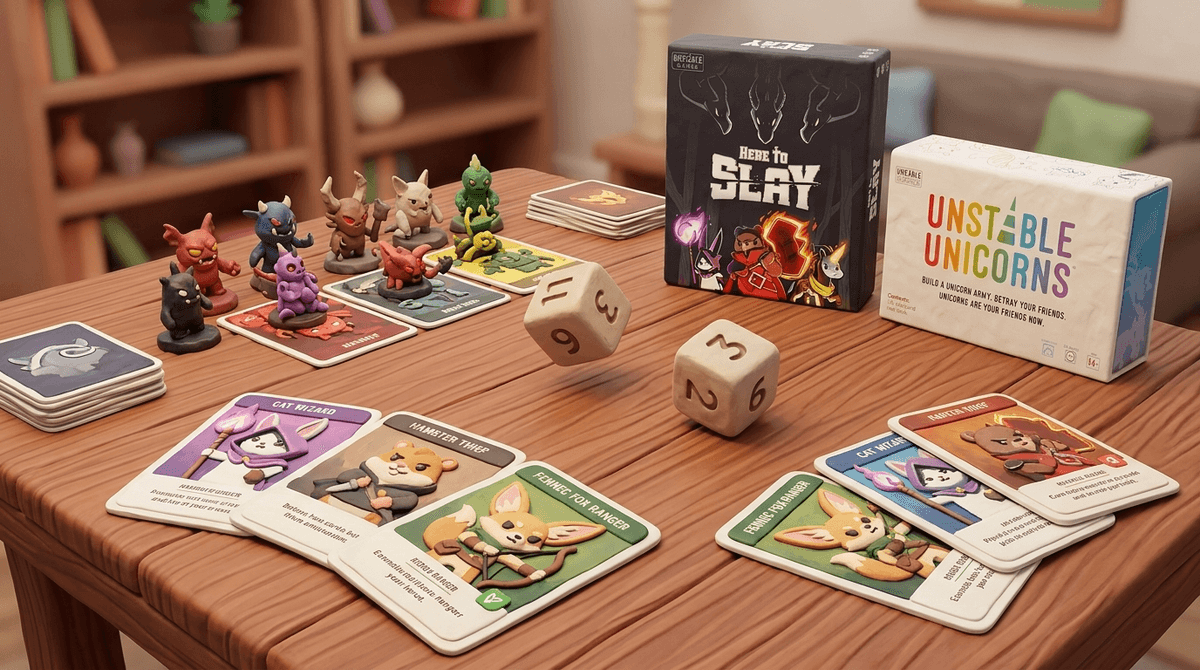
The "Unstable" Pedigree
If you recognize the art style, it’s because designer Ramy Badie and the team at Unstable Games have carved out a very specific niche: games that look like a Saturday morning cartoon but play like a bar fight. Like its predecessor Unstable Unicorns, this game relies heavily on the "take-that" mechanic. This isn't a game where you quietly build a farm or a railroad in your own corner of the table. You are constantly looking at your neighbor’s hand, waiting for the exact moment to ruin their day.
For a lot of parents, this is the friction point. If your household thrives on "cozy" games where everyone wins a little bit, this will feel like a bucket of cold water. But for the kid who finds traditional board games boring or slow, the ability to play a "Challenge" card and stop an opponent's winning move dead in its tracks is pure adrenaline.
Mechanics of the Skirmish
The game is built on a simple three-action-point system. You can draw a card, play a hero, or try to slay a monster. It’s intuitive enough that you can get through the rules in five minutes, which is why it sits at a low 1.68 complexity rating on BoardGameGeek. The real strategy—if you can call it that in a game this chaotic—comes from the party classes. You're trying to balance Fighters, Guardians, Thieves, and Wizards to trigger special abilities.
The "Challenge" mechanic is the game's signature move. When an opponent tries to play a card, you can throw down a Challenge and enter a dice-roll duel. It’s high-stakes and entirely luck-dependent. While serious hobbyists might roll their eyes at how much the dice dictate the outcome, that randomness is a great equalizer. It’s one of the few games where a ten-year-old has a legitimate shot at crushing a competitive adult because the dice simply favored the kid.
The "D&D Lite" Gateway
If your kid has expressed interest in Dungeons & Dragons but isn't ready for a 300-page rulebook, this is a perfect on-ramp. It introduces the core vocabulary of role-playing games—classes, modifiers, party leaders, and boss encounters—without the homework. It’s a "D&D Lite" experience that fits into a 45-minute window.
Because the game is so focused on sabotage, it’s worth reading our Parent's Guide to Here to Slay to see if your kid’s temperament can actually handle the "mean" side of the gameplay. Some kids find the back-and-forth theft hilarious; others might see a stolen Hero card as a personal betrayal.
Why it Sticks
The reason this game has over 8,500 ratings on BGG and a massive following isn't because it’s a mechanical masterpiece. It’s because it’s expressive. The cards are funny, the "slaying" feels rewarding, and the two different win conditions (slay three monsters or collect six different classes) keep the end-game from feeling like a foregone conclusion.
If you find yourself stuck in a loop of playing the same three "classic" board games that everyone actually hates, this is a loud, colorful, and slightly aggressive way to reboot family game night. Just don't expect a peaceful evening. Expect a loud one.