

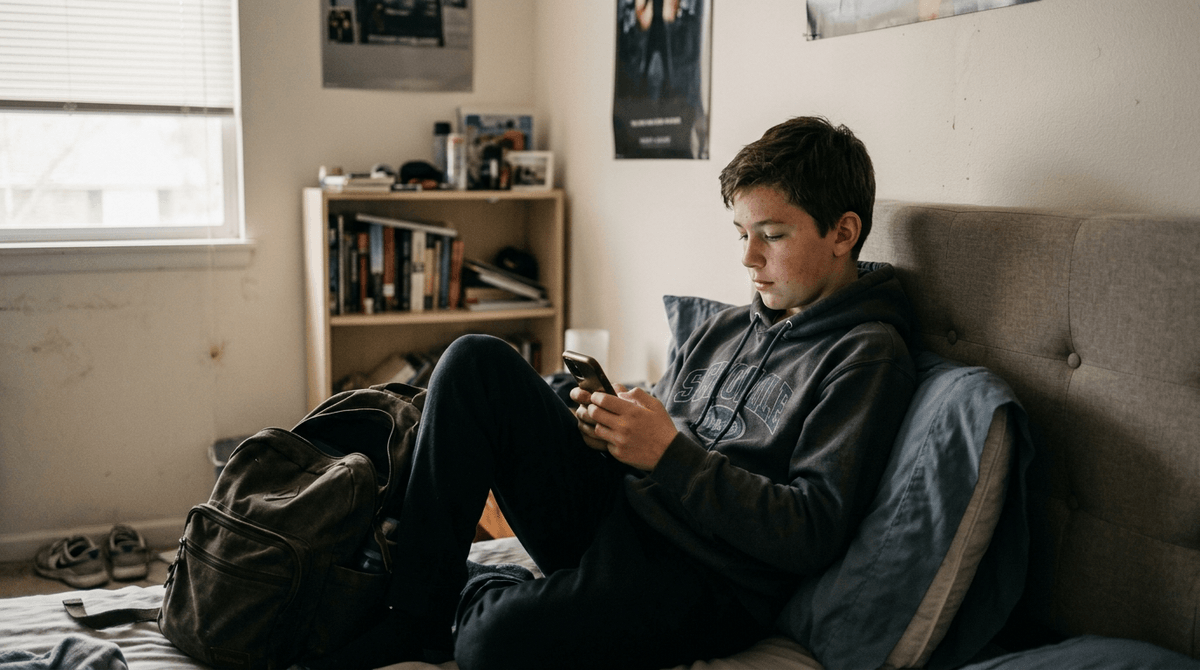

Children have settled into a post-lockdown reality where screens act as emotional buffers and packed schedules leave little room for true play or rest. This shift leaves middle-schoolers logging six hours of media daily while struggling with disrupted sleep and poor nutrition.
Kids are using screens as an emotional refuge from overscheduled routines, driving screen time to six hours a day and worsening sleep quality across the board.
A heavy screen habit is often a survival tactic for exhaustion and stress, not an addiction to entertainment. When daily schedules are tightly packed with adult-managed tasks, kids turn to phones and tablets to claim control and soothe themselves.
Understanding this shift changes how you intervene at home. Stripping away devices without addressing underlying schedule overload will likely trigger emotional meltdowns or shift the coping mechanism to late-night snacking.
Post-pandemic daily habits have permanently reshaped children's lives long after emergency restrictions lifted. Researchers set out to map screen use, sleep, movement, and eating patterns in school-aged children while capturing the emotional reasons kids rely so heavily on devices.
Every single child studied exceeded recommended screen limits, logging a median of six hours per day.
- Screens as an emotional refuge: Children explicitly reported using devices to escape stress, boredom, and tightly controlled daily routines.
- Sleep is fractured: Nearly half of the kids suffered from sleep disturbances, including night awakenings and breathing issues like snoring.
- Late-night coping: Almost three in ten children reported late-night snacking tied directly to stress or an inability to fall asleep.
- Dietary shortfalls: More than nine out of ten children consumed fewer than two servings of vegetables daily.
Kids have normalized a routine that clinical indicators define as unhealthy. Because their peers are also spending six hours on screens and staying up late, children perceive their habits as normal—creating a wide gap between how they feel and what their bodies actually need.
This study examined 217 children aged 8–12 from low-to-middle-income urban families attending pediatric clinics in Bogotá, Colombia. Because the findings rely on self-reported surveys and interviews, recall bias may play a role. As an observational study, it tracks behavioral patterns rather than proving direct cause and effect.
- If your child turns to screens the moment their schedule clears... audit their week to remove at least one structured activity and build in guaranteed, unmanaged downtime.
- If your child sneaks snacks or devices into bed late at night... address underlying bedtime anxiety and boredom rather than relying solely on kitchen lockouts or device bans.
- If your child thinks six hours of screen time is normal... shift the family focus from counting screen minutes to securing non-negotiable anchors like outdoor play and consistent sleep schedules.
Excessive screen time is often a symptom of schedule fatigue and emotional overload rather than pure digital addiction. Restoring downtime and unstructured play addresses the root cause far better than fighting over screen limits alone.
Castrellon-Vergara S, Rueda-Alfonso BN, Palacios-Ariza MA et al. (2026). Physical activity, sleep, dietary habits, and screen time in Bogotá's children post-pandemic lockdown: a mixed-methods study. International journal of qualitative studies on health and well-being. doi:10.1080/17482631.2026.2683936 — pubmed.ncbi.nlm.nih.gov