

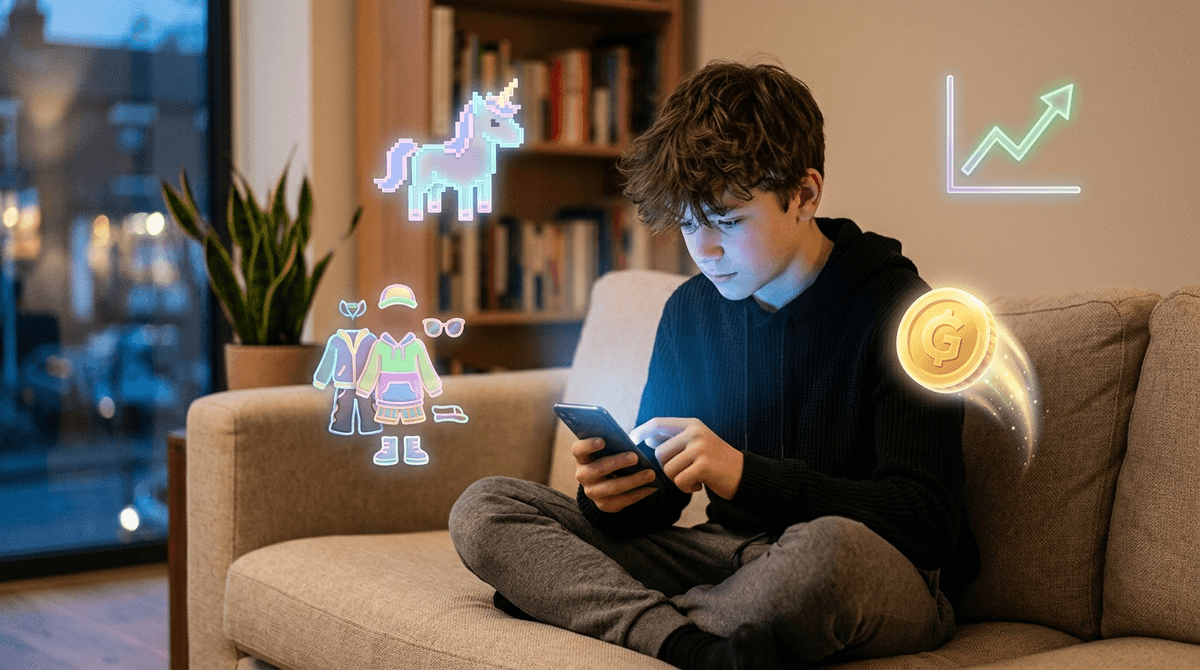
TL;DR: Your kid isn’t just playing games anymore; they’re participating in a multi-billion dollar unregulated commodities market. Whether it’s trading a "Neon Fly Ride" unicorn in Adopt Me! or flipping "Limiteds" in Roblox, kids are learning the highs of the "hustle" and the lows of getting "beamed" (scammed).
Quick Links for the Trading Obsessed:
- Best for learning basics: Rocket League
- The "Wild West" of trading: Roblox
- The status symbol king: Fortnite
- Safe creative alternative: Animal Crossing: New Horizons
- Learn more about how Robux is in fact real money

If you grew up trading Pokémon cards at the bus stop, you understand the core concept. But imagine if those cards could be traded 24/7 with strangers across the globe, had fluctuating prices like the NASDAQ, and could be stolen by a clever "phishing" link in a Discord chat. That is the modern in-game economy.
In games like Roblox, Counter-Strike 2, and Rocket League, items have real-world value. A "skin" (a cosmetic change to a character or weapon) might cost $5 today and $500 next month because of artificial scarcity. When kids talk about "stonks" or "preppy values," they are discussing the perceived market worth of digital pixels.
It’s not just about looking cool—though that’s a huge part of it. In the world of "Ohio" memes and constant social posturing, having a rare skin is the ultimate flex. It’s the digital equivalent of wearing a pair of limited-edition Jordans to school.
But there’s also a deeper psychological hook: The Hustle. Kids feel a sense of agency when they "win" a trade. They feel like entrepreneurs. They’re watching YouTubers who make "Zero to Neon" challenge videos, where they start with a common item and trade their way up to a legendary one. It feels like a game within the game, and for many, the trading is more addictive than the actual gameplay.
Because these marketplaces are often unregulated and involve children, they are a playground for scammers. If your kid comes to you crying because they got "scammed," it usually happens in one of these ways:
- The Trust Trade: A player asks your kid to give them an item first, promising to give something better back. (Spoiler: They won't).
- The Phishing Link: "Hey, check out my trade offer on this site!" The link looks like Roblox but is actually a fake site designed to steal their login credentials.
- The "Beaming": This is high-level account hijacking where scammers use "cookies" to bypass passwords and drain an entire inventory of rare items in seconds.
- Cross-Trading: Trading a Roblox item for a Fortnite item. This is almost always against the Terms of Service and is the easiest way to get scammed with zero recourse.
Check out our guide on how to spot a Roblox scam
Roblox is the epicenter of kid-economy culture. It has its own currency, Robux, and a "Limited" system where the platform releases items in restricted quantities. Once they sell out, the only way to get them is to buy them from other players at a markup.
- The Vibe: High stakes, high reward, very high risk of scams.
- The Game to Watch: Adopt Me!. While it looks like a cute pet simulator, it is actually a hardcore trading floor.
In this "car soccer" game, players trade "blueprints," car bodies, and "goal explosions."
- The Vibe: Generally safer than Roblox because the trading interface is more robust, but "price manipulation" (where groups of people lie about what an item is worth to drive up the price) is common.
- Age Range: 10+
Technically, Fortnite does not allow player-to-player trading. However, the desire for rare skins like "Renegade Raider" is so high that kids often try to buy or sell entire accounts on shady third-party websites.
- The Verdict: This is incredibly dangerous. Selling or buying accounts is the fastest way to get banned and lose all your money.
- Read our guide on Fortnite account safety
This is the million-dollar question.
The Argument for Entrepreneurship: Kids are learning about supply and demand, negotiation, and the value of a dollar (or a Robux). They have to research "price sheets," understand market trends, and learn how to talk to "customers." In a controlled environment, this can actually be a great lesson in digital literacy and finance.
The Argument for Gambling: Many of these items are obtained through "loot boxes" or "gacha" mechanics—randomized drops that provide a dopamine hit similar to a slot machine. When kids start "flipping" items for profit, the line between "trading" and "day trading" becomes very thin. If your child is constantly checking "values" on their phone and getting genuinely distressed when a market "crashes," it might be time to step in.
Ask our chatbot about the link between gaming and gambling
Ages 6-9: The "No Trading" Phase
At this age, kids don't understand the value of what they have. They will trade a $20 legendary pet for a "cool looking" common pet that is worth nothing.
- Action: Turn off trading in the game settings. In Roblox, you can restrict who can trade with your child in the Privacy tab.
Ages 10-13: The "Supervised Hustle"
This is when the obsession usually peaks. They want to be "rich" in-game.
- Action: Allow trading, but only with "Real Life Friends." Make it a rule that any "big" trade (anything involving items they spent real money on) has to be run by you first. It’s a great way to have a 30-second conversation about value.
Ages 14+: The "Digital Literacy" Phase
By now, they likely know more about the market than you do.
Instead of "Why are you wasting time on those stupid skins?" try these conversation starters:
- "I saw that Adopt Me! updated today. Did that change the value of your pets?"
- "How do you know if someone is giving you a fair deal? Do you use a value list?"
- "What’s the most famous scam going around right now? I want to make sure I know what to look for." (This positions you as a student, not a warden).
Digital economies aren't going anywhere. For today's kids, a "Limited" headband in Roblox is just as real as a physical toy.
The goal isn't to ban trading—it's to move your child from being a passive consumer (who gets scammed) to an informed participant (who understands the risks). If they can learn to spot a "trust trade" scam at age 11, they'll be much better at spotting a phishing email or a bad investment at age 25.
- Check the settings: Go into your child's favorite game and see if trading is "Open to Everyone," "Friends Only," or "Disabled."
- Audit the inventory: Ask them to show you their "best" item and explain why it's valuable.
- Enable 2FA: If they have more than $50 worth of "skins," their account is a target. Protect it.
Check out our full guide on setting up Roblox parental controls