

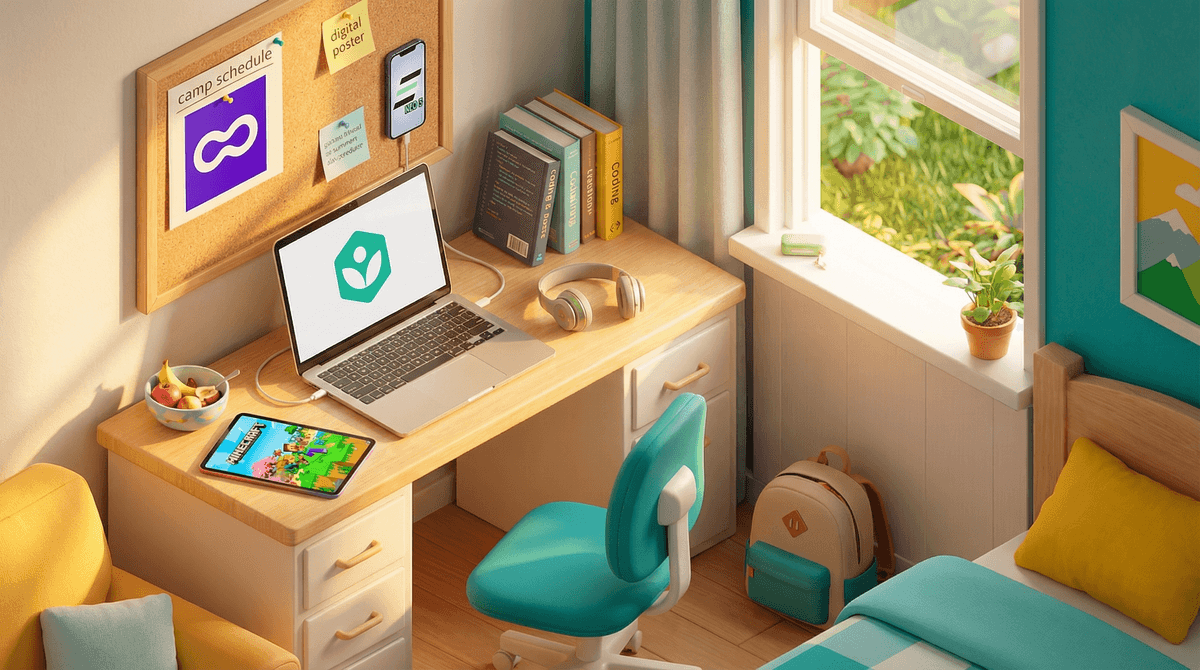
Remember when summer camps meant bug spray, friendship bracelets, and letters home written on actual paper? Well, welcome to 2025, where "camp" might mean your kid is learning Python in their pajamas or taking an animation class from an instructor in another time zone.
Online summer camps are structured virtual programs that run during summer break, offering everything from coding bootcamps to creative writing workshops to digital art classes. Some meet live via Zoom with real instructors and fellow campers. Others are self-paced courses your kid works through independently. And yes, some are basically just glorified YouTube playlists with a certificate at the end.
The range is wild. You've got Khan Academy offering free courses, specialized platforms like iD Tech running week-long intensive coding camps for $400+, Outschool hosting thousands of niche classes (Medieval History Through Minecraft, anyone?), and everything in between.
Here's the thing: online camps can be legitimately great. When they work well, they combine structure with interest-led learning in ways that feel less like school and more like... fun? Revolutionary, I know.
They get to go deep on their interests. Your kid obsessed with marine biology? There's probably a virtual camp taught by an actual marine biologist. Into game design? They can spend a week building an actual playable game instead of just playing Fortnite for eight hours a day.
They meet other weird kids (affectionate). One of the unexpected benefits parents report: their kid finds "their people." The 11-year-old who's really into stop-motion animation might not have peers who share that interest at their local rec center, but in a virtual camp? Suddenly they're in a cohort of fellow nerds.
No commute, no packing lunches, no lost water bottles. From a kid's perspective, rolling out of bed at 8:55 for a 9am camp start is pretty sweet. From a parent's perspective... same, honestly.
But let's not pretend this is all sunshine and low-latency connections. Online camps come with real challenges that are worth thinking through before you drop $300 on "Intro to Entrepreneurship for Tweens."
More screen time. And not just any screen time—this is the focused, cognitively demanding kind that can be genuinely exhausting. A three-hour online camp session requires way more mental energy than three hours of Minecraft. Your kid might finish "camp" and be completely fried, then still want their regular screen time for actual fun.
The quality is all over the map. Some online camps are run by credentialed educators with thoughtfully designed curriculum. Others are... someone who took a weekend course on "how to monetize your hobby" and is now charging $200 to teach your kid something they half-learned from YouTube themselves. There's almost no regulation or standardization.
"Summer camp" might be overselling it. The social-emotional benefits of traditional camp—learning to navigate bunk drama, trying new things when you're slightly uncomfortable, building independence—those don't translate to a Zoom room. Your kid isn't making s'mores or learning to canoe. They're... on a screen. Which they do all year anyway.
The participation range is enormous. In a live virtual camp, you might have kids who are deeply engaged, asking questions, unmuted and participating. And you might have kids who have the Zoom window open while they're actually playing Roblox in another tab. Guess which one your kid might be?
Ages 6-8: Online camps for this age group are tough. Their attention span for screen-based learning is limited, they need a lot of support to navigate the tech, and frankly, they'd probably benefit more from literally anything else. If you do go this route, look for camps that are 45-60 minutes max, highly interactive, and have a strong hands-on component (art supplies they use IRL, science experiments with household items, etc.). And you'll likely need to be nearby for tech support and engagement accountability.
Ages 9-12: This is probably the sweet spot for online camps. They're old enough to manage the technology mostly independently, young enough to still be excited about structured learning, and at an age where deep-diving into interests is developmentally perfect. Look for camps that include breakout rooms for small group work, have a final project or showcase, and run 2-3 hours max per day. Outschool has thousands of options in this age range—just vet the instructor reviews carefully.
Ages 13+: Teens can handle longer, more intensive programs, and might actually benefit from the flexibility of some self-paced options. This is where specialized camps (coding bootcamps, digital art intensives, college prep programs) can provide real skill-building and even portfolio pieces for future applications. But also be aware that teens are especially prone to the "I'll just have the window open while I do other stuff" approach. Programs with accountability built in (regular check-ins, peer collaboration, visible progress) work better.
Do the math on screen time. If you're trying to limit your kid to 2-3 hours of recreational screen time per day, and they're doing a 3-hour online camp... that's their whole budget before they've had any actual fun or connected with friends online. Think about whether you're willing to be flexible about limits during camp weeks, or whether you'd rather find programs that take less time.
Read the reviews like your bank account depends on it. Because it does. Look for specific feedback about: instructor engagement, technical issues, whether the promised curriculum was actually delivered, and how much kids actually learned vs. how much they just... existed in a Zoom room. Check out different online camp platforms to compare options.
Consider the hybrid approach. Some of the best "online camps" are actually hybrid models where kids get digital instruction but then go DO something offline. Coding camps where they build a game, then play it. Art camps where they learn digital techniques but create physical pieces. Writing camps where they workshop online but then submit to real publications. These tend to feel less like "more school on a screen" and more like actual summer enrichment.
Free and cheap options exist. Before you drop serious money, know that Khan Academy, many library systems, and museums offer free or low-cost virtual programming. Your local zoo might have free weekly sessions. YouTube channels like Crash Course and SciShow Kids have structured learning playlists. Sometimes "camp" can just be you curating a learning path and building in some structure.
Set up the environment for success. If you're doing this, don't let your kid take the camp from bed or from the couch with the TV on in the background. Dedicated workspace, good lighting, decent headphones, minimal distractions. Treat it like the real thing, even if it's virtual.
Online summer camps aren't inherently good or bad—they're a tool, and like any tool, effectiveness depends on how you use them and whether they're the right fit for what you're trying to accomplish.
They work best when:
- Your kid has a genuine interest in the topic (not just something you think they should learn)
- The program is well-reviewed with engaged instructors
- You're realistic about screen time trade-offs
- There's a balance with offline activities, physical movement, and unstructured time
They're probably not worth it when:
- You're just trying to fill time or keep them occupied
- The quality is questionable or it's just repackaged YouTube content
- Your kid is already maxed out on screen time
- You're sacrificing outdoor play, social time, or genuine rest for "productivity"
Summer doesn't have to be optimized. It's okay if your kid is bored sometimes. It's okay if they're not learning to code or building their personal brand or developing marketable skills at age 10.
But if you've got a kid who's genuinely excited to spend a week learning animation or marine biology or creative writing? And you've found a quality program that fits your family's screen time values? Go for it. Just maybe make sure they're also getting outside, moving their bodies, and having some truly unstructured time to just... be kids.
If you're considering online camps:
- Have your kid list 3-5 topics they're genuinely interested in (not what you wish they were interested in)
- Research 2-3 programs per topic, reading recent reviews carefully
- Calculate total screen time including camp hours—does this work for your family?
- Start with a shorter/cheaper program first to test the format
- Explore alternatives to traditional online camps that might offer similar benefits with less screen time
If you're looking for specific recommendations:
Remember: you're not failing if you decide online camps aren't for your family. You're also not failing if they become a valuable part of your summer routine. You're just... figuring it out, like the rest of us.