

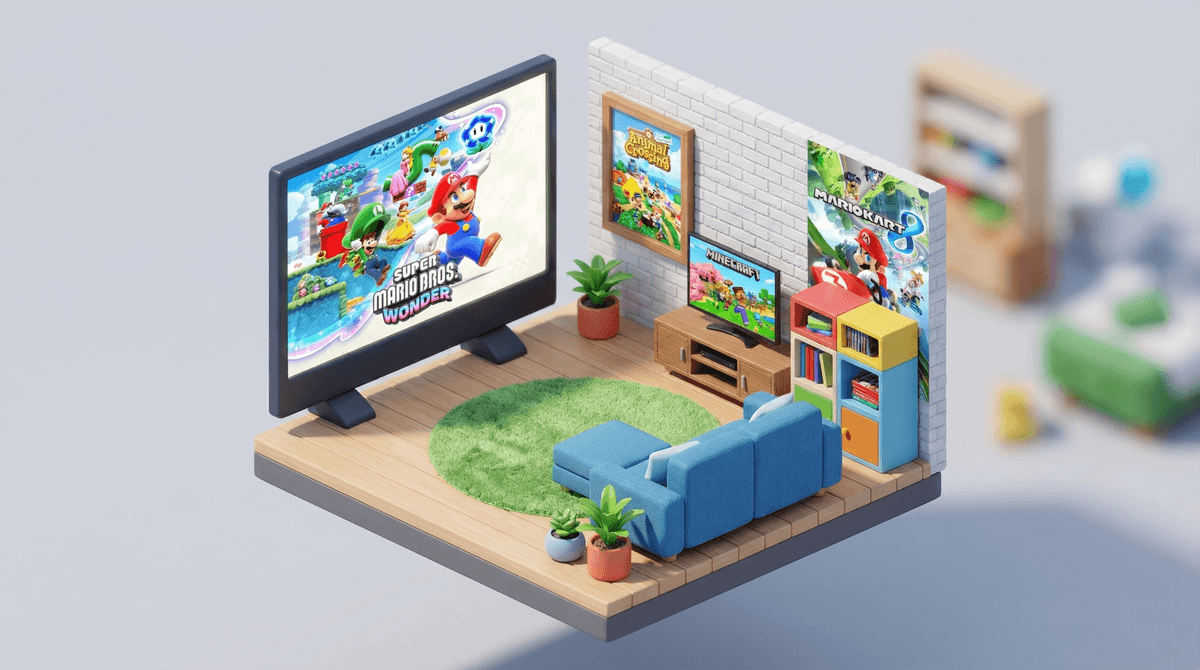
Look, the Nintendo Switch is basically the holy grail of family gaming. It's portable, it's got an actual library of games that won't make you want to gouge your eyes out, and—here's the kicker—it has local multiplayer that doesn't require everyone to own their own console or be connected to the internet.
But here's the thing: not all Switch games are created equal when it comes to family play. Some are genuinely fun for everyone from age 6 to 46. Others are "family games" in the same way that watching your kid play Fortnite while you scroll your phone is "quality time."
So let's talk about the games that actually work—the ones that create those rare moments where everyone's laughing together instead of arguing about whose turn it is or why someone keeps "accidentally" pushing everyone off the edge.
Before we dive into specific games, let's acknowledge why the Switch has become the default family console:
It's genuinely portable. You can play on the TV, then someone can take it to their room, then bring it on a road trip. No other console does this.
Local multiplayer is built-in. Up to 8 players on some games, and you can often use a single Joy-Con per person, which means you're not dropping $60 per controller.
The games are actually good. Nintendo's first-party titles are polished, creative, and—this matters—they don't assume everyone playing is a hardcore gamer.
It's not trying to be everything. No social media integration, no voice chat with strangers (mostly), no constant notifications. It's just... games.
Ages: 5+
This is the obvious one, but it's obvious for a reason. Mario Kart 8 Deluxe is the single best family game on the Switch, full stop. It has auto-accelerate and steering assist for younger kids, so a 5-year-old can actually finish races without constant frustration. Meanwhile, adults can turn off all assists and still get destroyed by a well-timed blue shell.
The chaos is the point. No one stays in first place for long, which means no one dominates completely. Yes, someone will cry about getting hit by a red shell right before the finish line. This is part of the experience.
Real talk: This game has caused more sibling arguments in my observation than any other, but also more genuine belly laughs. Set clear expectations about good sportsmanship before you start, and maybe don't play right before bedtime.
Ages: 6+
This is the newest 2D Mario game, and it's absolutely delightful. Up to 4 players can play together, and here's what makes it work for families: if you die, you turn into a ghost and can float back to another player to respawn. No one gets left behind waiting for everyone else to finish the level.
The "Wonder" effects—these trippy, surprising moments that happen in each level—are genuinely creative and fun to discover together. One level might turn everyone into music notes. Another might make the entire world melt. It's weird in the best way.
Bonus: There are easier characters (like Yoshi) who can't take damage, which means younger kids or less experienced players can participate without feeling like they're constantly failing.
Ages: 6+
This isn't a "play together at the same time" game for most families—it's more of a "pass the Switch around" or "everyone has their own island" situation. But it's worth mentioning because it's become a genuine cultural phenomenon for a reason.
Animal Crossing is cozy, creative, and has no real failure state. You're just... living on an island, decorating, catching bugs, talking to anthropomorphic animals. It's weirdly meditative.
Parent note: This game runs in real-time, which means if you play at 8 PM, it's nighttime in the game. Some kids find this magical. Others get frustrated they can't access certain bugs or fish that only appear during school hours. Just know what you're getting into.
Ages: 7+
Yes, Minecraft is on the Switch, and yes, it supports local multiplayer. If your kids are already Minecraft-obsessed (and statistically, they probably are), the Switch version is actually a nice middle ground between mobile and PC/console versions.
You can build together in Creative mode with zero pressure, or tackle Survival mode as a family project. There's something genuinely satisfying about working together to build a house before nightfall while zombies are spawning.
Real talk: The controls take some getting used to if you're coming from other versions, and the world size is more limited than PC. But for family play, especially with younger kids, these limitations are actually kind of nice—less overwhelming, more focused.
Want to understand why kids are so obsessed with Minecraft?
Ages: 8+
This is a cooking game where you and up to 3 other players work together to prepare and serve meals in increasingly chaotic kitchens. And when I say chaotic, I mean: kitchens that are on fire, kitchens split across two moving trucks, kitchens in outer space.
This game will test your family's ability to communicate under pressure. You'll need to delegate tasks, coordinate timing, and not yell at each other when someone burns the soup. It's basically a trust fall exercise disguised as a video game.
Warning: This game can get genuinely stressful. Some families love the challenge. Others end up in tears. Know your family's tolerance for pressure and competition before diving in.
Ages: 6+
If you have a Pokémon-obsessed kid (and again, statistically likely), this is the most family-friendly entry point on the Switch. It's a remake of the original Pokémon Yellow, which means it's relatively simple and nostalgic for parents who grew up with the series.
The co-op mode lets a second player join in to help catch Pokémon and battle. It's not the deepest multiplayer experience, but for a younger kid who just wants to "help," it's perfect.
Note: The newer Pokémon games (Scarlet and Violet) are more complex and better for older kids, but they don't have the same accessible co-op mode.
Ages: 7+
This is a puzzle-adventure game where Luigi explores a haunted hotel with a vacuum cleaner that sucks up ghosts. It's mildly spooky but not actually scary—think Scooby-Doo, not The Shining.
The co-op mode lets a second player control "Gooigi" (a goo version of Luigi), and you'll need to work together to solve puzzles. It's clever, funny, and genuinely well-designed.
Parent perspective: This is a great "one parent, one kid" game. The puzzles are engaging enough that you won't be bored, but not so hard that a 7-year-old will get frustrated.
Ages: 8+
Okay, this one's a bit different. Splatoon is a competitive multiplayer shooter, but instead of guns, you have paint weapons, and instead of killing opponents, you're covering the map in your team's color. It's Nintendo's take on the shooter genre, which means it's colorful, weird, and surprisingly deep.
The family angle here is more about playing together online or taking turns in the single-player campaign. It's not local multiplayer on one console (you'd need multiple Switches for that), but it's worth mentioning because it's one of the few competitive online games that doesn't feel toxic or inappropriate for kids.
Real talk: There is online multiplayer here, which means your kid might want to play with strangers. The good news is there's no voice chat with random players, and the community is generally less toxic than most online games. Still, worth understanding how online multiplayer works before diving in.
Look, Smash Bros is an incredible game. It's also a fighting game where the entire point is to beat up your opponents and knock them off the stage. For some families, this is harmless fun. For others, it turns into genuine aggression and tears.
The skill gap is also real—if one family member is significantly better than the others, it stops being fun pretty quickly. If your kids are similar ages and skill levels, great. If you've got a 6-year-old playing against a 12-year-old, it might not end well.
Yes, Fortnite is on the Switch. No, it's not really a "family game" in the traditional sense. It's a battle royale where you're playing against 99 other people online, and while you can play in the same squad with family members, the experience is more "parallel play" than "cooperative fun."
Also, the Switch version runs significantly worse than other platforms—lower frame rates, worse graphics, more lag. If your kid is already playing Fortnite elsewhere, fine. But I wouldn't recommend starting on the Switch.
Here's what you should actually know about Fortnite if your kids are asking to play.
Here's the deal: to play most games online, you need a Nintendo Switch Online subscription. It's $20/year for an individual or $35/year for a family plan (up to 8 accounts).
Is it worth it? If you're mainly playing local multiplayer (everyone in the same room), you don't need it. If your kids want to play Mario Kart with their friends online, or if you want access to the library of classic NES and SNES games that come with the subscription, it's a pretty good deal.
The family plan makes sense if you have multiple kids who each want their own profile, or if you want to share the subscription with another family (totally allowed, by the way).
Ages 5-7: Stick with games that have strong assist modes and low pressure. Mario Kart 8 Deluxe, Animal Crossing, and Super Mario Bros. Wonder (with easy characters) are your best bets.
Ages 8-10: They can handle more complex games and mild competition. Add Luigi's Mansion 3, Minecraft, and Pokémon to the mix. Overcooked! 2 if they can handle the pressure.
Ages 11+: Pretty much everything on this list is fair game, including more competitive titles like Splatoon 3 or Smash Bros if your family dynamic can handle it.
The Switch is genuinely great for family gaming, but the key is choosing games that match your family's dynamics. Are you cooperative or competitive? Do you have a wide age range or similar ages? Does someone melt down when they lose, or can everyone laugh it off?
Start with Mario Kart 8 Deluxe. It's the universal entry point, and if your family hates it, the Switch might not be for you. If you love it, branch out to Super Mario Bros. Wonder for co-op or Animal Crossing for something more chill.
And remember: the best family game is the one everyone actually wants to play together. If your kids are begging for Minecraft and you're pushing Luigi's Mansion, you're going to have a bad time. Meet them where they are, set some boundaries around screen time and sportsmanship, and enjoy the fact that you're actually doing something together that doesn't involve screens in separate rooms.
If you're just getting started: Get the Switch, get Mario Kart, see how it goes. Seriously, don't overthink it.
If you want more recommendations: Check out our full guide to age-appropriate Switch games or explore alternatives to the games your kids are already obsessed with.
If you're worried about screen time: The Switch has solid parental controls built in. You can set daily limits, restrict online features, and even pause gameplay remotely from your phone. Here's how to set them up.