

TL;DR: What's Actually Worth Watching Right Now
Streaming services are dumping new kids' movies faster than you can say "autoplay," but most of it is forgettable at best. Here's what's actually worth your time across the major platforms:
The Standouts:
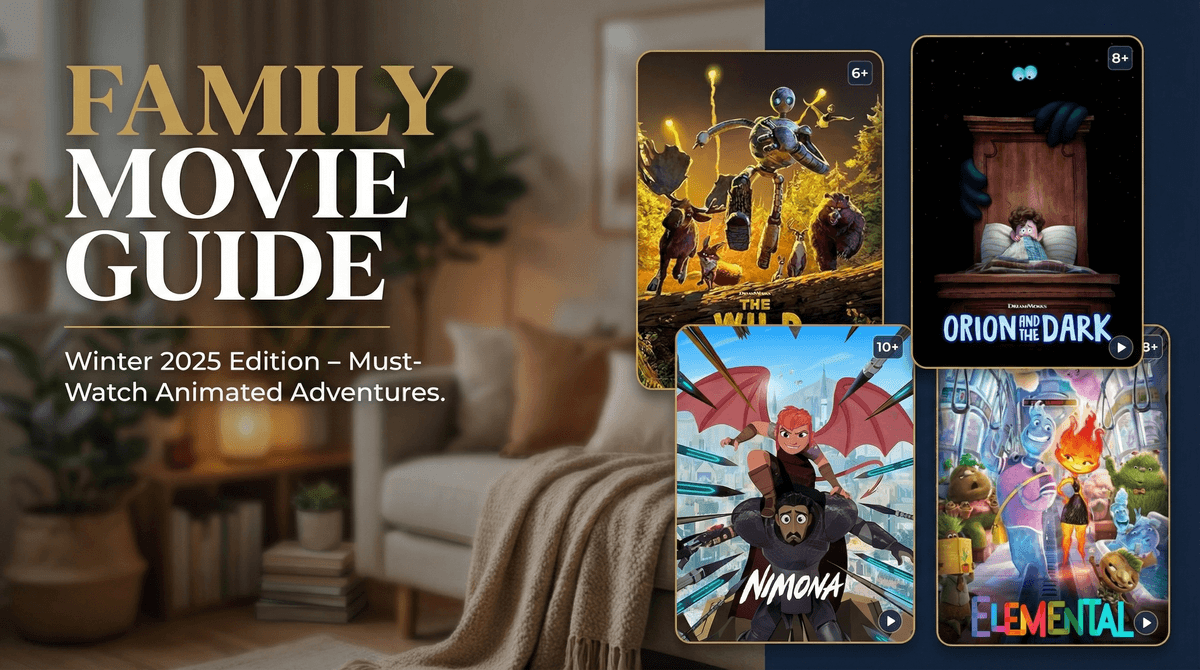
- Orion and the Dark (Netflix, Ages 6+) - Charlie Kaufman wrote a kids' movie about anxiety and it's surprisingly great
- Nimona (Netflix, Ages 10+) - Punk rock shapeshifter takes on the establishment, gorgeous animation
- Elemental (Disney+, Ages 7+) - Pixar's immigration metaphor that's better than the box office suggested
- The Wild Robot (Prime/Theaters, Ages 8+) - Possibly the best animated film of 2024, full stop
Now let's talk about how to actually navigate this streaming hellscape without your kids ending up three movies deep into direct-to-streaming garbage.
Every platform is playing the same game: flood the zone with "content" (I hate that word) and hope something sticks. For every legitimately good kids' movie, there are fifteen that feel like they were generated by an AI trained exclusively on rejected Illumination scripts.
You know the type: celebrity voice cast doing minimal effort, fart jokes, pop culture references that'll age like milk, and plots that make no sense if you think about them for more than thirty seconds. Your kids will watch them. They might even enjoy them. But you'll feel your soul leaving your body around minute forty-three.
The autoplay feature is designed to keep your kids watching, not to curate quality. Netflix doesn't care if the next thing is good—they care that your subscription renews.
Orion and the Dark (Netflix, Ages 6+)
Charlie Kaufman (yes, that Charlie Kaufman) adapted a kids' book about a boy who's afraid of everything, especially the dark. The Dark is personified as a big friendly shadow creature who takes Orion on a journey to understand his fears.
This could've been saccharine nonsense, but it's genuinely thoughtful about childhood anxiety without being heavy-handed. The animation style is distinctive, the story has actual layers (there's a meta-narrative frame that works surprisingly well), and it treats kids like they can handle complex emotions.
The catch: Some kids find the visual representation of fears a bit intense. If your kid is already anxious about the dark, maybe preview this one first. But for most kids, it's a beautiful way to talk about fear without making it a Big Serious Conversation.
Nimona (Netflix, Ages 10+)
This one almost didn't happen—Disney shut down production when they acquired Fox, and Netflix rescued it. Thank god they did.
Nimona is a shapeshifting teenage girl who teams up with a disgraced knight to clear his name. It's based on a graphic novel, and it keeps the punk rock energy and subversive edge. The animation is kinetic and stylized in a way that feels fresh, not like every other Pixar knockoff.
Why it works: It's genuinely funny (not just "funny for a kids' movie"), the relationship between Nimona and the knight feels earned, and it has things to say about otherness and belonging without being preachy. Also, there's a same-sex romance that's just... there, treated as completely normal, which is how it should be.
Content note: There's some intense action violence (no blood, but people definitely get hurt), and the themes around rejection and belonging might hit hard for sensitive kids. This is firmly in the tween zone.
Elemental (Disney+, Ages 7+)
Everyone dunked on this when it came out because it underperformed at the box office, but it's actually a solid Pixar film. The premise—a city where fire, water, earth, and air people live together, focusing on a fire girl and water boy who fall for each other—sounds like it could be painfully on-the-nose.
And yeah, it's an immigration story. Fire people are treated like second-class citizens, there are language barriers, family expectations about taking over the business. It's not subtle. But it's also genuinely sweet, beautifully animated (the fire and water effects are stunning), and has more emotional depth than you'd expect.
For parents: This is a good one if you want to talk about cultural identity and immigration with your kids. It's accessible for younger viewers but has enough nuance for older kids to engage with.
The Wild Robot (Prime Video/Theaters, Ages 8+)
If you haven't seen this yet, move it to the top of your list. A robot named Roz crashes on an uninhabited island and has to learn to survive, eventually becoming a parent to an orphaned gosling.
This is the kind of movie that reminds you why animation matters. It's gorgeous—the visual style is painterly and distinct. The story is emotionally sophisticated without being manipulative. It's about parenthood, belonging, nature versus technology, and finding your purpose, but it never feels like it's lecturing you.
Real talk: This movie will make you cry. Not "aww that's sweet" tears—full-on ugly crying. Multiple times. The kids will be fine; you will not be fine. Plan accordingly.
If your kids loved the book, they'll love this. If they haven't read it, they'll probably want to after watching.
These won't change your life, but they're competent enough that you won't hate yourself for putting them on:
- Wish (Disney+, Ages 6+) - Disney's 100th anniversary film that feels like a committee designed it, but the songs are catchy and the animation is pretty. It's fine.
- Leo (Netflix, Ages 8+) - Adam Sandler voices a 74-year-old lizard who's been a classroom pet forever. It's more charming than it has any right to be, though it drags in the middle.
- Migration (Peacock, Ages 5+) - Illumination does a duck family road trip. Predictable but inoffensive, good for younger kids who just want something colorful and silly.
I'm not going to link these because I don't want to dignify them with traffic, but avoid:
- Paw Patrol: The Mighty Movie - If your kids are already in the Paw Patrol vortex, I'm sorry. This won't make it better.
- Ruby Gillman, Teenage Kraken - DreamWorks at their most generic. It's not offensive, just aggressively forgettable.
- The Monkey King (Netflix) - Gorgeous animation wasted on a story that can't figure out what it wants to be.
The streaming platforms want you to stay on their platform, which means their recommendations are garbage. Here's how to actually find quality:
Use Common Sense Media: Yes, it's a bit conservative in its ratings sometimes, but the reviews are detailed and tell you what you actually need to know. They have age recommendations, content warnings, and reviews from both parents and kids.
Check the creative team: If you see names like Pete Docter, Genndy Tartakovsky, Tomm Moore, or studios like Laika, Cartoon Saloon, or Spider-Verse team, pay attention. These are people who care about animation as an art form, not just content generation.
Look for film festival pedigree: If an animated film played at Annecy, TIFF, or other actual film festivals, it's probably made by people who give a damn.
Trust your kids' teachers and librarians: They see what actually resonates with kids versus what's just marketing hype. If your school librarian recommends something, listen.
Use Screenwise's media pages: Every movie has a dedicated page with ratings, WISE scores, and parent reviews. You can see what other parents in your community think before committing to 90 minutes.
Ages 4-6: Stick with established franchises that have proven quality control—Pixar shorts, Studio Ghibli's gentler films (My Neighbor Totoro), classic Disney. New releases are hit-or-miss for this age.
Ages 7-9: This is the sweet spot for most family animated films. They can handle more complex plots and emotional beats. Orion and the Dark, Elemental, and The Wild Robot all work great here.
Ages 10+: They're ready for more sophisticated storytelling like Nimona, and you can start introducing them to anime films from Studio Ghibli (Spirited Away, Howl's Moving Castle) and Makoto Shinkai (Your Name).
The sibling problem: When you have a wide age range, finding something that works for everyone is genuinely hard. The Wild Robot and Elemental are your best bets—sophisticated enough for older kids, accessible enough for younger ones.
Not all streaming is created equal. Here's what actually matters:
Animation quality varies wildly: Netflix in particular will throw money at celebrity voice actors but skimp on animation. You can tell within thirty seconds if something was made with care or just pumped out to fill a content quota.
"Netflix Original" means nothing: It's just a distribution deal. Some Netflix "originals" are genuinely original productions, others are just films they bought distribution rights to. Nimona and The Wild Robot are quality; most of their kids' slate is not.
Disney+ has the back catalog advantage: Yes, their new stuff is inconsistent, but you have access to decades of Pixar, Disney Animation, and now Fox's Blue Sky Studios. That's worth the subscription alone.
Prime Video is the wild west: They have some gems (The Wild Robot is there now), but their kids' section is also full of the most random stuff. Use it for specific titles, not browsing.
Most new streaming movies for kids are designed to be watched once and forgotten. Your job isn't to find the perfect movie every time—it's to avoid the truly terrible ones and occasionally hit gold.
When you find something good, it's worth celebrating. The Wild Robot is the kind of film that reminds you what animation can do when it's treated as art, not just babysitting. Nimona shows that kids' movies can be genuinely subversive. Orion and the Dark proves that you can be thoughtful about difficult topics without talking down to kids.
The streaming services won't curate this for you—their algorithm wants engagement, not quality. But you can. Check reviews, ask other parents, use Screenwise's media database, and trust your instincts. If something looks like lazy cash-grab garbage, it probably is.
And remember: it's okay to rewatch the good stuff. Your kids don't need novelty as much as the platforms want you to think they do. If The Wild Robot becomes the movie they watch seventeen times, that's a win. Quality over quantity, always.
-
Check your current streaming subscriptions - What do you actually have access to? Compare streaming services for families if you're thinking about switching.
-
Set up profiles properly - Kids' profiles should have age restrictions enabled. Yes, they'll complain. Do it anyway. Here's how to set up parental controls on each major platform.
-
Create a family watchlist - Instead of letting your kids browse and click on whatever has the brightest thumbnail, build a pre-approved list together. It gives them choice within boundaries.
-
Schedule movie nights - Make watching something good together an event, not just default background noise. Turn off autoplay, make popcorn, actually watch with them.
-
Use Screenwise to preview - Before committing to a new release, check the media page
for ratings, reviews, and age recommendations from other parents in your community.
The good movies are out there. You just have to fight through the algorithm to find them.