

TL;DR
If your living room has been taken over by the minimalist, high-emotion world of Gerald and Piggie, you’re in good company. While the internet is currently obsessed with "brain rot" like Skibidi Toilet or the latest "Ohio" meme, the viral surge of My Friend Is Sad read-alouds on YouTube is actually a win for parents. These stories are the "starter pack" for digital empathy, teaching kids how to recognize big feelings in others and—more importantly—how to show up for their friends.
Quick Links:
- The Original: My Friend Is Sad by Mo Willems
- Best Digital Version: Mo Willems on YouTube
- The "Next Step" Show: Bluey
- The Best Reading App: Khan Academy Kids
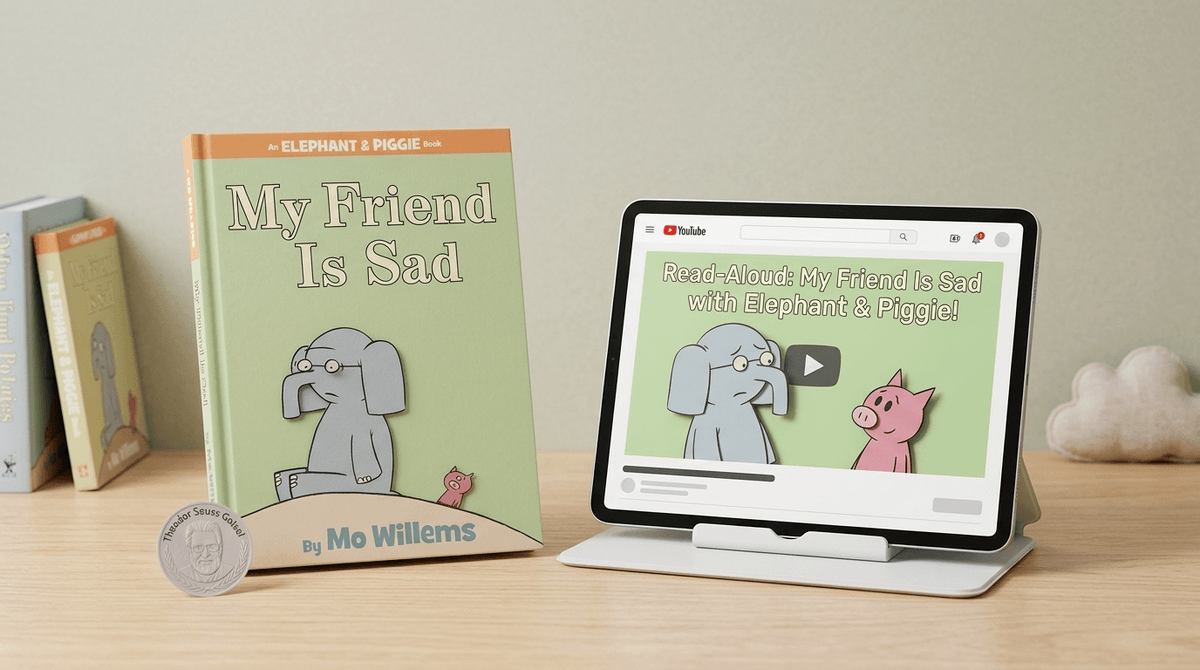
At its core, My Friend Is Sad is a classic picture book by Mo Willems, part of the legendary Elephant & Piggie series. But in the last year, it has taken on a second life in the digital world. If you search for it on YouTube, you’ll find hundreds of "read-aloud" videos, some with millions of views, ranging from official productions to teachers using puppets and parents doing "the voices."
The plot is simple: Gerald the Elephant is sad. Piggie, his best friend, sees this and decides to cheer him up by dressing up as various things Gerald likes (a cowboy, a clown, a robot). The twist? Gerald is still sad because Piggie isn't there to see the "cool stuff" with him. It’s a masterclass in perspective-taking, wrapped in a package that toddlers and early elementary kids actually find hilarious.
We spend a lot of time worrying about our kids becoming "iPad kids"—zoning out to bright colors and repetitive sounds. But the "My Friend Is Sad" trend represents a different corner of the internet. It’s the "Social-Emotional Learning" (SEL) side of YouTube.
In a world where digital communication often strips away tone and body language, these stories provide a foundational "code" for empathy. When your kid watches Gerald’s ears droop on a screen, they are practicing the exact same visual literacy they’ll need later to realize a friend is being left out of a Roblox server or feeling "salty" in a group text.

Kids are drawn to Gerald and Piggie because the characters are "real" in their reactions. Gerald isn't just "a little bummed"; he is dramatically, end-of-the-world sad. Piggie isn't just "trying to help"; she is frantically putting on costumes to fix her friend’s mood.
For a five-year-old, this is relatable content. They live in a world of big, unmanaged emotions. Seeing Gerald navigate sadness—and seeing Piggie fail several times before getting it right—is incredibly validating. It teaches them that:
- Sadness is okay. It’s not a "bad" emotion that needs to be hidden.
- Friendship is about presence. You don't need a robot costume to be a good friend; you just need to be there.
- Humor is a bridge. The slapstick nature of the digital read-alouds keeps them engaged long enough to absorb the lesson.
If your child is obsessed with My Friend Is Sad, you can lean into that interest with these high-quality, Screenwise-approved alternatives that build on the same themes.
If Elephant & Piggie is the "preschool" version of empathy, Bluey is the PhD level. Episodes like "The Show" or "Copycat" deal with sadness and disappointment in ways that are genuinely moving for both kids and adults. It’s the gold standard for modeling how to handle "big feelings" without being preachy.
Instead of letting the YouTube algorithm pick the next read-aloud, head to Storyline Online. It’s a website where famous actors read children’s books with high-quality animation. It’s a much safer, more intentional way to consume "digital books" than a random YouTube search.
Yes, the songs can be earworms, but Daniel Tiger is essentially a manual for early childhood emotions. If "My Friend Is Sad" sparked a conversation about helping friends, Daniel Tiger has a song for exactly how to do that.
This is arguably the best free educational app on the market. Beyond the reading and math, it has a dedicated "Social-Emotional" section with interactive stories that ask kids to identify how characters are feeling. It’s a great way to turn passive watching into active learning.
Another hit in the same series. This one focuses on delayed gratification—a skill that is increasingly rare in the age of "on-demand everything." It’s a perfect companion to My Friend Is Sad.
Ages 2-4: Stick to the physical books or the official Mo Willems YouTube videos. At this age, the goal is just recognizing the emotion. "Look at Gerald's face. How do you think he feels?"
Ages 5-7: This is the sweet spot for discussing "Piggie’s mistake." Ask your child: "Why didn't the robot costume make Gerald happy?" This helps them understand that sometimes, "fixing" a problem isn't what a friend needs—they just need company.
Ages 8+: By now, they might think Gerald and Piggie are "for babies," but the core lesson still applies to their digital lives. Use the story as a metaphor for how they interact in Minecraft or Discord. If a friend is "sad" (or frustrated/losing) in a game, do you try to "flex" your cool skins (like Piggie’s costumes), or do you actually listen to them?
Check out our guide on teaching digital etiquette to elementary students
While "My Friend Is Sad" is wholesome content, the platform it lives on—YouTube—is a wild west.
- The "Read-Aloud" Trap: Not all read-alouds are created equal. Some use AI-generated voices that are creepy and devoid of emotion, which defeats the purpose of an empathy lesson. Stick to channels like Storyline Online or the author’s official channel.
- The Sidebar of Doom: If you let the "Up Next" video play, you might go from a sweet story about an elephant to a weird, low-budget "Elsagate" style video or a loud, over-stimulating toy unboxing.
- Comments: Never leave a child alone with YouTube comments. Even on "Made for Kids" content, the comment sections (if enabled) can be a mess.
Pro-Tip: If you’re using YouTube for these stories, cast it to the TV rather than giving them the tablet. It keeps it a shared experience and makes it easier for you to "curate" the next video.
Learn more about the differences between YouTube and YouTube Kids
The magic of My Friend Is Sad isn't just in the watching; it’s in the "after-talk." You don’t need a degree in psychology to have a meaningful conversation here.
Try these prompts after the video ends:
- "Piggie tried so hard to cheer Gerald up. Have you ever tried to cheer someone up and it didn't work?"
- "Gerald was sad because he missed his friend. What do you do when you miss your friends?"
- "If you were Piggie, what would you have done differently?"
These questions move the content from "something they watched" to "something they know." In Screenwise terms, this is how we move from passive consumption to intentional engagement.
In a digital landscape filled with "brain rot" and mindless scrolling, My Friend Is Sad is a breath of fresh air. It’s a simple, effective tool for teaching the building blocks of empathy.
Whether they are reading the physical book or watching a high-quality read-aloud on PBS Kids, your child is learning that feelings are okay, friends are important, and sometimes the best way to help someone is just to sit next to them.
And honestly? In 2026, that’s a lesson we could all probably use a refresher on.
- Audit your YouTube: Check your history. Are your kids watching quality read-alouds or weird AI knock-offs?
- Bridge the Gap: Next time your child is upset, reference the book. "Are you feeling a little like Gerald right now? Do you need a costume, or do you just need me to sit here?"
- Explore Alternatives: If they’ve outgrown Gerald and Piggie, check out our guide on cozy games for kids that emphasize kindness and community over competition.