

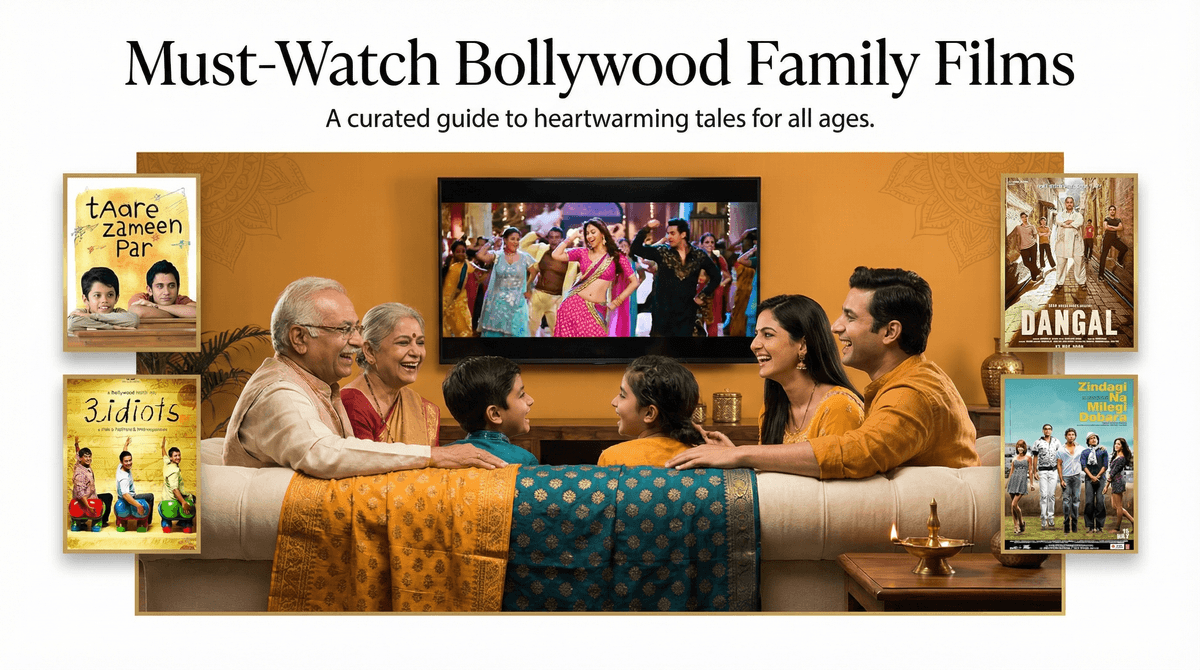
Must-Watch Bollywood Family Films for All Ages
TL;DR: Bollywood isn't just colorful song-and-dance sequences (though those are amazing). These films offer rich storytelling about family, identity, and navigating tradition in a modern world — themes that resonate whether your family has South Asian roots or you're just looking for something beyond the Disney+ algorithm. Here are the essential family-friendly Bollywood films that actually work for mixed-age viewing, with real talk about what makes them great and what to watch out for.
Quick picks by age:
- Ages 6+: Taare Zameen Par, Chillar Party
- Ages 10+: 3 Idiots, Dangal
- Ages 12+: Zindagi Na Milegi Dobara, Queen
If your family's media diet consists entirely of American and European content, you're missing out on stories that center different values, family structures, and cultural tensions. Bollywood films often tackle intergenerational conflict, duty vs. desire, and the immigrant experience in ways that Hollywood doesn't — and they do it with genuine emotion, humor, and yes, spectacular musical numbers that your kids will be humming for weeks.
Plus, representation matters. For South Asian families, seeing your culture reflected on screen is huge. For everyone else, exposure to different storytelling traditions builds cultural literacy and empathy. And honestly? The production values on modern Bollywood films rival anything coming out of Hollywood.
Ages 6+ | 2007 | 2h 45m
This is the film that makes grown adults sob in the first 20 minutes. It follows Ishaan, an 8-year-old struggling in school who everyone assumes is lazy or defiant — until a substitute art teacher recognizes he has dyslexia.
Why it works: Aamir Khan (who also directed) created something genuinely moving about neurodivergence, academic pressure, and seeing children for who they are rather than who we want them to be. The film doesn't sugarcoat how brutal the education system can be for kids who learn differently.
Conversation starters: This is perfect for talking about learning differences, the pressure to perform academically, and how we define success. If you have a kid who struggles in school, this film sees them. If you have a kid who excels, it builds empathy.
Content notes: Some intense scenes of a child being yelled at and punished. The emotional weight is real — have tissues ready.
Ages 10+ | 2009 | 2h 50m
Three engineering students navigate the pressure-cooker of an elite technical college while questioning whether conventional success is worth sacrificing curiosity, friendship, and mental health.
Why it works: It's genuinely funny while taking on India's intense academic culture and the "doctor/engineer or disappointment" mentality that many South Asian kids face. The film argues for passion over prestige, which is radical in cultures where parental expectations carry enormous weight.
Why kids love it: The humor lands across cultures (physical comedy, pranks, absurd situations), and the friendship between the three leads feels authentic. Plus there's a running mystery structure that keeps younger viewers engaged even during the heavier themes.
Content notes: One character attempts suicide (off-screen but discussed), and there's a childbirth scene that's played for comedy but might be intense for younger kids. Some dated attitudes about women, though the film does push back against these. Runtime is long — consider splitting it over two nights.
Ages 10+ | 2016 | 2h 41m
Based on the true story of wrestler Mahavir Singh Phogat who trains his daughters to become world-class wrestlers in a culture where girls are expected to marry young and forget their ambitions.
Why it works: This is a sports movie, a feminist story, and a complicated father-daughter narrative all at once. The father is both progressive (training his daughters when everyone says it's impossible) and controlling (imposing his unfulfilled dreams on them). The film doesn't pretend these contradictions don't exist.
Conversation starters: Gender expectations, parental pressure, what it means to support vs. control your kids, and how change happens in traditional communities. Also great for discussing women in sports more broadly.
Content notes: Wrestling violence (nothing graphic but it's a contact sport), and some scenes of the father being quite harsh in training. The film addresses child marriage as a reality for many girls in rural India.
Ages 12+ | 2011 | 2h 35m
Three childhood friends take a bachelor party road trip through Spain, confronting their fears, relationship issues, and what they actually want from life.
Why it works: It's a beautiful film about male friendship, vulnerability, and choosing joy over obligation. The Spain cinematography is stunning, and each friend's arc involves genuine growth. Plus the soundtrack is incredible.
Why older kids connect: The themes of figuring out who you are versus who everyone expects you to be resonate hard with teens. It's also refreshing to see male characters who talk about feelings, support each other, and grow without toxic masculinity.
Content notes: Some drinking, brief romance/kissing, and one character dealing with commitment issues. The maturity level is more about emotional themes than content — this is PG-13 territory.
Ages 6+ | 2011 | 2h 15m
A group of kids in a Mumbai neighborhood band together to save a street dog from the local politician who wants it gone.
Why it works: It's genuinely from a kid's perspective — the adults are obstacles, allies, or background characters. The kids are funny, flawed, and feel real. And it tackles class divisions in India through the friendship between the privileged neighborhood kids and a working-class boy.
Why younger kids love it: It's about kids solving problems, there's a dog, and the humor is age-appropriate. No talking down to the audience.
Content notes: Some mild peril for the dog, and themes about poverty and class that might need context depending on your kids' ages.
Ages 12+ | 2013 | 2h 26m
After her fiancé calls off their wedding, a sheltered young woman from Delhi decides to go on their planned honeymoon to Paris and Amsterdam — alone.
Why it works: Rani's journey from dependent daughter to independent woman is joyful and empowering without being preachy. She makes mistakes, has adventures, makes friends, and discovers she doesn't need to be rescued. It's a love letter to self-discovery.
Why teens connect: The pressure to follow a prescribed life path (school, marriage, kids) versus figuring out what you actually want is universal. Rani's transformation is about finding her voice, not finding a man.
Content notes: Some drinking and partying in Amsterdam, brief drug references (characters in a cannabis café, nothing graphic), and mature themes about sexuality and independence. This is for older tweens/teens who can handle those conversations.
Ages 12+ | 2019 | 2h 23m
When a man's son attempts suicide after failing an entrance exam, he gathers his college friends to tell the boy about their own "loser" years and how failure isn't the end of the world.
Why it works: It directly confronts India's academic pressure and suicide epidemic while being genuinely funny and heartfelt. The message — that you can fail and still build a meaningful life — is radical and necessary.
Conversation starters: Academic pressure, mental health, how we define success and failure, and the long-term perspective on setbacks. This is essential viewing for any family dealing with school pressure and anxiety.
Content notes: The film opens with a suicide attempt (the son survives). This is handled sensitively but it's intense. There's also college drinking and some crude humor. This is absolutely a film to watch WITH your teen and discuss afterward.
Runtime: Bollywood films are long. Most clock in around 2.5-3 hours because they're structured differently than American films — they're meant to be events, with intermissions built in. Don't try to power through if your kids are losing focus. Split them over two nights or take breaks.
Subtitles: Most of these films are in Hindi with English subtitles (some have dubbed versions but the voice acting is often awkward). If your kids aren't used to subtitles, start with the more visually dynamic films like Dangal or Zindagi Na Milegi Dobara. Reading subtitles is actually great for literacy, and kids adapt faster than you'd think.
Musical numbers: These aren't like Disney songs that advance the plot. They're more like music videos that express emotion, show the passage of time, or just exist for pure joy. Some kids find them jarring at first, others immediately love them. Let your kids know this is part of the storytelling style — it's not random, it's intentional.
Cultural context: You don't need to explain every cultural reference, but some basic context helps. The academic pressure in 3 Idiots hits different when you know about India's competitive exam system. The father's strictness in Dangal makes more sense when you understand rural Indian gender norms. A quick "in India, there's a lot of pressure to become a doctor or engineer" goes a long way.
Where to watch: Most of these are on Netflix, Amazon Prime, or Disney+ Hotstar (which has the best Bollywood selection if you're willing to add another streaming service). Some are available with ads on YouTube.
Ages 6-9: Stick with Taare Zameen Par and Chillar Party. Both center kids, have age-appropriate humor, and tackle themes (learning differences, friendship, standing up for what's right) that resonate with this age group.
Ages 10-12: Add 3 Idiots and Dangal. The themes get more complex (academic pressure, gender expectations, parental control) but nothing content-wise that's inappropriate. Be ready to discuss the heavier moments.
Ages 13+: Everything on this list works, including Queen, Zindagi Na Milegi Dobara, and Chhichhore. These films tackle independence, identity, mental health, and relationships in ways that speak directly to teen experiences.
If your family connects with these, here are some next steps:
-
For younger kids: Stanley Ka Dabba (about a boy who doesn't bring lunch to school), Bumm Bumm Bole (siblings trying to replace lost shoes)
-
For teens: Udaan (escaping an abusive father to pursue writing), English Vinglish (a mother learning English and finding her voice)
-
For the whole family: PK (an alien questions religious dogma, genuinely funny and thought-provoking)
You can also explore family films from other cultures — once you break out of the Hollywood bubble, there's so much great storytelling happening globally.
Bollywood family films offer something American cinema often doesn't: stories where family obligations matter deeply, where duty and desire are in genuine tension, where multiple generations live together and have to navigate their differences. These aren't perfect films (some have dated gender politics, most have product placement that would make Marvel blush), but they're emotionally honest and culturally rich.
Start with whatever matches your family's current interests — sports (Dangal), school pressure (3 Idiots), adventure (Zindagi Na Milegi Dobara). Let the films spark conversations about how different cultures approach family, success, and growing up. And don't be surprised if your kids start requesting more — once you've experienced Bollywood's emotional range and visual spectacle, a lot of Hollywood fare feels a bit... flat.
Also, if you're looking for more international family content or want to explore films about academic pressure, Screenwise can help you find what fits your family's needs and values.