

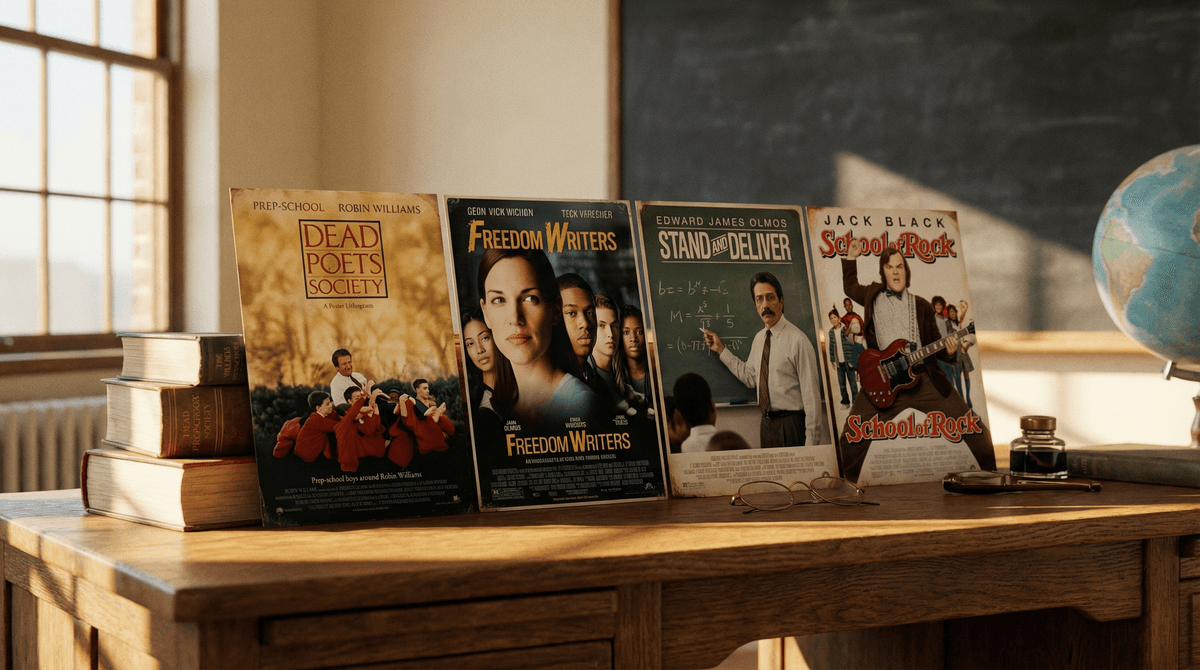
You know those movies where a passionate educator walks into a challenging classroom and transforms lives through the power of learning? Dead Poets Society, Freedom Writers, Stand and Deliver — the classics that made us all want to stand on desks and seize the day. These films about inspiring teachers have been around for decades, and honestly? They still hit different.
But here's the thing: watching these movies with your kids isn't just about nostalgia or showing them "what school used to be like." These stories about transformative educators can open up some genuinely meaningful conversations about what learning actually means, how to find mentors who see you, and what it looks like to think for yourself — topics that feel especially urgent in an age when AI can write your essay and TikTok can teach you calculus.
The best teacher movies aren't really about school. They're about finding your voice, questioning authority (respectfully), and realizing that learning can be thrilling rather than just something you endure until 3pm.
Dead Poets Society (1989) remains the gold standard — Robin Williams as Mr. Keating teaching boys at a stuffy prep school to "make your lives extraordinary" through poetry. Yes, it's melodramatic. Yes, the ending will wreck you. But the core message about thinking independently and finding your own path? Still resonates hard, especially for middle and high schoolers who are navigating peer pressure and figuring out who they want to be.
School of Rock (2003) takes a lighter approach — Jack Black as a failed rock musician who poses as a substitute teacher and forms a band with his students. It's genuinely funny, the kids are talented, and underneath the comedy is a real story about a teacher who sees potential that others missed. Great for ages 10+.
For younger kids, Matilda (1996) features Miss Honey, possibly the gentlest, most nurturing teacher in film history, who recognizes Matilda's brilliance when everyone else overlooks her. The contrast between Miss Honey and the terrifying Miss Trunchbull makes for great conversations about what good teaching actually looks like.
Freedom Writers (2007) shows Hilary Swank as a teacher working with at-risk teens in Long Beach, using writing and the story of Anne Frank to help students process their own experiences with violence and discrimination. It's rated PG-13 for good reason — there's gang violence, racial tension, and heavy themes. But for high schoolers, especially those interested in social justice, it's powerful stuff.
Stand and Deliver (1988) tells the true story of Jaime Escalante, a math teacher who successfully prepared inner-city students for the AP Calculus exam despite everyone doubting them. The movie tackles low expectations, systemic bias, and what's possible when someone actually believes in you. It's a bit dated in style, but the themes are unfortunately still relevant.
Mr. Holland's Opus (1995) follows a music teacher over 30 years, showing how teaching is often about the small moments and individual connections rather than grand gestures. It's long (143 minutes) and a bit slow for modern attention spans, but it's a beautiful meditation on what it means to influence lives over time.
Ages 8-10: Start with Matilda or School of Rock. Both feature kids as protagonists and keep things relatively light while still showing teachers who genuinely care.
Ages 11-13: Dead Poets Society works well here, though heads up — there's a suicide that's emotionally intense. Akeelah and the Bee (2006) is another solid choice, featuring Laurence Fishburne as a coach who helps a young girl compete in the National Spelling Bee.
Ages 14+: Freedom Writers, Stand and Deliver, and Dangerous Minds (1995) all deal with heavier themes but can spark important conversations about education, opportunity, and systemic challenges.
These movies tend to follow a formula: passionate teacher arrives, faces resistance, wins over students through unconventional methods, faces backlash from administration, ultimately makes a difference. It's predictable, but that predictability is actually useful for conversations.
Talk about the teacher-student relationship: These movies often show teachers going above and beyond — visiting students' homes, spending their own money, staying late. That's worth discussing: What's realistic? What's the teacher's responsibility versus what should come from family or community?
Question the "savior" narrative: Many of these films feature a teacher (often white) "saving" students (often students of color) from difficult circumstances. Freedom Writers and Dangerous Minds have been criticized for this. It's a real conversation to have with teens about whose stories get told and how.
Connect to their own experience: Ask your kid if they've ever had a teacher who really got them, or one who completely missed the mark. What made the difference? These movies can help kids articulate what good teaching and mentorship look like in their own lives.
The "think for yourself" paradox: Dead Poets Society is fascinating because Mr. Keating tells students to think independently... but they mostly just follow him instead. It's a great jumping-off point for discussing what independent thinking actually means and how hard it is to practice.
If your kids dig these, there are some great international options too. The Chorus (2004, French) is a beautiful film about a music teacher at a boarding school for troubled boys. Taare Zameen Par (2007, Indian) deals with dyslexia and a teacher who helps a struggling student in ways that feel genuinely fresh.
For something more recent, The Kindergarten Teacher (2018) is a darker, more complex take on a teacher who becomes obsessed with a gifted student — definitely for older teens only, but it complicates the inspiring teacher narrative in interesting ways.
Teacher movies work because they tap into something universal: we all remember the adults who saw us, challenged us, and helped us become who we are. Watching these films with your kids isn't about romanticizing school or teachers — it's about recognizing that learning happens in relationships, that mentorship matters, and that sometimes the most important lessons have nothing to do with the curriculum.
Plus, if your kid is complaining about school being boring, these movies might help them see that learning can be electric when someone makes it come alive. And if they're lucky enough to have a teacher like that? These films might help them appreciate what they've got.
Watch together: Pick one based on your kid's age and interests. Make it a weekend thing with popcorn.
Ask questions afterward: "What would you do if you were in that classroom?" "Do you have a teacher who believes in you like that?" "What do you think makes a good teacher?"
Look for real-life inspiration: If these movies resonate, consider finding documentaries about real educators or reading memoirs by teachers. The Freedom Writers Diary (the book the movie was based on) features actual student writing and hits even harder than the film.
Connect to current learning: How do these traditional classroom stories compare to learning on YouTube, Khan Academy, or with AI tutors? What's gained or lost? That's a conversation worth having .
.