

Let's be real: when you're scrolling through Netflix or Disney+ trying to find something for movie night, representation probably isn't the first filter you're applying. You're thinking "Will this hold their attention?" and "Please god let there be no fart jokes for 90 minutes."
But here's the thing—what kids see on screen shapes how they see themselves and others. For Black children, seeing characters who look like them as heroes, scientists, princesses, and everyday kids isn't just nice to have. It's foundational to identity development. And for non-Black kids? Diverse storytelling builds empathy, challenges stereotypes, and prepares them for the actual world they're growing up in.
This isn't about checking a box or being performatively woke. It's about building a media diet that reflects reality: that Black people exist in every genre, every story type, every role. Not just as sidekicks or historical figures (though those stories matter too), but as fully realized characters living full lives.
Research shows that kids as young as 3-4 years old notice race and begin forming ideas about it. By age 5, they're already developing biases based on what they see around them—including on screens. When Black characters are absent, or only show up in limited roles (the funny friend, the athlete, the historical trauma narrative), it sends a message. To Black kids: "You're not the main character." To everyone else: "This is all Black people can be."
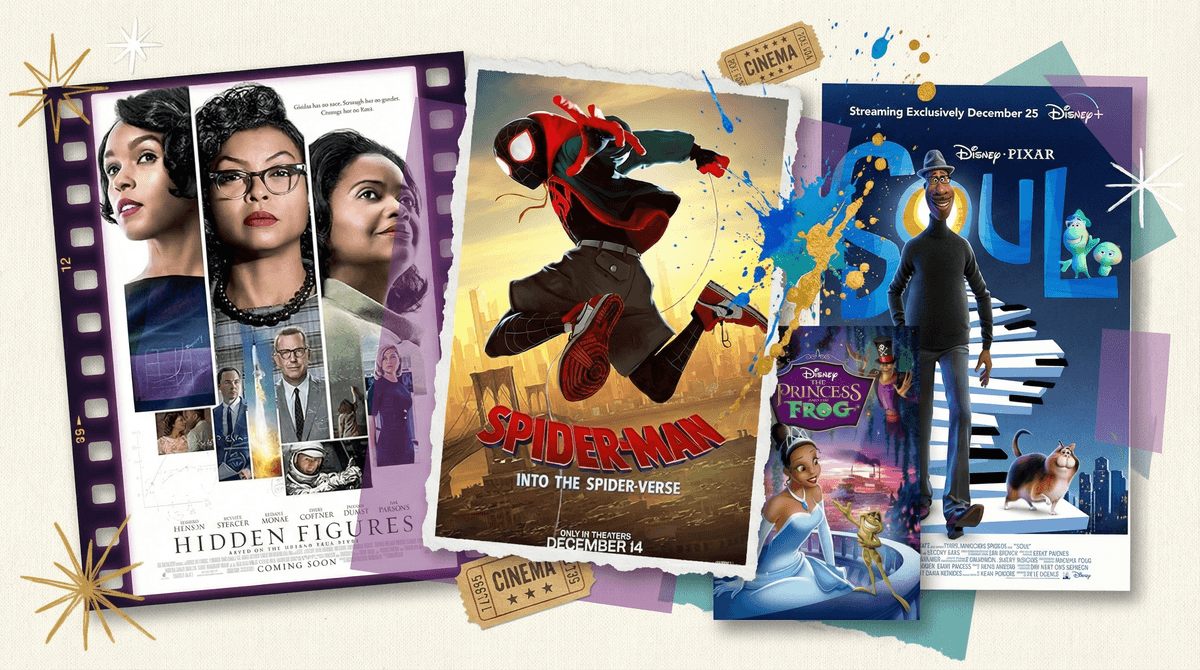
The good news? Representation is genuinely getting better. We're not in the Disney Renaissance era anymore where every princess was white and every villain was coded as "other." We've got Encanto, Moana, Spider-Man: Into the Spider-Verse, The Princess and the Frog, and so many more films where diverse characters aren't the exception—they're just the story.
But it still requires intentionality. The algorithm isn't optimizing for diversity. It's optimizing for what you've already watched.
Ages 3-7: Foundation Years
This is when kids are forming their baseline understanding of "normal." What you show them now matters.
Standouts:
- Encanto — Yes, it's Colombian not Black American, but representation matters across the diaspora, and this film is stunning
- The Princess and the Frog — Disney's first Black princess, set in New Orleans with incredible music
- Soul — Pixar's meditation on purpose and jazz (though heads up: some of the existential themes might sail over younger kids' heads)
- Akeelah and the Bee — An 11-year-old spelling bee champion from South LA (PG, great for older kids in this range)
Streaming tip: Disney+ has a "Celebrate Black Stories" collection that's actually curated well, not just thrown together.
Ages 8-12: Building Complexity
This is the sweet spot for movies that can handle more nuance—stories about identity, history, and contemporary Black life.
Must-watches:
- Spider-Man: Into the Spider-Verse — Miles Morales is one of the best superhero origin stories, period. Afro-Latino representation, incredible animation, and it doesn't make his Blackness the "issue"—it just is
- Hidden Figures — The NASA mathematicians who got us to space. Inspiring without being preachy (PG, though some kids might need context about segregation)
- Black Panther — The cultural phenomenon that showed Hollywood that Black-led blockbusters print money. Yes, there's action violence (PG-13), so know your kid
- Crooklyn — Spike Lee's semi-autobiographical film about a Brooklyn family in the 1970s. Real, funny, and honest about family dynamics
- The Wiz — The 1978 musical reimagining of Wizard of Oz with Diana Ross and Michael Jackson. Weird, wonderful, and so much style
Ages 13+: Real Conversations
Teens can handle—and need—stories that don't shy away from complexity, history, and contemporary issues.
Essential viewing:
- Selma — The voting rights movement and MLK. Heavy but important (PG-13)
- The Hate U Give — A teen witnesses police violence. Gut-wrenching and necessary (PG-13, but emotionally intense)
- Moonlight — A coming-of-age story about a young Black gay man in Miami. Beautifully shot, deeply moving (R rating for language, drug content, and some sexuality)
- Get Out — Jordan Peele's horror masterpiece about racism. Smart, scary, and sparks great conversations (R for violence and disturbing content)
Don't just watch "issue" movies. Yes, historical and social justice films matter. But Black kids (and all kids) also need to see Black characters in rom-coms, sci-fi, fantasy, and silly comedies. The goal isn't just to understand struggle—it's to see full humanity.
Watch together when possible. Especially with older kids and heavier content, your presence matters. Pause and talk through questions. How do you talk to kids about racism in media? — it's a conversation, not a lecture.
Representation isn't just about protagonists. Notice who's in the background, who has power, who gets to be funny, who gets to be smart, who gets to be flawed and complex. Kids pick up on all of it.
"Black movies" aren't a monolith. There's no single Black experience. Stories from Nigeria look different than stories from Atlanta look different than stories from London. Seek out variety.
Building a diverse watchlist isn't about quotas or virtue signaling. It's about giving kids—all kids—a richer, more accurate view of the world. Black children deserve to see themselves as heroes, leaders, scientists, and goofballs. Non-Black children deserve to grow up knowing that's normal.
The good news? You don't have to overhaul everything overnight. Just start noticing. Next movie night, scroll past the default recommendations and ask: "Who's telling this story? Who's centered?" Make it a habit, not a project.
And honestly? A lot of these movies are just better. Spider-Verse is arguably the best superhero movie of the last decade. Encanto has songs you'll actually want stuck in your head. Soul will make you cry in the best way.
Representation isn't a compromise on quality. Often, it's where you find the most interesting stories.
Start here: Pick one movie from the age range that fits your family and watch it this week. That's it. No pressure to become a film scholar overnight.
Go deeper: If your kids connect with a particular film, explore more from that director, actor, or genre. Loved Black Panther? Check out other Afrofuturism stories. Obsessed with Spider-Verse? Read the Miles Morales comics.
Make it normal: The goal is for diverse casting to be so standard in your house that it doesn't require a special "representation movie night." It's just... movie night.
And if you're looking for more specific recommendations based on your kids' ages and interests, Screenwise can help you build a personalized watchlist that actually fits your family.