

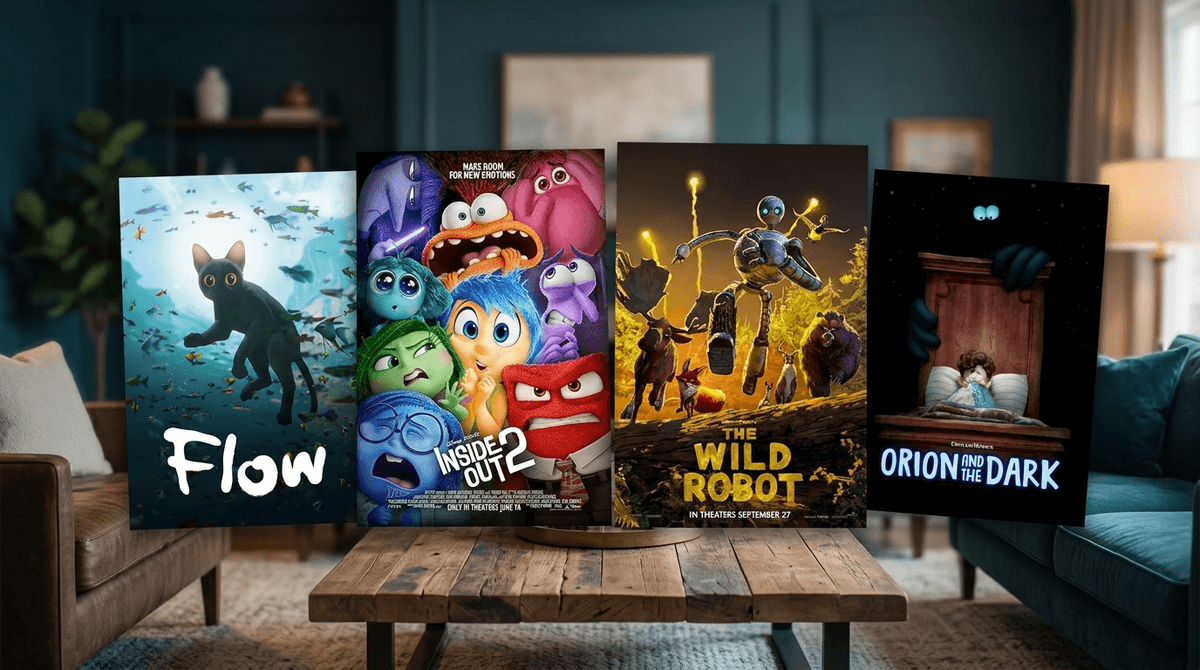
TL;DR: If you only have time for one movie this weekend, make it Inside Out 2 for the most accurate depiction of the "anxiety takeover" ever put on screen. If you want a visual masterpiece about empathy and community, go with The Wild Robot. For the younger kids struggling with literal "fear of the dark," Orion and the Dark is a solid Netflix pick.
Get a movie list based on your kid's specific temperament
We’ve all been there: the 5:00 PM meltdown because the "wrong" blue bowl was used, or the sudden, silent withdrawal of a pre-teen who was fine five minutes ago. As parents, we’re constantly trying to help our kids navigate a world that feels increasingly overwhelming. Between the social pressures of Roblox and the weirdly high-stakes "Ohio" memes, kids are carrying a lot of "big feelings" they don't always have names for.
Movies aren't just a way to get 90 minutes of peace (though, let’s be honest, that’s a huge perk). They are a low-stakes way to show our kids that what they’re feeling is normal. When a character on screen experiences a panic attack or feels like an outsider, it gives us a bridge to talk about those things without it feeling like a "lecture."
Here are the best movies from 2024 and 2025 that actually do the work of teaching emotional intelligence (EQ) without being "preachy" or—heaven forbid—boring.
Ages 6+ Look, Pixar basically owns the "emotional intelligence" category, but they really outdid themselves here. While the first movie was about the necessity of sadness, the sequel introduces Anxiety, Envy, Embarrassment, and Ennui.
The depiction of Riley’s "Anxiety" taking over the console is the most relatable thing I've seen in years. It shows kids (and parents) how anxiety isn't a "villain," but a protector that has gone off the rails. It’s a perfect tool for explaining why we sometimes make bad choices when we’re scared about the future. Read our full guide on talking to kids about anxiety after Inside Out 2
Ages 7+ Based on the The Wild Robot by Peter Brown, this movie is a masterclass in empathy, adaptability, and the "nature vs. nurture" of kindness. Roz is a robot programmed for tasks, but she has to learn to "override" her programming to care for an orphaned gosling.
It teaches kids that being "kind" isn't always the easiest path—sometimes it requires changing who you think you are. It also tackles the bittersweet reality of growing up and letting go, which might hit the parents harder than the kids. If your kid is the "logical" type who struggles to understand why people act the way they do, Roz is their perfect entry point into EQ.
Ages 5+ This Netflix original (written by Charlie Kaufman, of all people) is for the overthinkers. Orion is a kid who is literally afraid of everything—bees, the ocean, cell phone radiation, and especially the dark.
The movie personifies "Dark" and takes Orion on a journey to see that the things we fear are often just misunderstood. It’s a great pick for kids who struggle with nighttime anxiety or who have a "worst-case scenario" brain. It’s clever, a little bit meta, and much deeper than your average "don't be afraid" story.
Ages 6+ Elio is a kid who doesn't quite fit in on Earth, only to be beamed up and mistaken for the Ambassador of our planet. This is the ultimate movie for kids who feel like "outsiders." It deals heavily with self-confidence, the pressure of expectations, and finding your voice when you feel like you have nothing to say. If your kid is navigating "main character energy" vs. "NPC energy" in their social circles, Elio’s journey to embrace his weirdness is a great conversation starter.
Ages 8+ (or younger for patient kids) This is a gorgeous, dialogue-free film about a cat and several other animals surviving a flood. Because there’s no talking, kids have to rely entirely on reading body language and facial expressions to understand the characters' emotions. It’s a fantastic "stealth" lesson in social cues. It highlights cooperation and overcoming prejudice, as the animals have to trust each other to survive.
Learn more about how silent films can help kids with social-emotional learning
- IF: It tries very hard to be the next Up. It deals with grief and the loss of childhood wonder. It’s a bit messy and might be too slow for some kids, but the core message about how we use imagination to cope with pain is solid.
- Spellbound: A Netflix musical about a girl trying to break a spell that turned her parents into monsters. It’s a pretty literal metaphor for family conflict and how kids feel caught in the middle. The music is catchy, but the "emotional intelligence" is a bit on the nose.
Psychologists often talk about the "Name It to Tame It" technique. When a child can label an emotion—"I'm feeling Envy right now"—the activity in their brain shifts from the reactive amygdala to the rational prefrontal cortex.
Movies give them those labels. Instead of saying "I'm being a jerk," a kid can say, "I feel like my Anger is at the console right now." It creates a tiny bit of distance that allows for reflection.
Check out our guide on the best apps for emotional regulation
- Ages 4-6: Stick to movies with clear, personified emotions like Inside Out 2. At this age, they are still learning that other people have feelings different from their own (theory of mind).
- Ages 7-10: Look for movies about nuanced social dynamics and "unlikely friendships" like The Wild Robot. This is the prime age for learning about empathy and community.
- Ages 11+: Focus on movies that deal with identity and internal conflict. At this age, they are starting to manage their "public" vs. "private" selves, and seeing characters struggle with belonging (like in Elio) is incredibly validating.
If you finish a movie and immediately ask, "So, what did we learn about empathy today?", your kid will likely roll their eyes so hard they’ll see their own brain. Try these instead:
- The "Who was right?" bait: "Do you think Anxiety was actually trying to help Riley, or was she just being a villain?"
- The "What would you do?" scenario: "If you were the cat in Flow, would you have let the dog on the boat?"
- The "Relatability" check: "Which character’s 'brain' felt the most like yours today?"
We can't protect our kids from "big feelings," and we shouldn't. But we can give them the vocabulary to handle them. 2024 and 2025 have been surprisingly great years for movies that respect kids' emotional lives without talking down to them.
So, grab the popcorn, dim the lights, and let Pixar (or Dreamworks, or an indie cat movie) do some of the heavy lifting for you.
Next Steps:
- Pick one of the movies above for your next family movie night.
- Take the Screenwise Survey to see how your family’s media consumption compares to your community.
- Get more recommendations based on your kid's favorite books