

Movies Based on True Stories: What's Real, What's Hollywood, and How to Talk About It
You know that moment when the credits roll and your kid turns to you and says, "Wait, that actually happened?" That's the magic—and the minefield—of movies "based on a true story."
Here's the thing: "based on" is doing a LOT of heavy lifting in that phrase. It can mean anything from "we changed the names and invented 90% of the dialogue" to "we meticulously recreated events with historical consultants on set." And kids don't automatically know the difference.
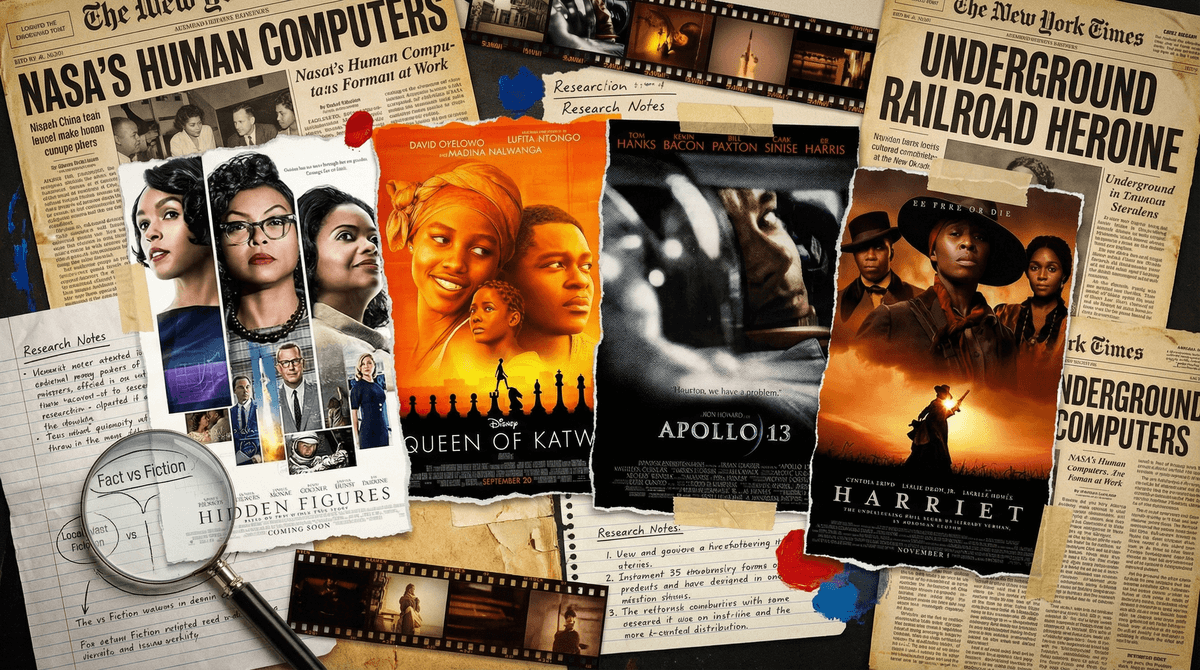
Movies like Hidden Figures, Harriet, and The Imitation Game introduce kids to real heroes and important historical moments. But they also take creative liberties—composite characters, compressed timelines, invented conversations, and sometimes outright fabrications for dramatic effect.
The problem? Kids are sponges. They absorb what they see on screen as fact, especially when the movie opens with those authoritative words: "Based on a True Story." Then they show up to history class confidently citing something that never actually happened.
We live in an era where distinguishing fact from fiction is a critical life skill. Deepfakes, AI-generated content, social media misinformation—it's everywhere. Teaching kids to question what they see in "true story" movies is actually teaching them media literacy for everything else they'll encounter.
Plus, some of these movies tackle heavy topics: war, racism, injustice, survival. When kids think they're learning history but they're actually absorbing Hollywood's version of it, that matters. Not because movies are bad—they're not—but because understanding the difference between inspiration and documentation is important.
And honestly? Some of these movies are just wildly inaccurate. Braveheart is a great movie. It's also historically bonkers. William Wallace didn't wear a kilt (they weren't a thing yet), didn't have a romance with Princess Isabella (she was a child at the time), and the Battle of Stirling Bridge famously... had no bridge in the movie. But try telling that to a 14-year-old who just watched Mel Gibson give that freedom speech.
They feel more important. There's something compelling about knowing real people lived through these events. It adds weight. Kids love Remember the Titans because it's an inspiring sports movie, but knowing it's based on real integration in Virginia schools makes it hit differently.
They're often more dramatic than pure fiction. Truth really is stranger than fiction sometimes. The story of Apollo 13? Absolutely riveting. The fact that it actually happened? Mind-blowing.
They can be conversation starters. A movie like Selma or 12 Years a Slave opens doors to talk about civil rights, history, and justice in ways that feel more accessible than a textbook.
Not all "true story" movies are created equal—or appropriate for all ages.
Ages 6-9: Light Historical Fiction
- Hidden Figures (PG) - Inspiring story about Black women mathematicians at NASA
- McFarland, USA (PG) - Underdog cross-country team story
- Dolphin Tale (PG) - About a dolphin with a prosthetic tail
At this age, keep it simple. These movies take liberties but the core message is intact. Focus on the themes: perseverance, teamwork, overcoming obstacles.
Ages 10-13: More Complex Stories
- The Boy Who Harnessed the Wind (PG-13) - Teen builds a windmill in Malawi
- October Sky (PG) - Kids building rockets in 1950s West Virginia
- Queen of Katwe (PG) - Ugandan girl becomes chess champion
- Erin Brockovich (R, but many families watch with tweens) - Environmental activism
This is the sweet spot for introducing the concept of "creative liberties." They're old enough to understand that movies compress time, create composite characters, and add drama.
Ages 14+: The Heavy Hitters
- Schindler's List (R) - Holocaust survival story
- 12 Years a Slave (R) - Slavery and survival
- Spotlight (R) - Investigative journalism uncovering abuse
- The Social Network (PG-13) - Facebook's founding (heavily dramatized)
Teens can handle—and benefit from—the harder conversations. But they also need the tools to fact-check what they're watching.
Before watching: "This movie is based on real events, which means some of it happened and some of it is made up for the movie. Let's see if we can spot what might be real and what might be Hollywood."
During/after watching:
- "What do you think actually happened versus what the movie made up?"
- "Why do you think they changed that part?"
- "What questions do you have about the real story?"
Do a quick fact-check together. Seriously, just pull out your phone. Look up the real person, event, or story. Read the Wikipedia page together. Watch a documentary clip. Learn more about teaching kids to fact-check media .
.
Point out the obvious Hollywood stuff. Nobody actually said that perfectly quotable line in the moment. Real people don't have dramatic music playing during important conversations. That romantic subplot? Probably invented.
Talk about why filmmakers make changes. Movies need to be entertaining. They need to fit a story arc. They need to compress years into two hours. That doesn't make them lies—it makes them movies. But it's worth understanding the difference.
The "based on a true story" label is legally meaningless. There's no threshold. A movie can be 5% accurate and still claim it. The Texas Chain Saw Massacre says it's based on a true story. It's not. (Well, very loosely inspired by Ed Gein, but that's it.)
Some movies are more accurate than others. Apollo 13 is remarkably faithful to the real events. The Greatest Showman is a fun musical that completely whitewashes P.T. Barnum's actual problematic history. Both say "inspired by true events."
Composite characters are everywhere. That one inspiring teacher? Often an amalgamation of three real people. That best friend who died tragically? Sometimes invented for emotional impact.
Historical consultants don't have final say. Studios hire historians to advise, then ignore them when drama demands it. It happens constantly.
Some inaccuracies matter more than others. Getting the color of someone's car wrong? Whatever. Changing the outcome of a civil rights case or inventing a romance that didn't happen? That matters.
"Based on a true story" movies can be incredible teaching tools—if you use them as a starting point, not the final word.
Watch them. Enjoy them. Let your kids be inspired by them. But also teach them to be curious. To ask questions. To look up the real story. To understand that movies are art, not documentaries, even when they're based on real events.
The goal isn't to ruin the magic of movies. It's to raise kids who can enjoy a great film and think critically about what they're watching. That's a skill that'll serve them well beyond movie night.
- Create a family fact-check routine: After watching a "true story" movie, spend 10 minutes looking up the real events together
- Watch documentaries as follow-ups: If your kid loved Hidden Figures, watch a documentary about NASA or the space race
- Check out Common Sense Media: They often note historical accuracy in their reviews
- Explore other ways to build media literacy skills
And hey, if your kid comes home from school correcting their history teacher because they "saw it in a movie," you'll know it's time for another conversation.