

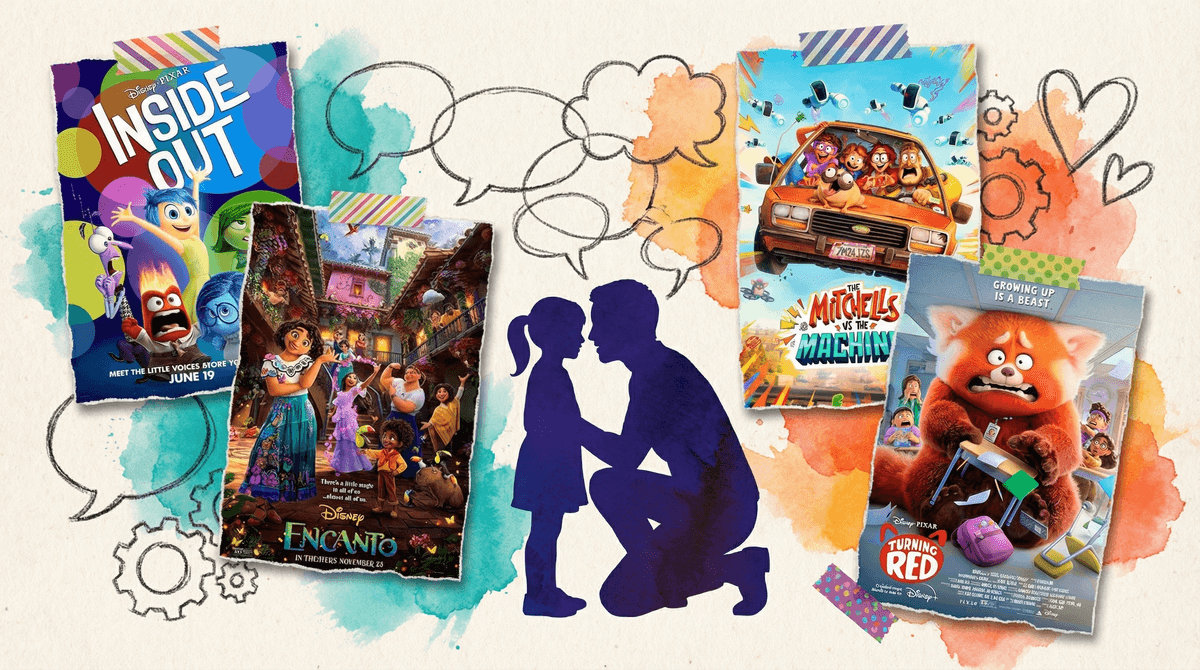
Look, we can tell our kids "use your words" and "listen with your whole body" until we're blue in the face, but sometimes the lesson lands better when it comes from a talking fish or a kid navigating middle school drama. Movies about communication aren't just feel-good family viewing—they're actually sneaky-good teaching tools for emotional intelligence, active listening, empathy, and how to navigate conflict without losing your mind.
These films show what happens when people don't communicate (spoiler: chaos), what it looks like when they finally do (spoiler: connection), and all the messy, awkward, beautiful stuff in between. We're talking about movies where the central conflict hinges on misunderstanding, where characters learn to express feelings they didn't know they had, or where listening—really listening—changes everything.
Here's the thing: kids are growing up in a world where they can send 47 messages in a group chat but freeze up when asked to have a real conversation. They're fluent in emojis but struggle to read facial expressions. They know how to ghost someone but not how to have a difficult conversation.
Communication skills aren't just nice-to-haves—they're the foundation for basically everything: friendships, family relationships, school success, future careers, romantic relationships, conflict resolution, self-advocacy. And unlike algebra (sorry, algebra), these are skills they'll actually use every single day for the rest of their lives.
Movies create a safe space to explore these concepts. Your kid can watch a character struggle to express their feelings, see the consequences, watch them try again, and witness the breakthrough—all from the safety of your couch with a bowl of popcorn. It's like a low-stakes practice run for real life.
Ages 4-7: The Foundation Years
Inside Out is the gold standard here. It literally shows kids that all feelings are valid and that expressing sadness isn't weakness—it's connection. The scene where Riley finally opens up to her parents? Chef's kiss. This movie does more for emotional literacy than a thousand "how are you feeling?" check-ins.
Zootopia tackles assumptions, stereotypes, and how our words can hurt even when we don't mean them to. Judy's press conference moment is a masterclass in how communication can break trust—and her apology shows how it can rebuild it.
Ages 8-11: Building Complexity
The Mitchells vs. The Machines is basically a love letter to families who struggle to connect across generational and interest divides. Katie and her dad speak completely different languages (literally—she speaks film, he speaks wilderness survival), and watching them figure out how to bridge that gap is both hilarious and genuinely moving.
Encanto shows what happens when a family doesn't talk about the hard stuff. Every character is walking around with unspoken pressure, unexpressed feelings, and assumptions about what everyone else needs. When they finally start being honest? The whole house—literally—can heal. The "What Else Can I Do?" scene between Mirabel and Isabela is everything.
Turning Red nails the specific communication breakdown between parents and tweens. Mei's journey from "perfect daughter who hides everything" to "person who can be honest about her feelings" is so relatable it hurts. Plus it opens up great conversations about how we perform for our parents vs. who we actually are.
Ages 12+: The Real Talk Years
The Perks of Being a Wallflower (PG-13, and do check the content warnings first) shows how trauma can lock up our ability to communicate, and how the right people—and the courage to be vulnerable—can unlock it. Charlie's journey from silent observer to someone who can finally tell his story is powerful.
Everything Everywhere All at Once (R-rated, so this is for older teens and parent-teen co-viewing) is wild and weird, but at its core it's about a mother and daughter who can't talk to each other. They literally have to travel through multiverses to figure out how to say "I love you" and "I see you" in ways the other can hear.
Lady Bird (R for language and some teen behavior) captures the specific torture of mother-daughter communication in the teen years—how love and criticism can feel identical, how we hurt the people we're closest to, and how sometimes distance helps us finally see each other clearly.
Don't just hit play and hope for osmosis. Here's how to make these films work harder for your family:
Before watching: Set it up. "This movie is about a family learning to talk to each other. Let's see if we notice any moments that feel familiar." No pressure, just awareness.
During watching: Resist the urge to pause every five minutes for a teaching moment (I know, I know). Let the story do its work. Maybe one or two "oh, this reminds me of..." moments if they're organic.
After watching: This is where the magic happens. Ask open-ended questions:
- "What did you notice about how [character] communicated?"
- "When did things get better/worse for them?"
- "Have you ever felt like that character?"
- "What would you have done differently?"
Days later: Reference it naturally. "Remember in Encanto when Mirabel finally told Abuela how she felt? That took courage. I see you doing that right now."
These movies aren't magic pills. Your kid won't watch Inside Out and suddenly become an emotionally articulate zen master. But they plant seeds. They give you shared language ("I'm feeling very Anger right now" becomes a legitimate household phrase). They normalize the idea that communication is a skill you practice, not something you're just born knowing how to do.
Also: model what you want to see. If you want your kids to express feelings and listen actively, they need to see you doing it. Apologize when you mess up a conversation. Say "I'm struggling to find the right words" out loud. Ask "can you help me understand what you mean?" These movies work best when they're part of a larger family culture, not a substitute for one.
Movies about communication give kids a framework for understanding something abstract and crucial. They show that misunderstandings are normal, that finding the right words is hard, that listening is active work, and that connection is always worth the awkwardness of trying.
Start with one movie that matches your kid's age and interests. Watch it together. Talk about it—or don't, and see if they bring it up later. Either way, you're building their emotional vocabulary and showing them that this stuff matters to you.
And honestly? Some of these movies might help us communicate better too. Inside Out made me cry for reasons that had nothing to do with my kids and everything to do with my own childhood. That's the real power of these films—they remind all of us that we're still learning how to connect.
Ready to build a communication-focused movie list for your family? Check out movies that teach empathy or films about emotional intelligence for more options. And if you want to explore what your kids are already watching and how it fits into their emotional development, Screenwise can help you understand your family's media habits in context.