

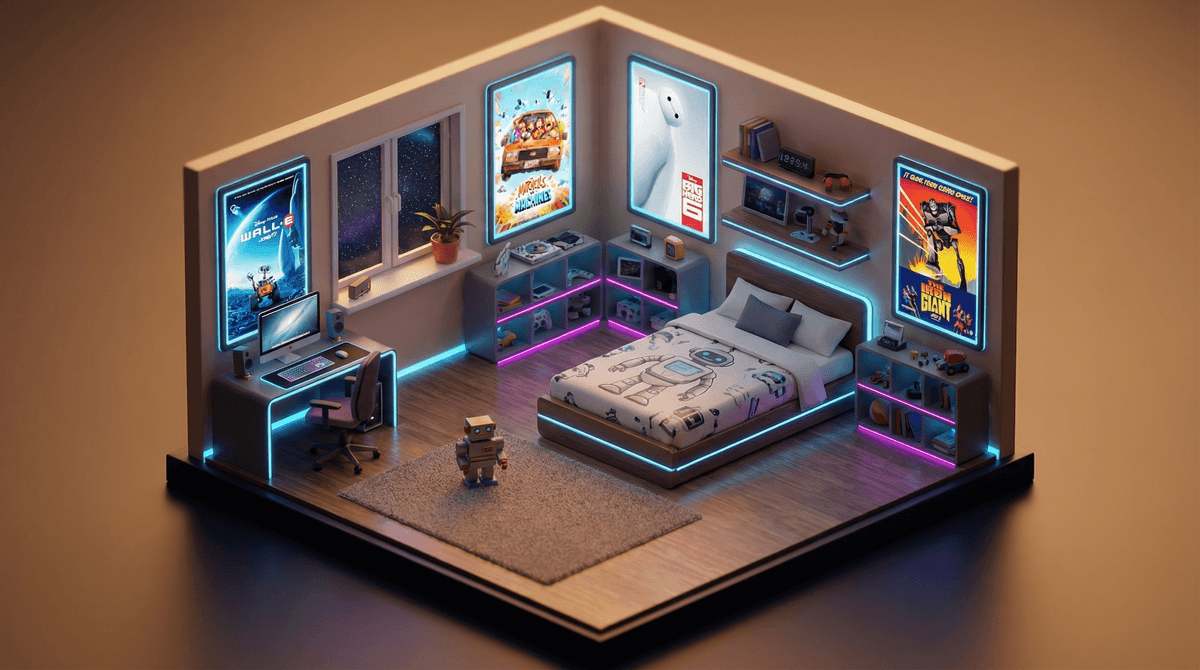
Here's the thing about movies featuring artificial intelligence: they're not just entertainment. They're probably the most accessible philosophy class your kid will ever take, wrapped in popcorn and special effects.
From WALL-E to M3GAN, from Her to The Mitchells vs. The Machines, these films are quietly shaping how the next generation thinks about consciousness, emotion, ethics, and what it means to be human. And given that your kids are growing up in a world where they'll be asking ChatGPT for homework help and talking to AI assistants daily, these movies matter more than you might think.
Kids today are the first generation growing up with AI as just... part of life. They're not impressed by talking computers—they're asking Alexa to play their favorite songs before they can read. The questions these movies raise aren't hypothetical sci-fi nonsense anymore. They're genuinely relevant.
WALL-E (ages 6+) asks: What happens when we let technology do everything for us? Your 8-year-old watching humans floating around in hover chairs, unable to walk, getting all their needs met by screens? That's hitting different in 2026 than it did in 2008.
Big Hero 6 (ages 6+) shows a healthcare robot learning to understand grief and friendship. It's asking whether something programmed to care can actually... care. And whether that distinction even matters.
The Mitchells vs. The Machines (ages 8+) is basically a love letter to weird families trying to connect in a world where tech keeps interrupting. The AI uprising is almost secondary to the real question: can we put our phones down long enough to see each other?
Ages 5-8: The "Robots Have Feelings Too" Phase
Start here with WALL-E, Big Hero 6, or Ron's Gone Wrong. These films introduce AI through the lens of friendship and emotion. The robots are cute, the stakes are manageable, and the lessons are clear: technology should help us connect, not replace connection.
Ron's Gone Wrong is particularly great for this age because it's literally about a kid getting a defective AI friend-bot, and the "defect" is that it doesn't harvest his data or manipulate him into engagement. It's accidentally teaching media literacy through a buddy comedy.
Ages 9-12: Getting Into the Ethics
The Mitchells vs. The Machines is perfect here—funny enough to hold attention, smart enough to spark real conversations. The AI villain isn't evil, just... doing exactly what it was programmed to do, which raises way better questions than a traditional bad guy.
The Iron Giant (yes, it's old, yes, it holds up) tackles whether something built as a weapon can choose to be something else. "You are who you choose to be" hits hard when you're talking about AI and autonomy.
Ages 13+: The Complicated Stuff
Her is rated R but honestly, the "R" is pretty soft—it's mostly for mature themes and one weird AI phone sex scene you can skip. For mature teens, it's an incredibly thoughtful exploration of whether AI relationships can be real, and what happens when AI evolves beyond us.
Ex Machina is genuinely unsettling and raises hard questions about consciousness, manipulation, and the male gaze in tech. It's not for everyone, but for a 16-year-old who can handle it, it's a masterclass in AI ethics gone wrong.
M3GAN is campier but actually asks interesting questions about giving AI too much control over parenting and emotional development. Plus, the dance scene is chef's kiss.
Don't just watch these movies—use them as conversation starters:
After WALL-E: "Do you think we're too dependent on screens? What would happen if we couldn't use them for a week?"
After The Mitchells vs. The Machines: "When do you think technology helps our family connect, and when does it get in the way?"
After Her: "Can you have a real relationship with something that isn't human? What makes a relationship real?"
After Ex Machina: "Who's responsible when AI does something harmful—the AI itself, or the people who created it?"
These aren't rhetorical questions. Your kids probably have more interesting answers than you expect, especially since they're growing up in this world.
Here's what's wild: most AI movies are accidentally about parenting.
Big Hero 6 is about a robot learning to parent a grieving kid. Ron's Gone Wrong is about whether algorithmic "perfect friendship" is actually friendship at all. M3GAN is literally about outsourcing emotional labor to technology because we're overwhelmed.
The best AI movies aren't really about whether robots will take over. They're about what we lose when we let technology replace human effort, and what we gain when we use it to enhance our humanity instead.
AI movies aren't just preparing kids for a future with robots—they're helping them think critically about the technology they're using right now. Every time your kid asks Siri a question, plays with an AI-powered toy, or talks to a chatbot, they're engaging with the questions these movies raise.
Watch these films together. Have the uncomfortable conversations. Let your kids challenge your assumptions about consciousness and emotion and what makes something "real." They're going to be making decisions about AI ethics in ways we can't even imagine yet.
And honestly? The kids who grow up thinking deeply about whether WALL-E has feelings are probably going to build better AI than the ones who don't.
Want more? Check out our guide to talking to kids about AI or explore age-appropriate movies about technology and ethics.
Curious about how AI is already in your kid's life? Learn about AI in kids' apps and games or find out what kids are actually using ChatGPT for.