

TL;DR
Mini Metro is the ultimate "anti-brain-rot" game. It’s a minimalist puzzle sim where you design the subway layout for an expanding city. It’s clean, it’s quiet, and most importantly, it has zero ads or microtransactions (if you buy the paid version). It’s perfect for kids aged 7 to 17 (and honestly, us too) who need a break from the high-decibel chaos of Roblox or Fortnite.
Quick Links:
If you looked at a screenshot of Mini Metro, you’d think you were looking at a stylized map of the London Underground or the NYC Subway. That’s because you are—sort of.
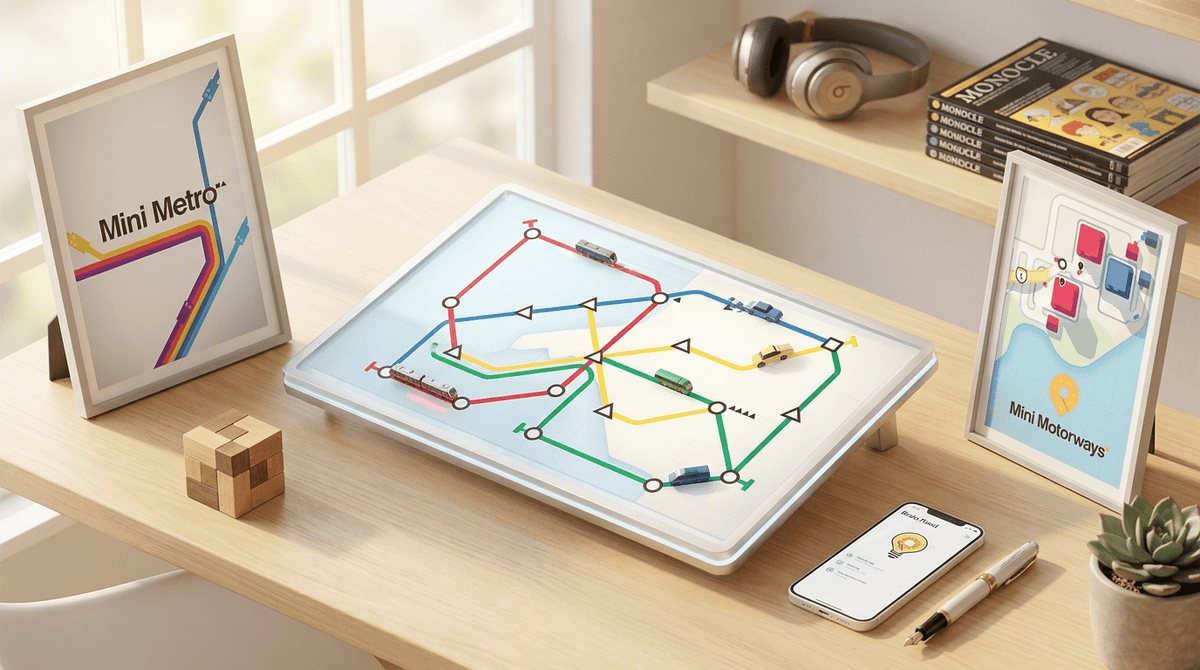
The game starts with three shapes (stations) and a few colored lines (tracks). You drag your finger or mouse to connect a circle to a square to a triangle. Little black shapes (passengers) appear at the stations and need to get to a station that matches their shape.
As the "week" progresses in the game, the city grows. New stations pop up in inconvenient places across rivers. You get rewards like more tunnels, more carriages, or new lines. But eventually, the city grows too fast. A station gets overcrowded, a timer starts ticking, and if you can't clear the crowd, the system shuts down. Game over.
It sounds stressful, but the aesthetic is incredibly "Zen." The music is generative, meaning it reacts to what you’re doing. Every time a train picks up a passenger, it creates a soft, melodic "ping." It’s basically a playable lo-fi beat.
We spend a lot of time worrying about "Skibidi Toilet" and the weird, loud, sensory-overload side of YouTube. Mini Metro is the literal opposite of that.
Kids love it because it offers a very specific kind of "flow state." It’s not about combat or "winning" in the traditional sense; it’s about efficiency. There’s something deeply satisfying about watching a perfectly designed transit system hum along.
For the younger crowd (ages 7-10), it feels like playing with a digital train set. For the older kids (12+), it becomes a high-level strategy game. They start obsessing over "interchanges" and "loop lines." It gives them a sense of control over a complex system, which is a big deal when you’re a kid whose daily life is mostly scheduled by adults.

We often talk about Minecraft teaching "creativity" or Roblox teaching "entrepreneurship" (though let's be real, Roblox mostly teaches how to ask for $20 for a virtual hat).
Mini Metro teaches Logistics and Resource Management.
In the real world, you can’t have everything at once. You have a limited number of "tunnels" and you have to decide: do I use this tunnel to connect the suburban circle station now, or do I save it for the square station that might pop up across the bay later?
It’s a lesson in:
- Prioritization: Which station is about to "overcrowd"?
- Iterative Design: You can delete and redraw your lines at any time. The game encourages you to pause, look at the mess you’ve made, and reorganize it to work better.
- Scalability: What worked when you had three stations will absolutely fail when you have twenty.
If you want a game that builds the "planning" part of the brain without the kid even realizing they’re learning, this is it.
If your kid is currently addicted to those "hyper-casual" games from the App Store—the ones where you're constantly dodging ads for other crappy games and every three seconds there's a flashing light telling you to buy "gems"—Mini Metro is the detox they need.
There are no "dark patterns" here. No "daily login bonuses" to keep them hooked. No "limited time offers" to pressure them into spending money. You buy the game once (usually around $4.99 on mobile or $10 on Steam) and you own it.
Compare this to something like Subway Surfers. While Subway Surfers is a classic, it’s designed to keep the dopamine spiking with constant rewards and ads. Mini Metro respects the player's intelligence and their attention span.
Learn more about the difference between "predatory" and "premium" games
Ages 6-9
They might find it "hard" to keep the city running for long, but they’ll enjoy the "Endless Mode." In Endless Mode, stations never overcrowd. They can just build the coolest-looking subway system they want without the "Game Over" screen. It’s a great way to practice fine motor skills and spatial awareness.
Ages 10-13
This is the sweet spot. They’ll start competing for high scores on the "Daily Challenge," which gives everyone in the world the same map to see who can handle the most passengers. It’s a "social" element that doesn’t involve a chat room or strangers—just a leaderboard.
Ages 14+
For teens, this is a "palate cleanser" game. It’s what they play while listening to a podcast like Stuff You Should Know or while decompressing after a long day of school. It’s cognitively demanding enough to keep them off TikTok, but quiet enough to be genuinely relaxing.
This is the shortest "Safety" section I’ll ever write: There are virtually no safety concerns.
- No Chat: There is no way for strangers to talk to your child.
- No User-Generated Content: You aren't going to stumble upon a "weird" map created by someone else.
- No Microtransactions: Once you pay for the app, the "bank account draining" risk is zero.
- Data Privacy: The developer, Dinosaur Polo Club, is known for being very "clean" with their data practices.
The only "risk" is that they might get frustrated when their city fails, but honestly, learning to handle a "Game Over" screen without throwing the iPad is a vital life skill.
If you want to sound like you know what's up when you see them playing, here are a few things to mention:
- The Maps are Real: The game features actual cities like London, Paris, New York, Osaka, and Saint Petersburg. Each map has unique challenges (like the many islands of Stockholm).
- The "Creative" Mode: If they’re getting frustrated, tell them to try "Creative Mode." It lets them add and remove stations at will. It’s basically the "God Mode" of urban planning.
- Check out the sequel: If they love Mini Metro, the same developers made Mini Motorways, which is about building roads and traffic lights. It’s arguably even more addictive and looks just as beautiful.
Instead of the usual "how was your game?", try these:
- "Which city are you working on today? I heard the London map is a nightmare because of the Thames."
- "What's your strategy for the 'Daily Challenge'? Are you a 'multiple carriages' person or a 'more lines' person?"
- "I noticed your stations are getting crowded—do you think you need a loop line or a direct shuttle?"
These questions show you're paying attention to the logic of the game, not just the "screen time" aspect.
Mini Metro is the kind of digital media we want more of. It’s intentional, it’s artistic, and it treats the player like a smart human being. It’s not "brain rot." It’s "brain food" served with a side of lo-fi chill.
In a world of "Ohio" memes and Skibidi Toilet chaos, Mini Metro is a quiet, geometric sanctuary.
- Download it: It’s available on iOS, Android, Nintendo Switch, and Steam.
- Play a round yourself: Seriously. It’s a great "waiting at the doctor’s office" game for adults too.
- Compare notes: Ask your kid to show you their most "efficient" city. You might be surprised at how their brain is starting to map out complex systems.