

TL;DR
If you want a digital LEGO set that encourages spatial reasoning and has zero "daily chore" pressure, go with Minecraft. If you want a cozy, low-stress world that actually rewards your kid for reading and teaches them about a "daily routine," Animal Crossing: New Horizons is the winner.
- Best for Preschool/K: Minecraft (Creative Mode)
- Best for Early Readers: Animal Crossing: New Horizons
- Best for Social Safety: Animal Crossing
- Best for Long-term Creativity: Minecraft
The "first video game" conversation usually starts around age five or six. Maybe they saw a YouTuber screaming about a Creeper, or they saw a cousin decorating an island with talking frogs. Suddenly, you’re at the crossroads: do we go with the blocks or the butterflies?
Both Minecraft and Animal Crossing are considered the "Gold Standard" for young gamers, but they offer fundamentally different experiences. One is a digital wilderness where you can build a 1:1 scale model of the Eiffel Tower; the other is a gentle social simulator where the biggest conflict is a raccoon asking you to pay your mortgage.
Here is how to decide which one fits your kid’s personality (and your sanity) best.
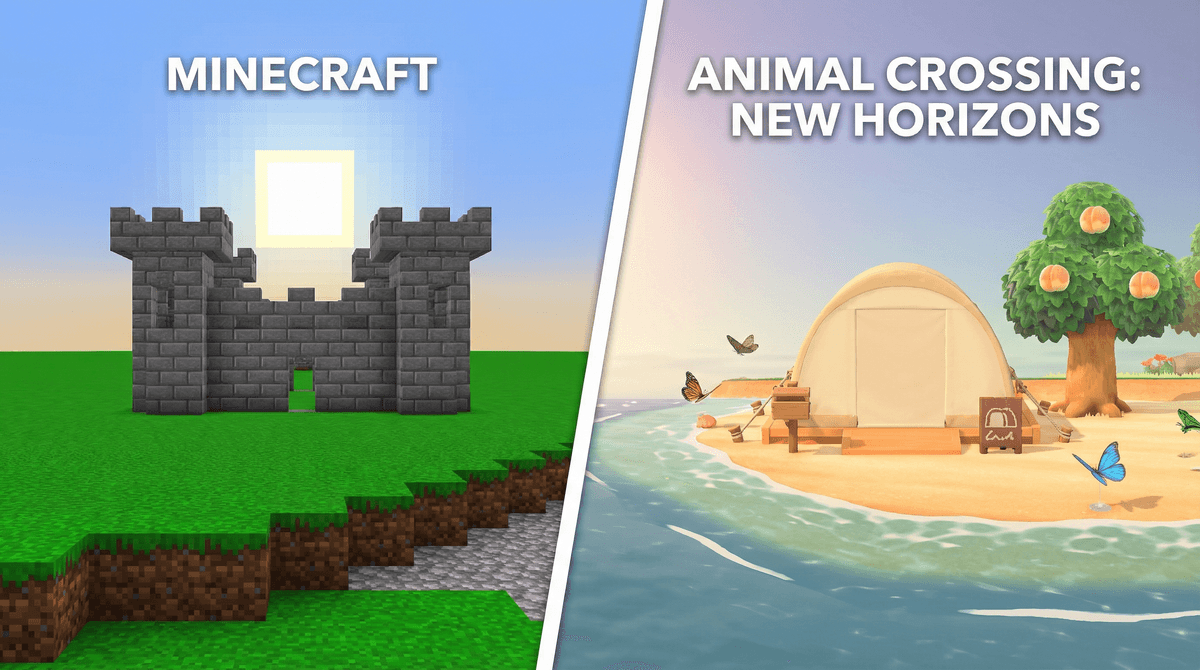
Minecraft is essentially an infinite bucket of digital LEGOs. There are two main ways to play: Creative Mode, where you have unlimited resources and can’t die, and Survival Mode, where you have to find food, build shelter, and avoid monsters (mobs) like skeletons and spiders.
In Animal Crossing, your child moves to a deserted island, sets up a tent, and slowly turns it into a thriving community. They fish, catch bugs, decorate their house, and talk to animal neighbors. The game runs on a real-time clock—if it’s 4:00 PM in your living room, it’s 4:00 PM on the island. If it’s winter outside, it’s snowing in the game.
This is the biggest factor for parents of kids aged 4-7.
Animal Crossing is incredibly text-heavy. There is no voice acting. Every instruction, every joke, and every request from a neighbor is delivered via text bubbles. If your child isn't reading yet, you are going to be "The Designated Reader" for the first 10 hours of gameplay. However, it is an incredible motivator for early readers. We’ve seen kids jump a full reading level just because they wanted to know what Blathers the Owl was saying about their new fossil.
Minecraft is much more intuitive for non-readers. While there is text in the menus, the core gameplay—breaking blocks and placing blocks—is purely visual and tactile. A five-year-old who can’t read a full sentence can still build a massive "diamond house" in Creative Mode just by recognizing the icons.
Ask our chatbot for more games that don't require reading
As a Screenwise parent, you’re likely thinking about who your kid is talking to.
This is a very "closed" social experience. By default, your child is alone on their island with NPC (non-player character) animals. To visit someone else’s island or have a visitor, you need to exchange a "Dodo Code" or be Nintendo Switch Friends. There is no open lobby where strangers can wander in and start talking to your kid. It’s a very safe "walled garden."
Minecraft is as safe or as "wild" as you make it.
- Single Player: Completely safe. Just your kid and the blocks.
- Local Multiplayer: Safe. Your kids play together on the couch or on the same home Wi-Fi.
- Public Servers: This is where the risk lives. If your kid joins a massive public server (like Hypixel), they are playing with thousands of strangers. While many servers have filters, the chat can get spicy, and "griefing" (people destroying your kid's hard work) is common.
Read our guide on setting up Minecraft parental controls
This is a subtle but important difference for digital wellness.
Animal Crossing is designed to be played every day. The game rewards "daily check-ins." There are daily fossils to dig up, new items in the shop, and limited-time events (like a fishing tournament on a specific Saturday). For some kids, this creates FOMO (Fear Of Missing Out). They might get anxious if they can't play on "Toy Day" (Christmas). On the flip side, it’s a great tool for teaching "15 minutes of play and then we’re done," because once you’ve done your daily chores, there’s less "urgent" stuff to do.
Minecraft doesn't care about the real-world clock. Your child can leave the game for six months, come back, and everything is exactly where they left it. There is no "daily streak" to maintain. However, Minecraft is much more "addictive" in the moment. Because it’s an infinite sandbox, it’s very easy for a kid to fall into the "just five more minutes" trap while they finish their castle.
Let’s be real: parents often worry these games are just "brain rot."
Minecraft is basically digital engineering. Kids learn about resource management, spatial awareness, and even basic logic circuits (Redstone). If your kid starts talking about "Redstone repeaters" and "logic gates," they are essentially learning the fundamentals of electrical engineering and computer science. It’s high-value play.
Animal Crossing is emotional and aesthetic intelligence. It’s about interior design, museum curation, and empathy. Your kid has to navigate the feelings of their neighbors. If they hit a villager with a bug net, the villager gets sad or angry. It’s a low-stakes way to practice social cues and "the long game" of saving up currency (Bells) for a big goal.
Check out our guide on why Minecraft is actually good for your kid's brain
If neither of these feels quite right, there are a few other "starter" options:
- Toca Life World: Best for the 4-6 age range. It's a digital dollhouse with zero pressure and zero combat.
- Stardew Valley: Like Animal Crossing but with farming and a bit more depth. Better for ages 8+.
- LEGO Fortnite: A newer competitor to Minecraft. It's free and looks great, but it lives inside the Fortnite ecosystem, which brings more social complexity.
- Roblox: The elephant in the room. We generally recommend waiting on Roblox until kids are a bit older (8+) due to the sheer amount of user-generated content and aggressive monetization.
Ages 4-6
Stick to Minecraft in Creative Mode. Turn the "mobs" (monsters) off so they don't get scared by the hissing sound of a Creeper. At this age, it's just about exploration. Toca Life World is also a fantastic, safer entry point.
Ages 7-9
This is the sweet spot for Animal Crossing. Their reading skills are sharp enough to handle the dialogue, and they’ll enjoy the "collecting" aspect. If they play Minecraft, they might be ready for Survival Mode, which introduces "scary" elements—talk to them about how losing your items when you "die" in a game is part of the learning process.
Ages 10+
They will likely want to play whatever their friends are playing. This usually means moving into Roblox or Minecraft multiplayer servers. This is the time to have the "Internet Safety" talk for the 100th time.
Minecraft is usually a one-time purchase. There is a "Marketplace" for skins and maps, but you can easily ignore it.
Animal Crossing is a one-time purchase with one optional (but large) paid expansion called Happy Home Paradise. There are no "loot boxes" or "micro-transactions" in the way Roblox has them.
If your kid is asking for "Robux" or "V-Bucks," they aren't playing these games—they're playing Roblox or Fortnite. Both Minecraft and Animal Crossing are much "cleaner" from a financial standpoint.
Learn more about how Robux is in fact real money
If you want a game that will grow with your child for the next five years and potentially spark an interest in coding or architecture: Get Minecraft.
If you want a game that serves as a "gentle" introduction to gaming, encourages reading, and provides a peaceful ritual you can even participate in together: Get Animal Crossing: New Horizons.
- Check the device: Minecraft is on everything (iPad, Xbox, PC, Switch). Animal Crossing is only on the Nintendo Switch.
- Set the timer: Before they start, agree on a "save and quit" signal. In Animal Crossing, you save by pressing the "-" button. In Minecraft, you hit "Save and Quit" from the menu.
- Play with them: Both games are much more fun (and easier to learn) if you spend the first 30 minutes playing "co-op" on the couch.
Ask our chatbot for a personalized gaming roadmap for your family