

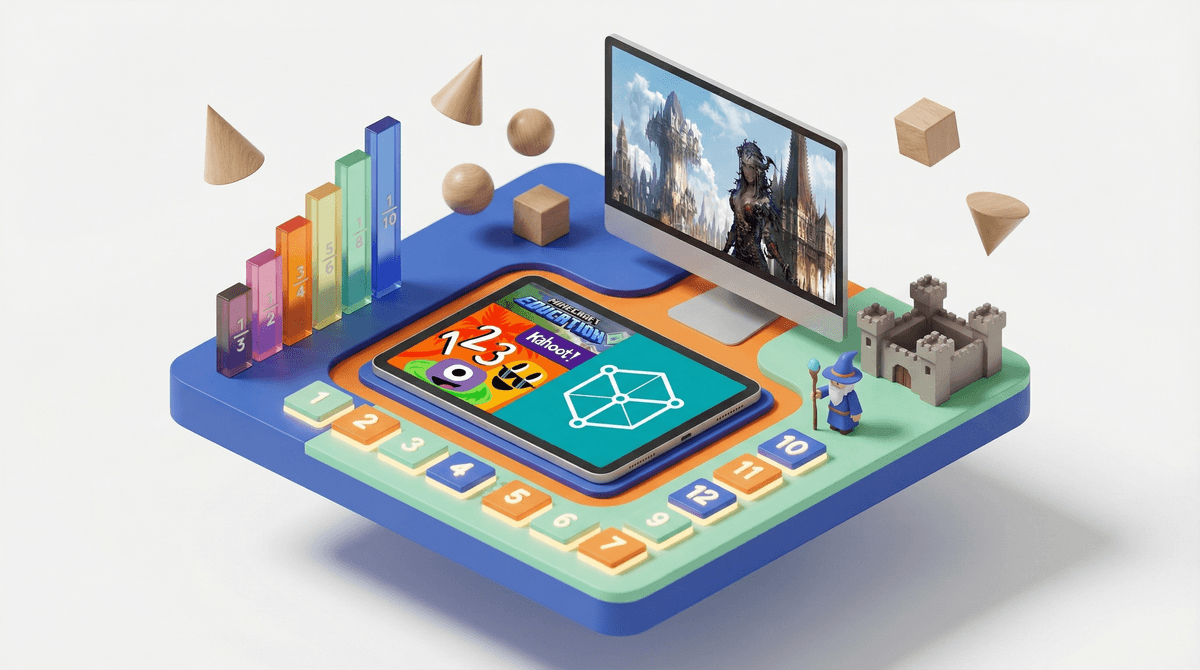
Fifth grade math is where things get real. We're talking fractions, decimals, order of operations, basic geometry, and the dreaded long division. This is also the year when a lot of kids start deciding whether they're "good at math" or not — which is heartbreaking because that mindset can stick.
Math games for 5th graders are apps, websites, and video games designed to make practicing these concepts feel less like homework and more like... well, anything else. The market is flooded with options: some are genuinely educational and engaging, others are basically flashcard drills with a cartoon mascot slapped on top, and a few are just thinly-veiled screen time with a "learning" label to make parents feel better.
The real question isn't whether math games exist (they do, hundreds of them), but whether they're actually teaching your kid anything or just keeping them quiet for 30 minutes.
Let's be honest: most 5th graders would rather eat their shoe than do another worksheet. Math games work when they tap into what actually motivates kids at this age:
Competition and progression. Games like Prodigy let kids level up characters and battle monsters by solving math problems. It's not subtle, but it works. Kids will power through dozens of fraction problems if it means their wizard gets a new hat.
Social elements. Some games let kids compete with friends or classmates. Kahoot! turns math practice into a live game show, and suddenly everyone cares deeply about equivalent fractions.
Instant feedback without judgment. Getting a problem wrong in front of the class? Mortifying. Getting it wrong in a game? Just try again. Good math games provide immediate feedback in a low-stakes environment, which is actually huge for learning.
They're not worksheets. This cannot be overstated. Fifth graders are developmentally primed to resist anything that feels like busywork, and a game — even an educational one — feels different than a stack of papers.
Here's where it gets tricky. The app store is full of "educational" games that are really just digital worksheets with sound effects. Your kid clicks through multiplication problems while a cartoon character cheers, but there's no actual game mechanic — just drill and practice dressed up in bright colors.
Then there are games that are too game-y. The math becomes a minor speed bump between the fun parts. Your kid spends 30 seconds answering a question to unlock 5 minutes of non-educational gameplay. You think they're learning; they're really just grinding through the math to get back to the actual game.
The sweet spot? Games where the math is the gameplay, not a barrier to it. DragonBox does this beautifully with algebra concepts — kids are solving equations without even realizing it because the mechanics are so integrated. Minecraft Education Edition can work this way too, especially with the right lesson plans around geometry and spatial reasoning.
Based on what we know about how 10-11 year olds learn (and what keeps them engaged), here's what to look for:
Adaptive difficulty. The game should adjust to your kid's level. Too easy and they're bored; too hard and they're frustrated. Khan Academy Kids and IXL both do this well, though IXL can feel more like practice than play.
Conceptual understanding, not just memorization. Fifth grade is when kids need to understand why math works, not just memorize steps. Look for games that show visual representations of fractions, let kids manipulate shapes, or explain the logic behind operations. Mathigon excels at this with interactive lessons.
Limited ads and microtransactions. This is non-negotiable. If your kid is getting interrupted every 3 minutes to watch an ad or begging you for in-app purchases to progress, the learning is secondary to the business model. Prodigy has been criticized for this — the free version is functional, but the constant upselling can be distracting.
Actual engagement, not just time-filling. Ask yourself: is my kid thinking hard about math, or just clicking through to get to the next level? If they can zone out and still progress, it's probably not doing much.
Let's address the elephant in the room: is time spent on math games "educational screen time" or just screen time with extra steps?
The answer is... it depends. Twenty minutes on a well-designed math game where your kid is genuinely problem-solving? That's different than 20 minutes of YouTube. But an hour of mindlessly clicking through problems while half-watching TV? That's not learning, that's just pixels.
Here's a useful framework: educational screen time should feel effortful. If your kid finishes and can't tell you anything they learned or struggled with, it probably wasn't that educational. If they come to you frustrated about a problem or excited about figuring something out, that's a good sign.
Also worth noting: even the best math game shouldn't replace actual math instruction. These are practice tools, not teachers. If your kid is struggling with fractions, a game might help reinforce concepts, but it won't replace a good explanation from a teacher or tutor.
For kids who love video games: Minecraft Education Edition with math-focused worlds, or Kerbal Space Program for physics and problem-solving (though this skews older).
For kids who need motivation: Prodigy hits the dopamine buttons effectively, just be aware of the premium pressure. Reflex Math is similar but focuses specifically on math fact fluency.
For kids who like puzzles: DragonBox series, especially for algebra readiness. Set (the card game, also available as an app) is excellent for pattern recognition and logical thinking.
For kids who respond to structure: IXL is comprehensive and aligned with standards, though it can feel more like practice than play. Khan Academy offers videos plus practice and is completely free with no ads.
For kids who like to build and create: Scratch isn't explicitly a math game, but programming involves tons of mathematical thinking — coordinates, variables, logic, patterns.
The game is free but constantly pushing premium features. This creates a two-tier experience where the free version is deliberately frustrating. Your kid isn't learning; they're being marketed to.
Progress requires watching ads. Hard pass. The incentive structure is all wrong.
The math is superficial. If problems could be answered by random clicking without consequence, it's not teaching anything.
Your kid can't explain what they're learning. Check in occasionally: "What are you working on?" If they can't articulate it, they might not be engaging deeply.
It's replacing all other math practice. Games are a tool, not the whole toolkit. Kids still need to work problems on paper, explain their thinking out loud, and struggle through challenges without a "hint" button.
Set expectations upfront. "This is practice time, not free play time." The goal is learning, and if they're not engaged with the math, it's not working.
Check in on what they're doing. Sit with them for a few minutes. Are they thinking or just clicking? Are they getting problems right or just guessing?
Use it as a supplement, not a replacement. 15-20 minutes of a good math game can reinforce concepts from school. Two hours probably won't double the benefit.
Talk about what they're learning. "Show me how you solved that fraction problem." This reinforces the learning and helps you gauge whether it's actually sticking.
Be willing to quit a game that's not working. Not every app will click with every kid. If it's a battle or they're clearly not engaged, try something else.
Math games for 5th graders can be genuinely useful tools — but only if they're actually teaching math, not just keeping kids occupied. The best ones make kids think hard, adapt to their level, and integrate math into engaging gameplay rather than treating it as a barrier to fun.
But they're not magic. A mediocre math game won't turn a struggling student into a math whiz, and even a great one won't replace good instruction and practice. Think of them as one tool in the toolkit: useful when used intentionally, less so when they're just filling time.
The real win? Finding a game that makes your 5th grader think "huh, I actually kind of get this" instead of "I'm bad at math." That mindset shift is worth way more than any high score.
Not sure which math game is right for your kid? Try using Screenwise's list maker for personalized recommendations based on your child's interests and learning style . Or check out our guide on how to evaluate educational apps to develop your own BS detector.