

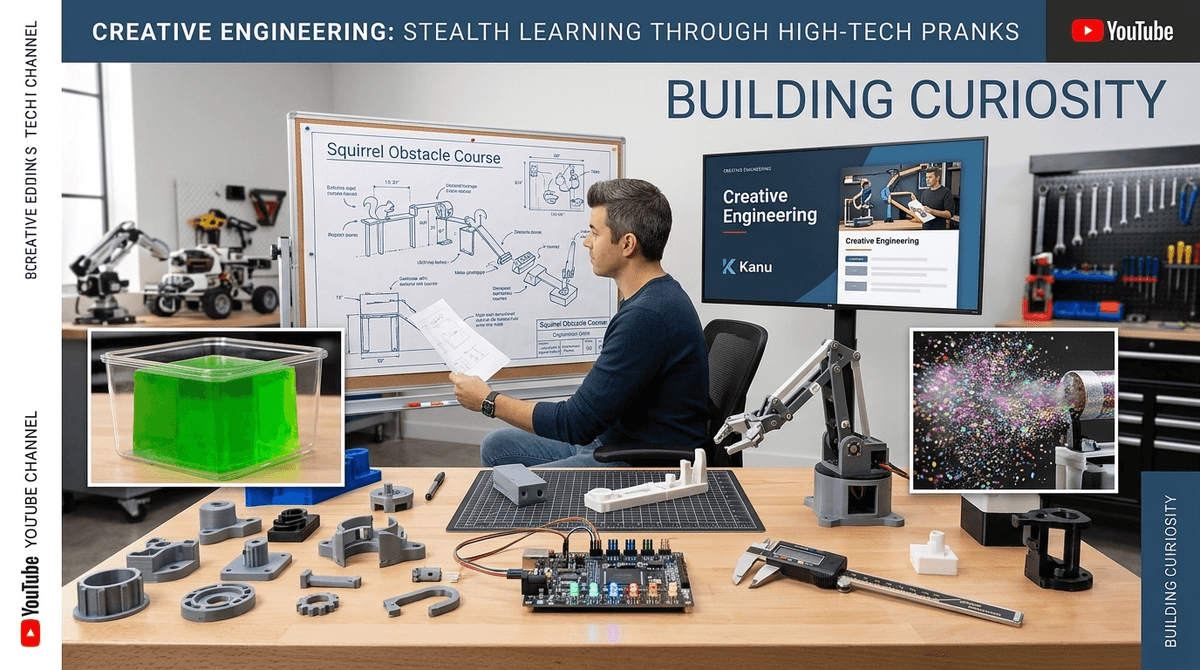
TL;DR: Mark Rober is the gold standard of "Good YouTube." He’s a former NASA engineer who builds massive, viral engineering projects—think squirrel obstacle courses and glitter bombs for porch pirates—to sneakily teach kids physics and the scientific method. It’s high-energy, high-budget, and actually makes your kid smarter.
Quick Links:
- The Channel: Mark Rober on YouTube
- The Subscription Box: CrunchLabs
- Similar Quality: SmarterEveryDay, Veritasium, and Hacksmith Industries.
If you haven’t been introduced yet, Mark Rober is the guy who made science "cool" for the iPad generation. He spent nine years at NASA (working on the Curiosity Rover) and a stint at Apple as a product designer before becoming a full-time creator.
His videos aren't your typical middle-school science fair projects. We’re talking about the world’s largest Jello pool, a liquid sand hot tub, and the legendary "Glitter Bomb" series that uses high-tech engineering to prank people who steal packages.
While the "hook" is usually a crazy stunt or a viral prank, the "meat" of every video is a deep dive into engineering principles. He uses 3D animations to explain things like angular momentum, fluid dynamics, and centripetal force in a way that doesn't feel like school. It’s "stealth learning" at its finest.
Kids are obsessed with Mark Rober for the same reason they love MrBeast: the production value is insane, the stakes feel high, and there’s a genuine sense of curiosity.
But unlike a lot of high-energy YouTube that relies on screaming and "brain rot" editing, Rober’s content is grounded in reality. Kids love:
- The "Justice" Factor: The Glitter Bomb videos are incredibly satisfying for kids who hate bullies or "bad guys."
- The Animals: His "Squirrel Obstacle Course" videos (starring squirrels like Phat Gus) have a narrative arc that rivals a Pixar movie.
- The "I Could Do That" Energy: Even though he’s using expensive tech, he always emphasizes the "trial and error" process. He shows his failures, which makes the eventual success feel earned.
In a world where Skibidi Toilet is a thing, Mark Rober is a breath of fresh air. From a digital wellness perspective, this is "High-Value Screen Time."
According to Screenwise community data, Mark Rober is one of the few channels that bridges the gap between elementary-aged kids (ages 7-10) and cynical teenagers (ages 13-16). It’s "co-viewing" gold. If you’re looking for something to watch with your kids that won't make you want to poke your eyes out, this is it.
More importantly, Rober champions the "Scientific Method" without ever calling it that. He starts with a question, builds a prototype, fails miserably, iterates, and eventually finds a solution. In a digital world that often prizes instant gratification, his videos celebrate the "grind" of building something real.
If you’re just starting out, here are the "essential" Mark Rober experiences:
This is what put him on the map. He uses GPS tracking, fart spray, and massive amounts of glitter to track down porch pirates. It’s hilarious, but it also teaches kids about circuit design and specialized sensors.
Mark builds a literal "Ninja Warrior" course for the squirrels in his backyard. It’s a masterclass in mechanical engineering and animal behavior. Your kids will never look at a squirrel the same way again.
He goes to the Bahamas to test whether sharks actually prefer human blood over other scents. It’s thrilling, slightly scary, but deeply educational about marine biology and the reality of shark behavior vs. movie myths.
Ever wondered what it's like to swim in Jello? He actually does the math to figure out the refrigeration and chemical requirements to make it happen. It’s pure, messy physics.
Recommended Ages: 6 to 106
- Ages 6-9: They will love the stunts, the animals, and the "boom" factors. They might skip over some of the heavier physics talk, but the visual storytelling keeps them engaged.
- Ages 10-14: This is the sweet spot. They’re old enough to understand the engineering challenges and might even be inspired to try some of his smaller builds (like the "phone kiting" or simple catapults).
- Ages 15+: Teens appreciate the high-level production and the "behind the scenes" look at how he uses his NASA background in the real world.
Check out our guide on YouTube safety settings for different ages
Is there any "catch"? Not really, but here are two things to keep in mind:
- The "CrunchLabs" Sales Pitch: Mark Rober launched a subscription box called CrunchLabs. In newer videos, there is usually a 2-3 minute segment where he promotes his "Build Box." Unlike some influencers who shill low-quality junk, these boxes are actually fantastic engineering kits. However, be prepared for your kid to ask for a subscription. It’s about $30/month, so it's an investment.
- Safety & "Don't Try This At Home": Mark often works with high-pressure air, massive weights, or complex chemicals. He always includes "Don't try this at home" warnings, but if you have a kid who is a "natural-born tinkerer," you might want to have a conversation about which experiments are "Mark-level" and which are "backyard-safe."
If your kid is a fan, use it as a bridge to other interests. You can ask:
- "What was the biggest 'fail' Mark had in that build, and how did he fix it?" (This builds resilience and growth mindset).
- "If you had to build a trap for a porch pirate, what would your 'payload' be instead of glitter?"
- "Why do you think he spent six months on a squirrel course? Was it worth the effort?"
Mark Rober is the rare creator who respects his audience's intelligence. He doesn't talk down to kids, and he doesn't use cheap tricks to get views. He’s proof that science doesn't have to be a dry textbook—it can be a glitter-covered, squirrel-chasing, Jello-filled adventure.
If your kid is going to spend an hour on YouTube today, there is no better place for them to be than on this channel.
- Watch together: Pick the "Squirrel Obstacle Course" for your next family movie night.
- Expand the horizon: If they love Mark, introduce them to Simone Giertz (the "Queen of Useless Robots") or The Slow Mo Guys.
- Get hands-on: Check out Scratch if they want to start "engineering" their own digital games and animations.
Get a list of STEM YouTubers for a kid who loves Minecraft and Lego