

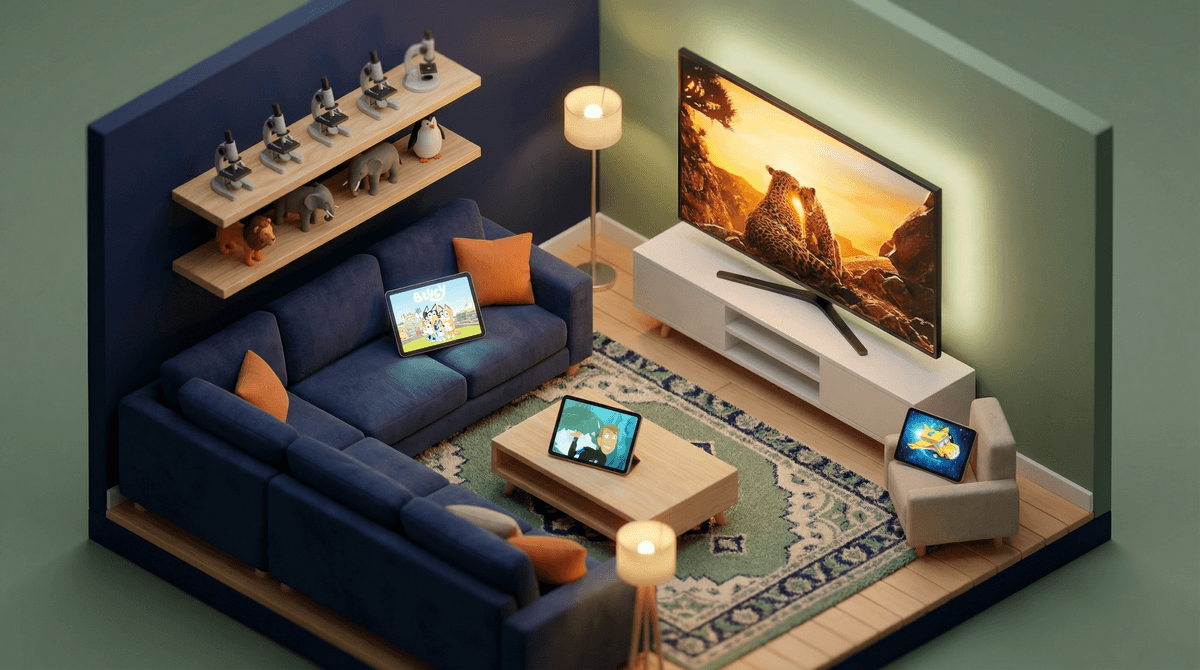
Making TV Time Count: How to Turn Screens into Learning Opportunities
Look, I'm not going to pretend that all screen time is created equal. We all know there's a difference between your kid watching a nature documentary and watching YouTube compilations of people opening surprise eggs for three hours. But here's the thing: TV time doesn't have to be a guilty pleasure or a parenting failure. With some intentionality (and let's be real, not even that much effort), you can turn regular screen time into something that actually enriches your kid's life.
The average kid watches about 2-4 hours of TV per day, depending on age. That's a LOT of time. If we're being honest, some of that is going to happen whether we like it or not—because dinner needs to get made, because you're on a work call, because it's been a long day and everyone needs a break. The question isn't really "should my kid watch TV?" It's "how can I make the TV time that's already happening work better for our family?"
And here's what the research actually shows: it's not just about how much screen time, it's about what kind and what happens around it. A kid watching a quality show with a parent who talks about it afterward? That's fundamentally different from a kid zoning out alone to whatever autoplay serves up next.
1. Choose Content That Actually Does Something
Not all shows are educational in the traditional sense, and that's okay. But there's a huge difference between content that's designed to engage kids' brains and content that's designed to keep them sedated long enough for ads to load.
For younger kids (ages 3-7):
- Bluey — honestly the gold standard for teaching emotional intelligence and creative play
- Daniel Tiger's Neighborhood — those songs are annoying but they WORK for teaching coping strategies
- Octonauts — actual marine biology wrapped in adventure stories
- Tumble Leaf — gorgeous stop-motion that teaches scientific thinking
For elementary age (ages 6-10):
- The Magic School Bus Rides Again — the reboot is legitimately good
- Avatar: The Last Airbender — teaches complex themes about war, identity, and redemption
- Odd Squad — makes math genuinely fun (shocking, I know)
- Wild Kratts — animal science with actual zoology concepts
For tweens and teens (ages 10+):
- Nature documentaries (seriously, Our Planet is stunning)
- Mythbusters — scientific method in action
- Historical dramas that spark curiosity (even if they take liberties)
- The Great British Baking Show — wholesome competition, teaches persistence and creativity
The key: look for shows that model problem-solving, showcase diverse perspectives, or teach actual skills. Bonus points if it's something you can actually stand to watch with them.
2. Be In The Room (At Least Sometimes)
You don't have to co-view every single episode of everything your kid watches. That's unrealistic and honestly, sometimes you need them occupied so you can do literally anything else. But co-viewing some of the time makes a massive difference.
When you watch together:
- You can gauge what your kid is actually absorbing
- You can clarify confusing parts or correct misinformation
- You make it a shared experience instead of a isolating one
- You get natural conversation starters
Even just being in the room while you're doing something else helps. You can chime in with "oh wow, that's interesting" or "what do you think about that?" without making it a whole production.
3. Talk About What They're Watching
This is where the magic happens. The conversation after (or during) the show is often more valuable than the show itself.
Some easy conversation starters:
- "What was your favorite part?"
- "Why do you think that character did that?"
- "Would you have made the same choice?"
- "What do you think will happen next?"
- "Have you ever felt like that character?"
For older kids, you can go deeper:
- "What do you think the show is trying to say about [friendship/honesty/courage]?"
- "Do you think that's realistic? Why or why not?"
- "How would that situation be different in real life?"
You're not interrogating them. You're just... talking. Like you would about a book or something that happened at school.
YouTube is its own beast. The algorithm is designed to keep kids watching, not to educate them. That said, there ARE great educational channels:
- Crash Course Kids — science and engineering for elementary age
- SciShow Kids — answers science questions kids actually ask
- Art for Kids Hub — step-by-step drawing tutorials
The trick with YouTube: curate playlists or use YouTube Kids with strict content settings. Don't let the algorithm decide what your kid watches. Learn more about YouTube vs. YouTube Kids to figure out which makes sense for your family.
Let's be real: some content is just... not great. Those bizarre finger family videos. Unboxing videos that are basically 20-minute toy commercials. Whatever Skibidi Toilet is doing to our collective consciousness.
Here's my take: a little mindless entertainment is fine, but it shouldn't be the default. If your kid watches 2 hours of TV a day, maybe 20-30 minutes of that can be pure entertainment fluff. The rest should have some kind of value—whether that's learning something new, exploring emotions, or just being well-crafted storytelling.
And honestly? Some of what looks like "brain rot" to us is actually how kids are connecting with their peers. Knowing the latest meme or viral trend is social currency. You don't have to love it, but you can acknowledge its role in their social world.
Set up your streaming services for success:
- Create separate kids profiles with age-appropriate content
- Use parental controls to filter out the garbage
- Build playlists of approved shows so you're not negotiating every single time
- Set screen time limits so TV doesn't become the default activity
Create simple rules:
- "We watch together on weekends"
- "Only shows from the approved list during the week"
- "Pause when someone asks you a question"
- "No screens during meals" (this one matters more than people think)
Link screen time to other activities:
- "You can watch one episode after you finish your homework"
- "Let's watch this baking show and then try making something together"
- "After this nature documentary, want to go look for bugs outside?"
TV time doesn't have to be a waste. With intentional choices about what your kids watch, some co-viewing when you can manage it, and conversations that help them process what they're seeing, screens can actually be a tool for learning and connection.
The goal isn't perfect educational content 100% of the time. The goal is to be thoughtful about what's happening during those hours, to make sure it's not just passive consumption, and to use it as a jumping-off point for real-world experiences and conversations.
And look, if you need to put on Bluey for the third time today so you can make dinner without a meltdown? That's fine. Bluey is genuinely great, and you're doing your best. The fact that you're even reading this means you're being intentional about your family's screen time, and that matters more than getting it perfect every single day.
Want to dig deeper? Check out our guides on age-appropriate Netflix shows, setting up parental controls, or balancing screen time with other activities. And if you're wondering whether that specific show your kid is obsessed with is actually any good, search our media database for parent reviews and WISE scores.