

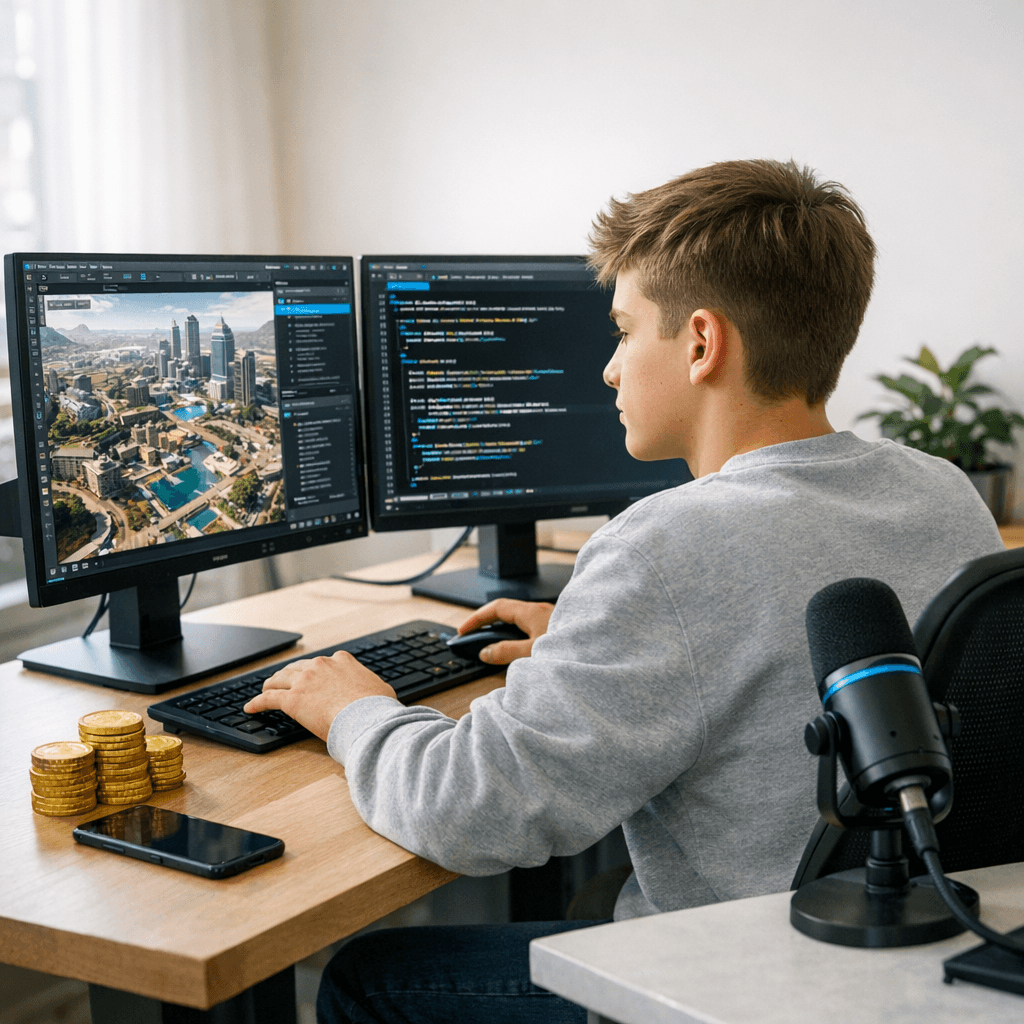
Roblox Side Hustles: Is Your Kid an Entrepreneur or Just Working for Robux?
TL;DR: Your kid can actually make real money on Roblox in 2026, but it's complicated. Some teens are cashing out thousands through the DevEx program, while others are grinding for virtual currency that never converts to anything. Here's what parents need to know about the Roblox creator economy, AI game-building tools, and whether your child is learning valuable skills or just getting exploited by platform economics.
Quick links: Roblox | Roblox Studio tutorials | Understanding DevEx
So your 11-year-old just announced they're "starting a business" and when you asked what kind, they said "I'm making a Roblox game." And honestly? They might not be wrong.
The Roblox creator economy has evolved way beyond kids slapping together obby courses in their bedroom. In 2026, we're seeing middle schoolers use AI tools to generate 3D assets, teenagers forming actual development studios with revenue-sharing agreements, and yes—some kids are making legitimate money. But we're also seeing a lot of kids working dozens of hours for pennies, or worse, getting scammed by fake "hiring" schemes.
According to our Screenwise community data, about 60% of families with Roblox users allow their kids to play on public servers and engage with the broader platform—which means they're exposed to this whole economy. Let's break down what's actually happening.
First, the facts: Roblox's Developer Exchange (DevEx) program lets creators convert their earned Robux into actual USD. The current rate? About 350 Robux = $1 USD (after Roblox takes its cut). To even qualify for DevEx, your kid needs:
- At least 50,000 earned Robux in their account
- To be 13+ years old
- A verified email and tax information
- To maintain community guidelines compliance
That 50,000 Robux threshold? That's roughly $140 in real money, but it could represent hundreds of hours of work depending on what your kid is doing. Some teens hit this in a few months with a viral game. Others grind for years and never get there.
The success stories are real—there are teenagers making $10K-$50K annually through popular Roblox games. But they're the extreme outliers. Most kids earning Robux are making maybe $20-$100 a year if they cash out at all.
Creating Games in Roblox Studio
This is the most legitimate path and potentially the most educational. Roblox Studio is a surprisingly sophisticated game development tool that teaches real coding concepts (Lua scripting), 3D modeling, game design, and even basic economics.
The 2026 twist: AI tools have made this way more accessible. Kids can now use AI to generate 3D models, write basic scripts, and even create game mechanics they describe in plain English. This is both exciting (lower barrier to entry!) and concerning (are they actually learning anything, or just prompting AI?).
If your kid is genuinely building games, they're potentially learning:
- Programming fundamentals
- Project management
- User experience design
- Basic business concepts (monetization, marketing)
Red flags to watch for:
- Spending money on assets or "game development courses" before they've built anything
- Working with anonymous "partners" who promise to split profits
- Obsessively checking player counts and revenue instead of enjoying the creative process
Building for Other Creators
Some kids get "hired" by other young developers to build parts of games—creating UI elements, scripting features, or building maps. This can be legitimate collaborative work, but it's often exploitative.
The problem: Most of these arrangements are informal, with no contracts or guaranteed payment. Kids might work for weeks on a project, only to be told "the game didn't make enough money" or simply ghosted. There's no labor protection here—it's the Wild West.
What to discuss with your kid:
- Never work for free with promises of "future payment"
- Get agreements in writing (even if it's just Discord messages)
- Understand that most Roblox games make $0
- Their time has value—would they rather spend 40 hours learning to build their own game?
Selling Assets and Models
Some creators make money selling 3D models, clothing items, or game assets through the Roblox marketplace. This can actually be a decent side hustle for kids with design skills, but the market is saturated and AI-generated content is flooding the platform.
Trading and Reselling (The Sketchy Stuff)
Some kids try to "flip" limited-edition Roblox items or engage in trading schemes. This is basically speculation and often involves scams. If your kid is talking about "investing" in Roblox items, that's a red flag—they're gambling, not building skills.
The elephant in the room: In 2026, kids can build surprisingly complex Roblox games using AI tools without understanding much about actual game development. They can prompt an AI to "create a racing game with power-ups" and get a functional prototype.
Is this good or bad?
Honestly? It depends on how they're using it.
Good use: Using AI as a teaching assistant—generating code, then studying it to understand how it works. Using AI to handle tedious tasks while focusing on creative design and game balance. Learning to prompt effectively, which is increasingly a valuable skill.
Bad use: Copy-pasting AI-generated games with no understanding, then wondering why they don't make money. Using AI to mass-produce low-quality content that clutters the platform.
The kids who are actually succeeding with AI tools are the ones who understand game design principles and use AI to accelerate their workflow, not replace their thinking.
Ages 8-10: Too young for the creator economy. If they want to build in Roblox Studio, great—treat it as creative play, not a business. Definitely don't set up DevEx or discuss money-making.
Ages 11-13: Can start learning Roblox Studio seriously if interested. Focus on skills and learning, not monetization. They can't even access DevEx until 13, so there's no point in the "make money" framing yet.
Ages 14-17: Old enough to understand the economics and potentially earn real money if they're genuinely skilled and dedicated. This is where the "entrepreneurship" framing can be appropriate—but with heavy doses of reality about time investment, failure rates, and platform economics.
For all ages: If they're spending more time thinking about money than creating, something's wrong. The kids who actually succeed are the ones who build games because they're passionate about game design, and the money is a nice side effect.
Time investment vs. return: If your kid is spending 20 hours a week on Roblox development and making $5 a month, that's not entrepreneurship—that's exploitation by platform economics. They'd literally be better off with a lemonade stand or babysitting.
Social pressure and scams: The Roblox community is full of "get rich quick" schemes, fake hiring opportunities, and kids pressuring other kids to "invest" in their projects. Our data shows that 85% of families aren't allowing kids to use AI tools yet, but many kids are accessing them anyway through Roblox development communities.
Actual skill development: Is your kid learning to code, design, and problem-solve? Or are they just clicking through tutorials and copying other games? The former is valuable regardless of money. The latter is just time-wasting.
The comparison trap: With YouTube and TikTok full of "I made $10,000 on Roblox!" content, kids get unrealistic expectations. Most of those success stories involve years of work, existing audiences, or just plain luck.
Here's the real talk: Yes, some kids are making real money on Roblox. But most aren't, and that's okay.
The value of Roblox Studio isn't really about the money—it's about learning game development, creative problem-solving, and understanding how digital economies work. If your kid is genuinely passionate about building games and happens to make some money, that's awesome. If they're grinding away trying to hit DevEx minimums while hating every minute, they should stop.
The "entrepreneurship" framing can be motivating, but it can also be stressful and set kids up for disappointment. About 55% of kids in our community are gaming regularly, but only a tiny fraction are creating content that generates revenue.
If your kid wants to pursue Roblox development:
Do:
- Encourage learning actual skills (coding, design, project management)
- Set time limits so it doesn't consume their life
- Celebrate creative achievements regardless of money
- Help them understand platform economics and realistic expectations
- Consider it a hobby that might generate some pocket money, not a business
Don't:
- Let them spend family money on "investments" in their game
- Allow them to work for free for anonymous online "employers"
- Frame it as "you could make thousands!" when most make nothing
- Let it replace actual age-appropriate jobs for teens
- Ignore what they're actually building or who they're talking to
If your kid is already deep in Roblox development:
- Have an honest conversation about time investment vs. returns
- Review their DevEx status if they're 13+ and see if they're on track
- Check who they're collaborating with and ensure it's safe
- Discuss their goals—is it about money or creative expression?
If your kid wants to start:
- Begin with Roblox Studio tutorials focused on learning, not earning
- Set clear time boundaries (maybe 3-5 hours per week to start)
- Frame it as a creative hobby, not a job
- Wait until 14+ before discussing monetization seriously
If you're skeptical about the whole thing:
- That's fair! There are other ways to learn game development that might be more educational
- Consider alternatives like Scratch for younger kids or Unity tutorials for serious older teens
- Remember that only about 30% of families in our community are giving kids this kind of digital independence anyway
The Roblox creator economy is real, complex, and evolving fast with AI tools. Some kids are genuinely building valuable skills and earning money. Others are getting exploited by platform economics or wasting time chasing unlikely success. Your job is to help your kid figure out which path they're on—and whether this is actually how they want to spend their time.