

TL;DR
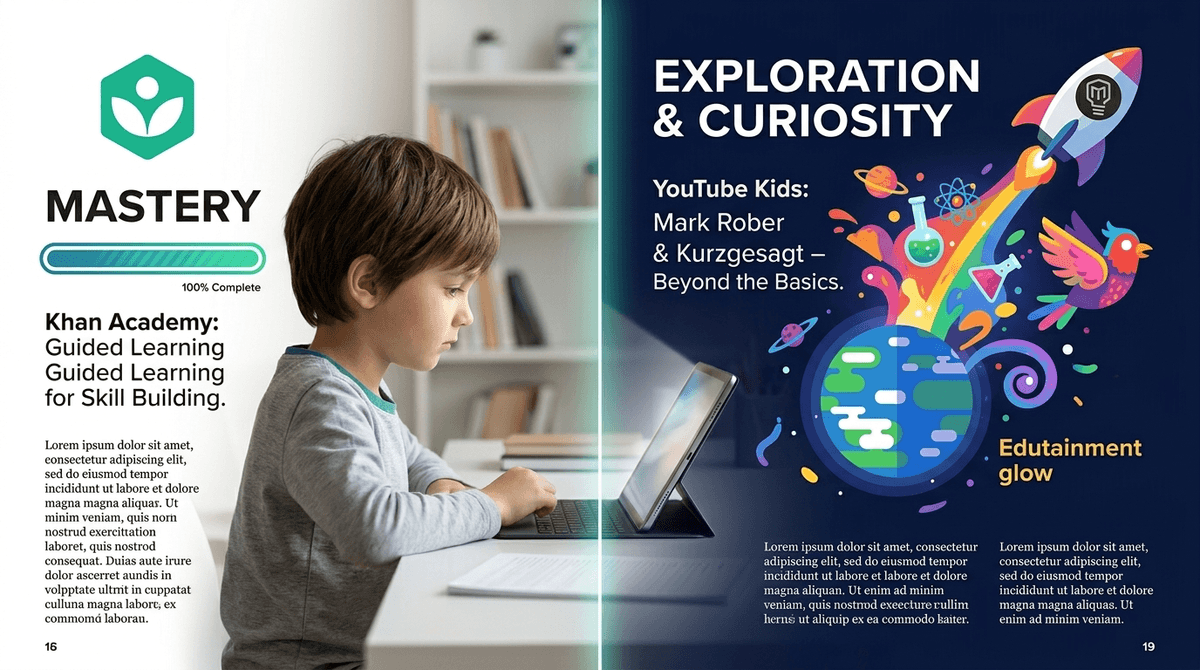
If you’re short on time (because, let’s be real, the laundry isn’t going to fold itself), here is the breakdown: Use Khan Academy when your child needs to actually master a concept for a test or a grade. Use YouTube to spark curiosity or see a concept in action.
Top Picks for Digital Learning:
- For Core Mastery: Khan Academy (Ages 5-18)
- For Science/Engineering: Mark Rober (Ages 8+)
- For High-Level Science: Veritasium (Ages 12+)
- For Humanities/History: Crash Course (Ages 13+)
- For the Littles: Khan Academy Kids (Ages 2-8)
We’ve all been there. Your kid is struggling with long division or the periodic table, and your own brain has long since deleted that particular file to make room for grocery lists and the lyrics to every song in Moana. You tell them to "look it up online," and twenty minutes later, you find them watching a video of a guy in a toilet suit singing about "Skibidi."
Welcome to the digital learning dilemma. We want our kids to use the internet as the ultimate library, but the algorithm wants to treat them like a captive audience for a 24/7 circus.
The two heavyweights in this space are Khan Academy and YouTube. One is a non-profit "classroom in a box" that is about as wholesome as a home-grown organic carrot. The other is a chaotic, neon-lit "edutainment" factory that can teach you how to build a nuclear reactor or rot your brain with "Ohio" memes, depending on which way you swipe.
Let’s decode which one your kid actually needs right now.
Khan Academy is the gold standard for a reason. It’s structured, it’s trackable, and it’s intentionally designed to prevent the "illusion of competence."
Why It Works
The secret sauce of Khan is Mastery Learning. In a traditional classroom, the class moves on to Unit 2 even if your kid only got a 70% on Unit 1. That 30% gap eventually becomes a "Swiss cheese" hole in their knowledge that causes them to fail Algebra two years later.
Khan doesn't let them move on until they prove they get it. It uses a clean interface with zero ads, zero "recommended" videos of people eating 10,000 calories, and a very clear progress bar. For parents who want to know exactly what their kids are doing, the dashboard is a dream.
The "Boring" Factor
Let’s be honest: Khan Academy can be a bit dry. Sal Khan’s voice is soothing—almost too soothing. It feels like school. If your kid is already burnt out from an eight-hour day at a desk, getting them to log into Khan Academy can feel like a negotiation for a hostage release.
Learn more about motivating kids for online learning
YouTube is where "learning" meets "entertainment." It is the most powerful educational tool ever created, and also the most dangerous distraction machine.
Why Kids Love It
YouTube creators are masters of engagement. They use high-end editing, humor, and storytelling to make complex topics feel like a movie. When a kid watches Mark Rober explain potential energy by dropping a giant bowling ball onto a trampoline, they aren't just memorizing a formula; they are seeing the physics in the real world.
The Rabbit Hole Problem
The problem with YouTube isn't necessarily the content—it's the algorithm. The "Up Next" sidebar doesn't care if your kid learns calculus; it cares that they stay on the site. A search for "how to code in Python" can quickly devolve into "Minecraft speedruns" because the algorithm knows your kid's weaknesses better than you do.
Check out our guide on YouTube vs. YouTube Kids
The biggest mistake parents make is thinking these two platforms do the same thing. They don't.
- Exposure (YouTube): This is for the "Aha!" moment. It’s great for sparking interest. If your kid hates history, watching Oversimplified might make them realize that the French Revolution was actually kind of wild. But they won't necessarily be able to pass an AP exam based on that video alone.
- Mastery (Khan Academy): This is for the "I can do this" moment. It’s for when they need to sit down, do the practice problems, and ensure they actually understand the mechanics of the subject.
The "Illusion of Competence"
Research shows that watching a video of someone solving a math problem makes us feel like we understand it, but when we’re given a blank piece of paper, we freeze. YouTube is great for the feeling of understanding. Khan Academy is built for the reality of understanding because it forces the kid to do the work.
If you're going to let them use YouTube for learning, steer them toward creators who actually care about accuracy and depth.
Ages 8+ | Former NASA engineer who builds crazy contraptions to explain engineering principles. It’s high-energy, funny, and genuinely educational. This is the gold standard of "edutainment."
Ages 10+ | Beautifully animated videos about science, space, and philosophy. They take incredibly complex topics (like black holes or the immune system) and make them visual. Note: Some topics can get a bit existential/heavy for younger kids.
Ages 13+ | Started by the Green brothers (John and Hank), this channel covers everything from World History to Organic Chemistry. It’s fast-paced and leans into a "cool teacher" vibe.
Ages 8+ | Destin Sandlin explores the world through a scientific lens. Whether he's looking at how a cat always lands on its feet or how a rocket works, his enthusiasm is infectious.
Elementary School (Ages 5-10)
Stick to Khan Academy Kids for structured learning. It’s delightful, safe, and has zero ads. If they use YouTube, keep them on YouTube Kids with a "hand-picked content only" setting. At this age, the "rabbit hole" is too tempting and the "Skibidi Toilet" brain rot is real.
Middle School (Ages 11-13)
This is the transition phase. They’ll likely start using YouTube for "how-to" videos (how to build a house in Minecraft, how to draw, etc.). This is a great time to introduce the concept of the "algorithm" and how it tries to steal their time. Use Khan Academy as the primary tool for homework help.
High School (Ages 14-18)
By now, they are likely using YouTube for everything. The key here is helping them find high-quality creators and using Khan Academy specifically for SAT/ACT prep (it’s the official partner of the College Board) and AP course mastery.
Get a learning plan based on your kid's grade
When a kid searches for "fractions" on YouTube, the top results might be great. But the "Recommended" videos on the side will be whatever they usually watch. If they usually watch Roblox streamers, the sidebar will be full of Roblox.
Pro-Tip: Teach your kids to use the search bar on Khan Academy first. If they still don’t get it, then they can move to YouTube, but with a specific goal: "I am going to watch one video by Math Antics and then close the tab."
Khan Academy is the textbook; YouTube is the field trip.
You wouldn't expect a kid to learn everything from a field trip, and you wouldn't want them to spend their whole life staring at a textbook. The "Screenwise" way is to balance the two. Use Khan for the heavy lifting and the data-backed progress. Use YouTube to keep them excited about the world and to show them that learning isn't just something that happens in a classroom.
Just keep an eye on that "Up Next" button. Because the distance between "The History of the Roman Empire" and "100 Layers of Duct Tape Challenge" is much shorter than you think.
- Audit the Subscriptions: Sit down with your kid and look at who they follow on YouTube. If it’s all "brain rot," suggest one or two of the channels above.
- Set Up Khan: Create a parent account on Khan Academy and link your child’s account so you can see their progress without hovering.
- Talk About the Algorithm: Explain that YouTube is a business designed to keep them watching, not a teacher designed to help them learn.
Check out our guide on setting digital boundaries for schoolwork