

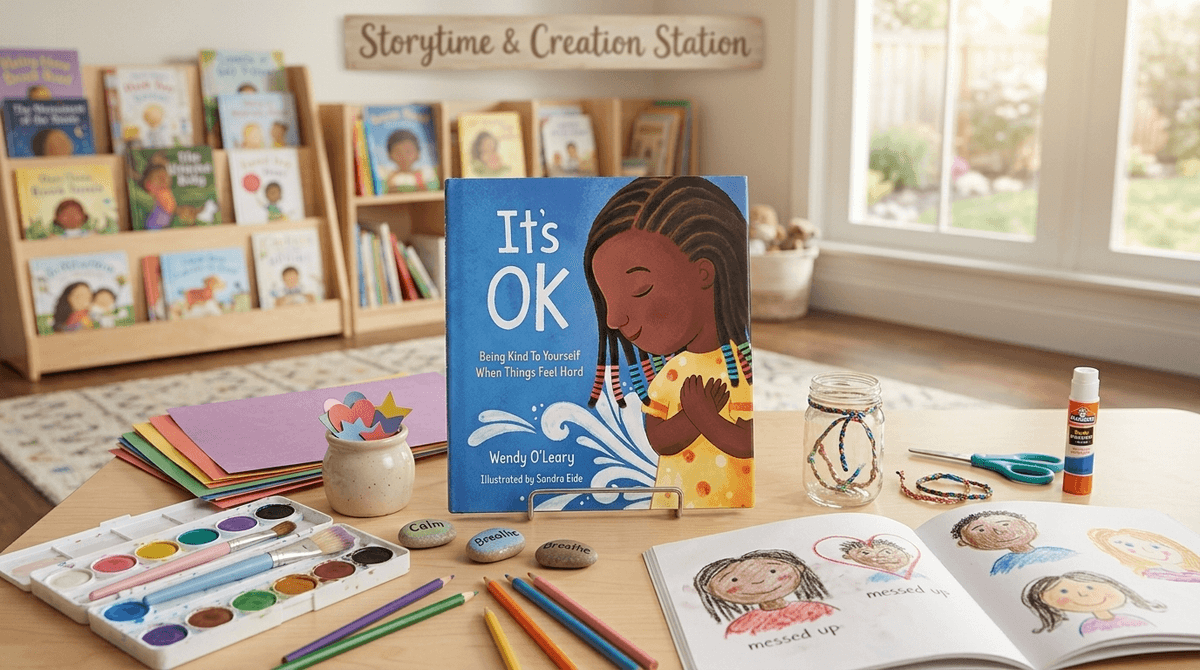
It’s OK by Wendy O'Leary by Wendy O’Leary isn't another "toxic positivity" manifesto telling your kid to just smile through the pain. It’s a tactical manual for the physiological reality of being a kid who hasn't yet mastered the art of failing gracefully. If you’ve ever watched a Lego tower collapse and seen your child’s face go through the four stages of grief in three seconds, this is the book you actually want on the shelf.
TL;DR
It’s OK is a practical, non-preachy guide to self-compassion for kids ages 4–9. Unlike most "feelings" books that stay in the clouds, Wendy O’Leary focuses on physical sensations and actionable self-talk. If your kid is a perfectionist who melts down over a smudged drawing or a lost game, It's OK by Wendy O’Leary is a high-value addition to your bookshelf. It provides a "May I..." framework for self-kindness that builds emotional resilience without feeling preachy. Pair it with The Girl Who Never Made Mistakes or the low-stakes exploration of A Short Hike to help them lower the stakes of being "perfect."
Most "feelings" books for kids fall into two traps: they’re either way too abstract ("just be happy!") or they’re so saccharine they make your teeth ache. Wendy O’Leary avoids both. She acknowledges that things are hard—that making a mistake feels bad, that being left out hurts, and that being frustrated is a real physical sensation.
The book introduces the concept of self-compassion through a series of "May I..." phrases. It’s not telling the kid how to feel; it’s offering them a way to talk to themselves. For a kid who is currently their own worst critic, having a pre-written script for kindness is often the only way they can actually access it.
If you want to see how the book's rhythm lands before you buy it, this read-aloud gives a good sense of the pacing:
Most children's books about emotions fall into one of two traps: they’re either too abstract ("Just find your inner peace!") or too condescending. It’s OK skips the fluff and goes straight to the mechanics of self-compassion. It acknowledges that when things go wrong—you drop your ice cream, you lose the game, you can’t get the drawing right—it doesn't just "feel bad," it feels like a physical emergency.
Screenwise community data shows that only about 30% of kids are hitting high marks for independence in their daily routines. The other 70% are usually stuck in the friction points: the frustration of a hard math problem, the sting of a social rejection, or the sheer exhaustion of a long day. This book targets that 70% by giving them a script that isn't about being "the best," but about being "okay" with being human.
We know from our data that managesBedtime is a major hurdle, with only 30% of families reporting that their kids handle the transition with total independence. Often, bedtime is when the "big feelings" from the day finally catch up to a kid. The screen is off, the distractions are gone, and the brain starts tallying up the day's mistakes.
Using It’s OK as a bedtime read isn't just about literacy; it’s about "emotional off-boarding." It gives kids a way to process the day’s friction so they don't carry it into their sleep. For parents trying to move their kids toward that 30% independence bracket, this book is a legitimate tool for the kit.
Don't just read the book and close it. The real value is in the "body scan" technique O’Leary introduces.
The Conversation Starter: Next time your kid is frustrated (maybe they’ve hit their 4.2-hour average screen time limit and the transition is getting rocky), ask: "Where is the 'not okay' feeling right now? Is it in your hands? Your tummy?"
By moving the focus from the reason for the anger to the feeling of the anger, you bypass the argument and move straight to the regulation. It’s a pro-move that turns a potential meltdown into a self-awareness win.
If It's OK lands well in your house, you’re likely dealing with a "Big Feelings" kid who needs more than just a pep talk. Here is the extended universe of media that hits the same note of "excellence over perfection."
This is the perfect companion piece. It tells the story of Beatrice Bottomwell, who has never, ever made a mistake—until she does, in front of everyone. It’s a great way to talk about the "perfectionist's trap" and how much more fun life is once you let go of the streak.
For the kid who rips up their paper the second a line goes wonky, this book is a game-changer. It’s interactive and shows how a tear in the paper becomes a bird’s mouth or a smudge becomes a character. It turns "ruined" into "started."
If you want to move this lesson into gaming, skip the high-stress competitive stuff. A Short Hike is a masterclass in "it’s okay to just wander." There are no "Game Over" screens, no wrong ways to climb the mountain, and the dialogue is genuinely funny and human. It’s the digital equivalent of a deep breath.
Hilda is a great role model because she messes up constantly. She’s brave and kind, but she’s also impulsive and often has to fix the messes she makes. Unlike many "perfect" protagonists, Hilda’s growth comes from her mistakes, not her successes.
Q: What age is "It's OK" actually for? It’s the sweet spot for ages 4 to 9. Younger kids (3-5) will appreciate the simple rhythm and the pictures, while older kids (6-9) will actually be able to apply the self-compassion scripts to their real-world problems like schoolwork or sports.
Q: My kid thinks "feelings books" are cringe. Will they like this? O’Leary’s book is less "cringe" than most because it’s not about "hugging your feelings." It’s very matter-of-fact about the physical sensations of being upset. It reads more like a manual than a sermon, which usually sits better with skeptical kids.
Q: Does this book help with bedtime anxiety? Yes. Since only about 30% of kids manage bedtime independently, using this book to "clear the deck" of the day's frustrations can significantly lower the anxiety that keeps kids from settling down.
It’s OK is a rare find: a "social-emotional learning" book that kids actually want to read and parents don't mind reciting. It’s specific, it’s physical, and it’s the perfect antidote to the "perfection or bust" culture.
- For more titles that help kids navigate the world, check out our best books for kids list.
- If your kid is more of a visual learner, explore our digital guide for elementary school to find shows and apps that build similar emotional skills.
- Get a personalized book recommendation for your child
