

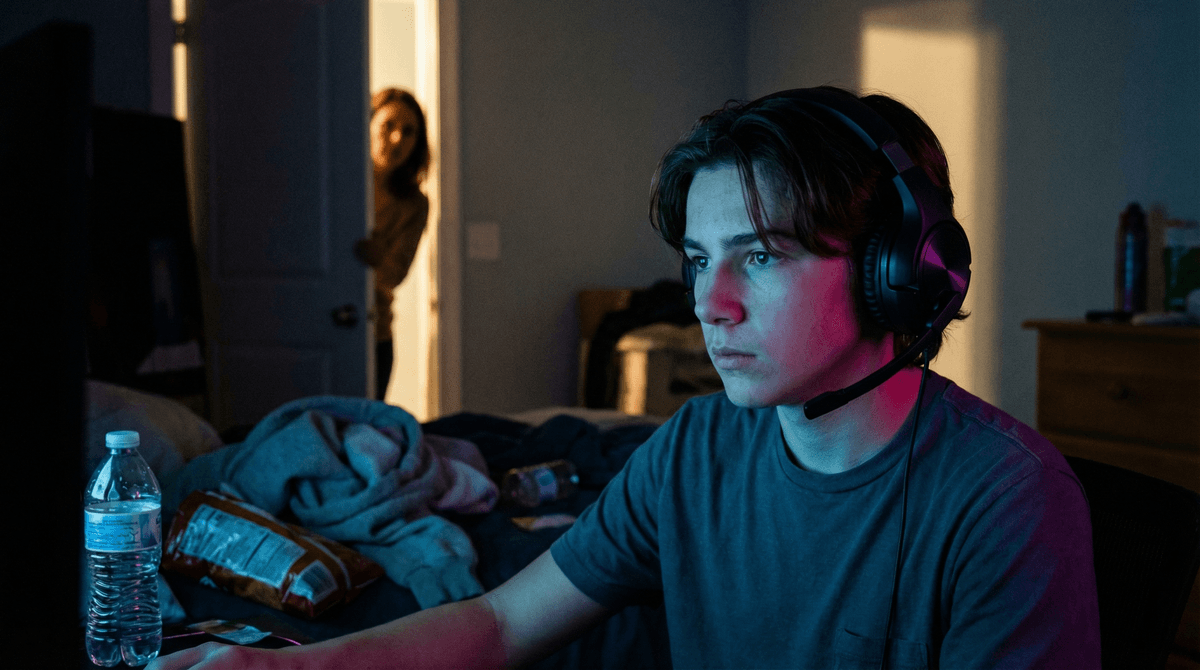
TL;DR: Most kids go through "gamer phases" where a specific title like Fortnite or Roblox becomes their entire personality. It’s usually fine. However, it becomes a problem—and potentially a clinical "Gaming Disorder"—when it compromises their hygiene, sleep, schoolwork, or real-world friendships. If they’re "rage-quitting" life to stay in the game, it’s time to intervene.
Quick Resources:
We’ve all been there. You’re trying to call them for dinner for the fifth time, and all you get back is a muffled scream about "lag" or how they can’t pause an online match in League of Legends. It’s easy to look at a kid who has spent six hours straight building a "Skibidi Toilet" museum in Roblox and think, “This is it. Their brain is officially cooked.”
But there is a massive difference between a kid who is deeply passionate about a hobby and a kid who is spiraling into a behavioral addiction. One is a phase; the other is a problem.
In the gaming world, kids often use the word "sweaty" to describe players who are trying way too hard. As parents, we need to know when our kids' gaming habits have moved from "having fun" to "dangerously sweaty."
The World Health Organization (WHO) actually recognizes "Gaming Disorder" as a clinical condition. It’s not just about the amount of time spent playing—it’s about the impact that time has on the rest of their life.
Think of it like this: If your kid spent ten hours a day practicing the piano, you’d probably be looking for a conservatory. If they spend ten hours a day on Minecraft, you’re looking for an intervention. The medium matters, but the functional impairment is the real metric.
If you’re wondering if your kid has crossed the line, look for these specific behaviors. One or two might just be a "gamer phase," but a combination of these is a signal to hit the brakes.
1. The "Withdrawal" Rage
Does your kid act like they’re detoxing when you take the controller away? We’re not talking about a little grumbling. We’re talking about genuine aggression, physical outbursts, or a level of irritability that seems totally out of proportion to losing access to [Brawl Stars](https://screenwiseapp.com/media/brawl-stars-app.
2. Neglecting Basic "Humaning"
If they are skipping showers, forgetting to eat (or only eating "gamer fuel" like Takis and Prime), and staying up until 3:00 AM to finish a "grind," you have a problem. When Discord notifications become more important than sleep hygiene, the "addiction" label starts to fit.
3. Loss of Interest in Everything Else
Remember when they liked soccer? Or drawing? Or even just hanging out at the mall? If those interests have been completely cannibalized by Fortnite or Valorant, and they have zero desire to engage with the physical world, it’s a red flag.
4. Lying and Deception
Are they sneaking the iPad under the covers? Are they lying about how long they’ve been playing? When a kid starts "gaming the system" just to get more screen time, the relationship with the tech has become compulsive.
The reason gaming is so addictive isn't just because the graphics are "Ohio" (that’s kid-speak for weird or cringe, by the way). It’s because modern games are engineered to be "brain rot" in the most literal sense—they are dopamine delivery systems.
Games like Genshin Impact use "gacha" mechanics (essentially gambling) to keep kids pulling for new characters. Roblox uses a constant stream of user-generated content so there is always something new to see. It’s a never-ending loop of "just one more level."
Learn how game designers use "dark patterns" to keep kids playing
The "addiction" look varies depending on how old your kid is.
Elementary (Ages 6-10)
At this age, it’s usually about emotional regulation. They don't have the prefrontal cortex development to stop themselves. If they are obsessed with Toca Life World or Minecraft, the "addiction" looks like epic meltdowns during transitions. Recommendation: Set hard limits using external timers so you aren't the bad guy—the clock is.
Middle School (Ages 11-14)
This is the danger zone for social gaming. They feel like if they aren't on Discord or playing Among Us with the squad, they are socially dead. Recommendation: Focus on "digital sunset" rules. No gaming after 9:00 PM. Period.
High School (Ages 15-18)
Here, it’s about escapism. If high school is stressful, the virtual world is where they feel powerful. Addiction here looks like failing grades and "hermiting." Recommendation: This requires a conversation about why they are escaping. Are they avoiding anxiety or depression?
Sometimes, the "addiction" is a symptom, not the disease. Kids with ADHD or Autism are often drawn to gaming because the feedback loops are incredibly satisfying for their brains. In these cases, the game is a "safe" place where they understand the rules.
However, we have to be No-BS about certain platforms. Roblox is often a toxic mess of predatory monetization and "brain rot" content. If your kid is addicted to a game that is basically a digital casino, that’s different from a kid who is obsessed with the creativity of Terraria.
Healthy Alternatives to "High-Stress" Games
If you need to pivot them away from the "sweaty" competitive games, try these:
- Stardew Valley (Cozy, low stress)
- Unpacking (Zen-like puzzle game)
- Animal Crossing: New Horizons (Social but gentle)
- Catan (Get them into physical board games!)
Ask our chatbot for more game recommendations based on your kid's interests
Don't go in with "You're addicted and I'm taking your PC." That’s a recipe for a blowout. Instead, try the "Functionality First" approach.
“Hey, I’ve noticed that when you play Fortnite for more than two hours, you get really angry with your sister and you’ve been skipping your homework. I love that you’re good at the game, but it’s starting to mess with your real life. We need to figure out a schedule that works for both.”
You aren't attacking the game; you're highlighting the consequences.
Gaming isn't the enemy. For many kids, it’s their primary social outlet and a source of genuine skill-building. But like anything that feels good, it needs guardrails.
If your kid is still laughing with friends, getting their B- in Algebra, and occasionally smelling like soap, they’re probably just in a phase. If they’ve turned into a "sweaty" basement-dweller who hasn't seen sunlight in 48 hours, it’s time to step in.
- Audit the Games: Check the WISE scores for the games they are playing most.
- Set a "Tech-Free" Zone: Dinner table and bedrooms are the easiest places to start.
- Model the Behavior: If you’re scrolling TikTok while telling them to get off Minecraft, you’ve already lost.
- Use Screenwise: Take our family digital habits survey to see how your kid's gaming compares to other kids in their grade.
Learn how to use Screenwise to track your family's digital health