

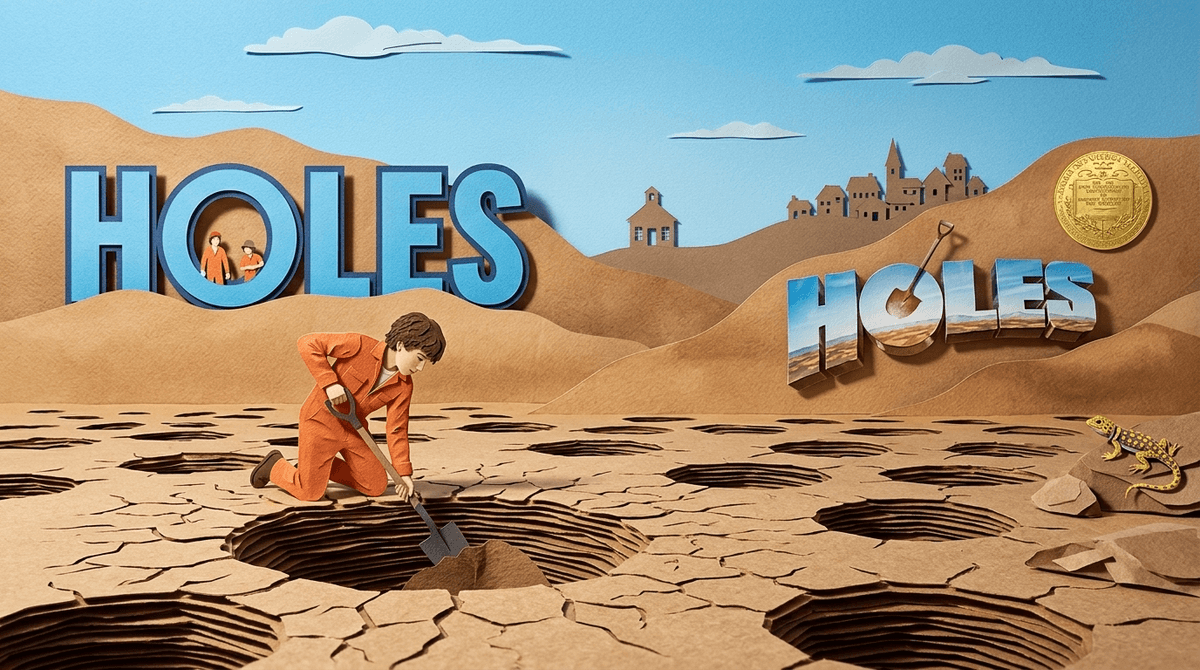
TL;DR: Holes by Louis Sachar is a masterpiece of middle-grade fiction, but it doesn't pull its punches. For most 9-year-olds (4th grade), it’s the perfect "step up" book—gritty enough to feel "grown-up" but grounded in a clear sense of justice. If your kid is sensitive to themes of child endangerment or historical racism, you might want to read it together.
Quick Links for the Journey:
- The Original: Holes by Louis Sachar (Book)
- The Adaptation: Holes (Movie)
- The Sequel-ish: Small Steps by Louis Sachar
- Similar Vibes: Wonder by R.J. Palacio
If you missed this one in the late 90s or early 2000s, here’s the breakdown: Holes follows Stanley Yelnats IV, a kid who is perpetually in the wrong place at the wrong time thanks to a multi-generational family curse. When he’s unjustly convicted of stealing a pair of sneakers, he’s sent to Camp Green Lake—which is neither green nor a lake. It’s a juvenile detention center in the middle of a Texas desert where boys are forced to dig five-foot-deep holes every single day.
The story weaves together three timelines: Stanley’s current struggle, his "no-good-dirty-rotten-pig-stealing-great-great-grandfather" in Latvia, and the tragic 19th-century outlaw story of "Kissin' Kate" Barlow. It all converges in a way that is honestly more satisfying than almost any modern mystery series.
At nine, kids are often hitting a "literary wall." They’re moving past the whimsical magic of The Wild Robot and starting to look for stories that acknowledge the world can be unfair.
Holes is the "gateway drug" to complex storytelling. It deals with systemic injustice, bullying, and the weight of history, but it does so through the lens of a kid who just wants a friend and a drink of water. It’s a heavy book, but it’s a "safe" heavy. It gives them the vocabulary to talk about things like "fate" and "consequences" without being a total downer.
Let’s talk about the grit. This isn't a "brain rot" YouTube video where everything is loud and meaningless. This is a story with real stakes. Here is what might make a 9-year-old (or their parent) flinch:
The Physical Hardship
The book describes heat exhaustion, dehydration, and physical labor in a way that feels visceral. For a kid who gets upset when the Wi-Fi goes out, the idea of digging a hole in 100-degree heat under the watch of a cruel Warden can be stressful.
The "Yellow-Spotted Lizards"
The book features fictional lizards that are lethally poisonous. One bite and you’re dead. There’s a constant looming threat of these creatures, and yes, characters do get bitten (though the "good guys" usually have a plot-armor reason to survive).
Historical Violence and Racism
The backstory of Kissin' Kate Barlow involves a schoolteacher who falls in love with a Black onion seller in the 1800s. The town’s reaction is violent: they burn down the schoolhouse and murder the man. This leads Kate to become a vengeful outlaw. It’s handled with grace, but it’s a direct, unvarnished look at American racism that might require a "pickup truck conversation" on the way home from school.
The Warden
The main antagonist is a woman who uses rattlesnake venom in her nail polish to scratch people. She’s a classic "scary adult" figure—manipulative, uncaring, and powerful.
Check out our guide on how to talk to kids about scary characters
While the "official" recommendation is often ages 10+, I find that 9 is the sweet spot for many kids, provided they have the right context.
- For the 8-9 Year Old: This is a great "read-aloud" or "co-read." You can handle the heavy lifting of the historical timelines while they focus on Stanley and his friend Zero.
- For the 10-12 Year Old: They can likely fly through this solo. They’ll appreciate the "puzzle" aspect of the plot—how all the pieces fit together at the end.
- For the Sensitive Kid: If your child is still having nightmares about the spiders in Harry Potter and the Chamber of Secrets, the lizards and the Warden's cruelty might be a bit much. Hold off until 10 or 11.
If your kid loves Holes, they are likely ready for more "meaningful grit." Here are some top-tier recommendations:
If they handled the emotional weight of Kate Barlow’s story, this is the gold standard for "sad but necessary" childhood reading. It deals with grief and imagination in a way that sticks with you forever.
For the kid who loved the "mystery" and "puzzle" aspect of how Stanley's family history connected. It’s a classic whodunnit that respects a 9-year-old's intelligence.
A more modern take on the "bad kid/good kid" dynamic. It’s about a bully who gets amnesia and has to decide who he wants to be. It’s very popular in 4th and 5th-grade classrooms right now.
Honestly? This is one of the best book-to-movie adaptations ever made. It’s rated PG, it stars a young Shia LaBeouf, and it stays incredibly faithful to the book. It’s a great "reward" for finishing the novel.
See our full list of book-to-movie adaptations for 9-year-olds
You know how we talk about whether Roblox is teaching kids about money? Holes has a weirdly similar vibe regarding "value." The boys are digging for a "treasure" they don't understand, under a system that exploits them.
It’s a great way to talk to your kid about labor and reward. Why is the Warden making them do this? What is the "treasure" actually worth? It’s a much better conversation than "Can I have 800 Robux for a virtual hat?"
Is Holes too intense? No. It’s just intense enough.
In a world where kids are constantly bombarded with "brain rot" content—low-effort YouTube shorts or repetitive mobile games—Holes is a breath of fresh (albeit dusty) air. It’s a story that assumes your 9-year-old is smart, empathetic, and capable of handling the truth about the world.
If they can handle the idea that sometimes life is unfair, but that friendship and integrity can eventually break a "curse," then they are ready for Camp Green Lake.
- Grab the book: Check your local library or buy a copy here.
- Set a "Movie Night" goal: Tell them once they finish the book, you’ll watch the Holes movie together.
- Talk about it: Use the "Kissin' Kate" backstory to have a real conversation about history. It’s better they hear it from you than a random TikTok.
Learn more about navigating difficult historical themes in kids' media