

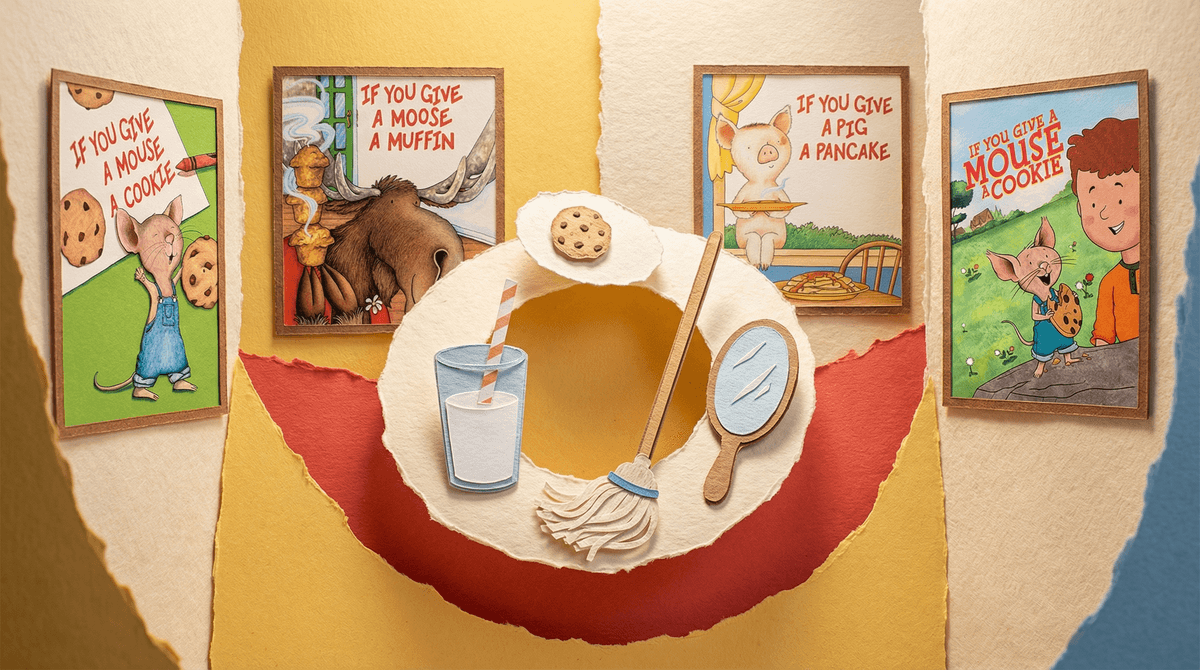
If You Give a Mouse a Cookie is a beloved children's book by Laura Numeroff, first published in 1989. The story follows a simple premise: a boy gives a mouse a cookie, which triggers an endless chain of requests. The cookie leads to milk, which leads to a straw, which leads to a napkin, a mirror, nail scissors, and on and on until the mouse circles back to wanting another cookie.
It's a circular tale about cause and effect, told with charming illustrations by Felicia Bond. The book has spawned an entire series (If You Give a Pig a Pancake, If You Give a Moose a Muffin, etc.) and even an Amazon Prime animated series.
But here's the thing that makes parents laugh-cry when reading it: this book is literally about parenting.
The first time you read this book as a kid, it's a fun, silly story about a demanding mouse. The first time you read it as a parent, you realize you ARE the boy, and your child IS the mouse, and oh my god, this is your entire life.
"Can I have a snack?" turns into "Can you cut it up?" which becomes "I need a different plate" which leads to "Actually I want something else" which circles back to "I'm still hungry."
Sound familiar?
The book perfectly captures that parenting experience of one simple yes snowballing into an afternoon of cascading requests. And in our current digital landscape, this dynamic has gone into hyperdrive.
The modern version looks like this:
- "Can I watch one episode?" → "Just one more?" → "Can I watch on the iPad instead?" → "My iPad is dead, can I use yours?" → "I need the password" → "Can I download this game I saw in an ad?" → "The game needs in-app purchases" → "Everyone has this" → back to "Can I watch one more episode?"
The mouse isn't just asking for cookies anymore. He's asking for Robux, YouTube access, and his own Discord server.
Despite feeling like a cautionary tale about setting boundaries, the book offers some genuinely useful lessons:
Cause and Effect: Every action has consequences and leads to something else. This is fundamental logic that kids need to understand—and it applies beautifully to digital decisions. Downloading that "free" game leads to ads, which leads to wanting to pay to remove ads, which leads to learning about in-app purchases .
.
Anticipating Needs: The mouse knows what he'll need next. Teaching kids to think ahead ("If you're taking the iPad to the car, what else do you need? Headphones? Charger?") is a valuable executive function skill.
Circular Patterns: Sometimes we end up right back where we started. This is actually comforting for young kids who thrive on predictability and routine.
The Relationship Matters: Throughout all the requests, the boy keeps helping the mouse. There's patience, care, and connection. The requests aren't portrayed as bad—they're just... a lot.
Ages 2-5: This is peak age for the book itself. Kids this age are living in the cause-and-effect discovery phase. They're also making approximately 47 requests per hour, so the story resonates. For screen time, this age group is still in the "co-viewing is essential" phase—you're the boy, they're the mouse, and you're navigating PBS Kids together.
Ages 5-8: Kids can start seeing themselves in the mouse and find it funny. This is a great age to start talking about the "one more" cycle with screens. "Remember how the mouse kept needing one more thing? How do you think we can plan better so we're not always asking for one more episode?"
Ages 8-12: The book becomes a useful metaphor for talking about digital rabbit holes. "You wanted to watch one Minecraft video, and now it's been an hour. What happened?" They can start identifying their own "mouse patterns" and developing self-awareness about how one thing leads to another online.
The exhausting cycle in the book mirrors three major challenges in digital parenting:
The "Just One More" Trap
Every parent knows the negotiation: "Just one more level." "Just one more video." "Just five more minutes." The mouse's circular requests are exactly how YouTube's autoplay or TikTok's infinite scroll works—designed to keep you in the loop.
The fix: Time limits set BEFORE starting. "You can watch two episodes" is clearer than "okay, time to stop" after an undefined period. Use built-in timers on devices, or try apps like Screen Time (iOS) or Family Link (Android).
The Slippery Slope of Permissions
"Can I download this game?" seems innocent. But that game wants notifications. And access to contacts. And location. And now it's asking for payment information. One cookie becomes a whole privacy policy you didn't read.
The fix: Practice the pause. "Let me check that out first" becomes your default. Use that time to actually look up the game, read reviews, check age ratings on Common Sense Media, and make an informed decision.
The Endless Comparison Cycle
"Everyone has Roblox" leads to "Everyone has Robux" leads to "Everyone has Snapchat" leads to "Everyone has an iPhone." The mouse's requests never end, and neither does the "everyone has it" argument.
The fix: Know your actual community norms. Sometimes "everyone" means two kids in the friend group. Sometimes it actually is 80% of the class. Either way, you get to decide based on YOUR family's values, not the mouse's wants.
If You Give a Mouse a Cookie isn't telling you to stop giving the mouse cookies. It's not a cautionary tale about saying no to everything. The boy in the story keeps helping! He's patient and kind and engaged.
The lesson isn't "set rigid boundaries and never budge." It's "understand that one yes leads to another request, so go in with your eyes open."
In digital parenting, this means:
- Anticipate the cascade: If you're saying yes to YouTube Kids, you're also signing up for "just one more video" negotiations
- Plan for the circle: Decide in advance how many cookies (episodes, levels, videos) you're comfortable with
- Stay in relationship: The requests aren't manipulation—they're normal kid behavior in a world designed to generate more requests
- Give yourself grace: Some days you'll set perfect boundaries. Some days the mouse gets the whole package of cookies. Both are fine.
Want to understand your family's specific "mouse patterns" better? Screenwise can help you see where your family's digital habits fall compared to your community, so you can make decisions based on data, not just the exhausting feeling that you're saying yes to everything.
Check out how other families are handling screen time negotiations or explore our guides on setting up parental controls that work with your family's values, not against them.
Because at the end of the day, we're all just trying to figure out how many cookies to give the mouse—and whether those cookies come with Wi-Fi access.