

Look, we all want our kids to learn something when they're watching TV, right? History content feels like the perfect win-win: they're entertained, we feel less guilty about screen time, and maybe—just maybe—they'll remember something useful for that 5th grade social studies project.
But here's the thing: not all history TV is created equal. Some shows are basically historical fan fiction with great costumes. Others are so dry your kid would rather watch paint dry. And then there's the stuff that's technically accurate but filled with content that'll have you diving for the remote faster than you can say "age-appropriate."
History TV for families means finding that sweet spot: content that's engaging enough to hold attention, accurate enough to actually teach something, and age-appropriate enough that you're not fielding awkward questions during dinner.
History content done right can be genuinely transformative. It helps kids:
- Develop critical thinking - Understanding cause and effect, analyzing sources, recognizing bias
- Build empathy - Seeing the world through different perspectives and time periods
- Connect the dots - Realizing that current events didn't just appear out of nowhere
- Get curious - One good documentary can spark a lifelong interest
The problem? A lot of "educational" history content is either dumbed down to the point of uselessness or so focused on entertainment that the actual history gets lost. And don't even get me started on the shows that present conspiracy theories as legitimate historical debate.
For Elementary (Ages 6-10):
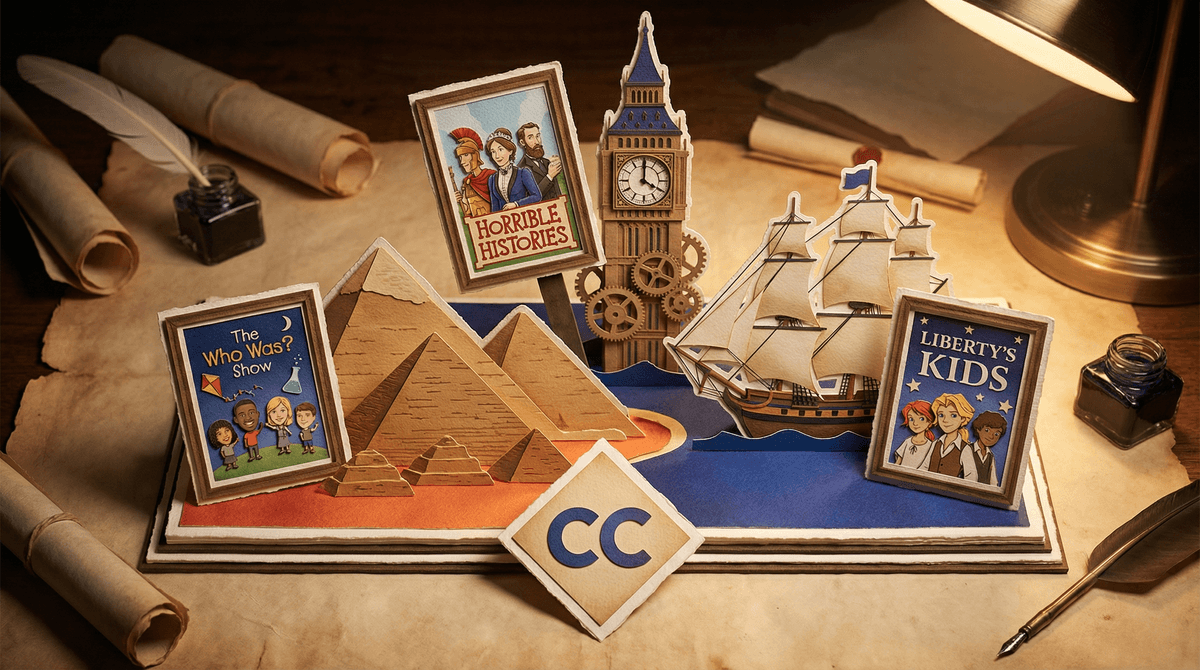
Liberty's Kids is the gold standard here. Yes, it's animated. Yes, it's from 2002. But it's genuinely well-researched, presents multiple perspectives, and doesn't shy away from complexity while remaining age-appropriate. Your kid will actually learn about the American Revolution, not just "America good, Britain bad."
Carmen Sandiego (2019) on Netflix sneaks in geography and cultural history through a heist show format. It's not deep historical analysis, but it's a great gateway drug to getting kids interested in different places and time periods.
For Middle School (Ages 10-14):
Horrible Histories is brilliant—genuinely funny sketch comedy that teaches real history. British, but covers world history. The humor helps kids remember the content way better than any textbook. Fair warning: it doesn't sanitize history, which is actually a feature, not a bug. Wars were gross. Medieval medicine was horrifying. Kids can handle it.
The Who Was? Show on Netflix (based on the book series) uses sketch comedy to bring historical figures to life. It's goofy, but the facts are solid.
For Teens (Ages 14+):
Crash Course World History on YouTube is fast-paced, engaging, and actually comprehensive. John Green talks quickly, but the content is college-level quality made accessible. Great for high schoolers or advanced middle schoolers.
Ken Burns documentaries are the real deal—particularly The Civil War, Baseball, and The Vietnam War. These are long (we're talking hours), but they're genuinely excellent. Watch them together in chunks. The Vietnam War doc in particular is heavy and should be for older teens only.
The History Channel's "ancient aliens" era content - Just no. This stuff presents fringe theories as legitimate historical debate. Your kid does not need to think aliens built the pyramids.
Overly dramatized historical dramas without context - Shows like Vikings or The Tudors can be entertaining, but they take massive liberties with historical accuracy. If your teen wants to watch these, fine, but make it clear this is "inspired by" not "based on" history.
Anything that glosses over or romanticizes problematic historical figures - Some older content presents colonizers, slaveholders, or war criminals as uncomplicated heroes. That's not teaching history; that's teaching propaganda.
Co-watch when possible, especially with younger kids. Pause and discuss. Ask questions like "Why do you think they made that choice?" or "How would you have felt in that situation?"
Follow up with primary sources - After watching something about ancient Egypt, look up actual hieroglyphics together. After a WWII documentary, read a letter from a soldier. The Library of Congress has amazing free resources.
Check the facts - If something seems too dramatic or simplified, look it up together. This teaches media literacy alongside history.
Connect to current events - History isn't dead stuff that happened to dead people. Draw lines between what they're watching and what's happening now.
Elementary kids need clear heroes and villains, but don't need graphic violence or complex moral ambiguity. Focus on adventure, discovery, and "how did people live back then?" content.
Middle schoolers can handle more complexity—understanding that historical figures were flawed humans, learning about injustice and resistance, seeing multiple perspectives on the same events.
High schoolers can and should engage with difficult history—genocide, systemic oppression, war crimes. But even teens benefit from processing heavy content with adult support.
Good history TV for families exists, but you have to be intentional about finding it. The best content treats kids like intelligent humans capable of understanding complexity, doesn't sanitize the past, and makes historical figures feel like real people rather than marble statues.
Start with Liberty's Kids for younger kids, Horrible Histories for middle schoolers, and Crash Course for teens. Build from there based on your kids' interests.
And remember: watching history content together and talking about it is worth way more than passively consuming even the best documentary alone. History isn't just facts and dates—it's understanding how we got here and where we might be going.
- Audit your current streaming services - Search for "documentary" and "history" and see what's available. PBS and BBC content is usually solid.
- Ask your kids what time periods or topics interest them - A kid obsessed with dinosaurs might love paleontology documentaries. A kid into fashion might love a documentary about the history of clothing.
- Set up a weekly "history night" - Make it special. Pop popcorn, watch 30-45 minutes of something historical, talk about it.
- Check out alternatives to mindless YouTube content for more educational viewing options.
History is just stories about real people. Find the storytellers who make those stories come alive, and your kids will actually want to learn.