

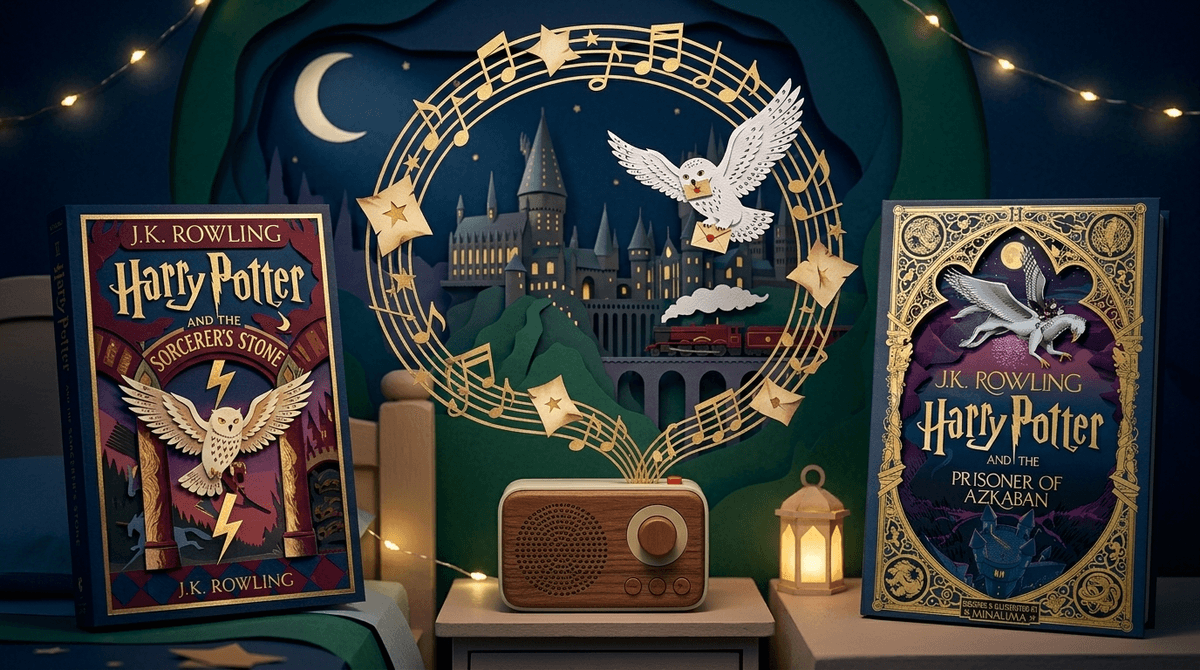
TL;DR: Harry Potter audiobooks are the gold standard for transitioning kids from "brain rot" YouTube loops to deep-work listening. Whether you choose the classic Jim Dale versions or the massive 2025 full-cast Audible production, you’re getting a screen-free win that builds vocabulary and makes 10-hour road trips actually bearable.
Quick Links for the Magic:
- The Classic (US): Harry Potter and the Sorcerer's Stone read by Jim Dale
- The New Standard: Harry Potter 2025 Full-Cast Series (Audible)
- The Free Route: Libby App (Connect your library card!)
- The Screen-Free Device: Yoto Player
If your kid’s current vocabulary is 40% "Skibidi," 30% "Ohio," and 30% "Rizz," it’s time to stage an intervention—but not the kind that involves a lecture. We all know the struggle: you want them off Roblox or YouTube, but you also need twenty minutes to cook dinner without someone starting a literal fire.
Audiobooks are the "middle way." They provide the high-stimulation storytelling kids crave without the dopamine-shredding blue light of a screen. Harry Potter specifically is the "gateway drug" to literacy because the world-building is so immersive that kids forget they aren't actually looking at a screen.
Research shows that listening to a story uses the same cognitive processing as reading one. For kids with dyslexia or ADHD, audiobooks aren't "cheating"—they’re an accessibility tool that allows them to enjoy the same cultural touchstones as their peers without the frustration of decoding text.
If you’re diving into the Potter-verse, you have to pick a side. It’s like the iPhone vs. Android of the wizarding world.
Jim Dale is a legend. He created over 130 distinct voices for the series. His voice for Hermione is a bit polarizing (she can sound a little whiny in the early books), but his pacing and the way he handles the whimsical elements of The Sorcerer's Stone is unmatched. He won two Grammys for these recordings for a reason.
Many parents swear by Stephen Fry. His narration is "cozier." It feels like a very smart uncle reading you a bedtime story. It’s less "performative" than Dale’s, which some kids find easier to fall asleep to. The catch? If you’re in the US, these are harder to get legally without some VPN wizardry or a UK-based Audible account.
Coming in late 2025, Audible and Pottermore Publishing are releasing "mega-productions" of all seven books. We’re talking over 100 actors, immersive sound design (think real wind howling and wands clinking), and a cinematic score.
- The Pro: It’s basically a movie for your ears. It will likely hold the attention of kids who find a single narrator "boring."
- The Con: It leaves less to the imagination. Part of the magic of audiobooks is that the kid "builds" the world in their head. A full-cast production does some of that work for them.
The biggest mistake parents make is starting the series too early or assuming that because Book 1 is "for kids," Book 7 is too. The series "grows up" with the reader.
Ages 6-8: The Sorcerer's Stone and The Chamber of Secrets
These are whimsical, British, and relatively safe. There’s "peril," but it’s mostly of the "giant chess set" variety. These are perfect for bedtime.
Ages 9-11: The Prisoner of Azkaban and The Goblet of Fire
This is where things get "dark." We introduce Dementors (literal soul-sucking metaphors for depression) and, by the end of Book 4, a character actually dies. If your kid is sensitive, you might want to co-listen to the end of Goblet of Fire.
Ages 12+: The Order of the Phoenix through The Deathly Hallows
These are long (Order of the Phoenix is 26 hours!). They deal with angst, government corruption, and heavy loss. They are fantastic, but they aren't "little kid" books anymore.
Check out our guide on the scariest moments in Harry Potter for kids
If you give a kid a smartphone to listen to an audiobook, they will be on TikTok within 45 seconds. The goal is to separate the content from the "distraction machine."
- The Yoto Player: This is the gold standard for kids under 10. You buy physical cards, they pop them in, and the book plays. No screen, no camera, no microphone. They sell the Harry Potter collection as a set.
- The Toniebox: Similar to Yoto, but uses little figurines. Great for younger siblings, but the HP "Tonies" are currently limited and the format is a bit clunky for 20-hour books.
- Old School MP3 Players: Remember those? You can find "dumb" MP3 players on Amazon for $30. Load the files from Audible or Libby and give them a pair of wired headphones.
- Smart Speakers: "Alexa, play Harry Potter Book 1." It’s easy, but be careful—smart speakers are also a gateway to "Alexa, play Skibidi Toilet song" at 3:00 AM.
We can’t talk about Harry Potter without acknowledging that J.K. Rowling has become a controversial figure regarding her views on gender identity.
For some families, this is a dealbreaker and they choose to borrow the books from the library (via Libby) so no new royalties go to the author. For others, they separate the art from the artist. Regardless of where you stand, your kids will likely hear about this as they get older. Use it as a conversation starter about how we can love a story while disagreeing with the person who wrote it.
Once your kid finishes the 100+ hours of Potter, they will have an "audiobook hangover." Here is the recovery plan:
- For the 8-12 set: Percy Jackson & The Olympians read by Jesse Bernstein. It’s fast-paced, funny, and great for kids with ADHD.
- For the "I want something epic" kid: The Hobbit read by Andy Serkis. Serkis (who played Gollum in the movies) does an incredible job.
- For the "I like animals" kid: The Wild Robot by Peter Brown. It’s shorter, beautiful, and very "now."
- For the mystery lover: The Westing Game. It’s a classic "who-dunnit" that keeps them guessing.
Harry Potter audiobooks aren't just entertainment; they are a lifestyle hack. They turn the "witching hour" (that 5:00 PM to 6:00 PM chaos) into a quiet, imaginative time. They turn the "are we there yet?" of a road trip into "wait, don't turn it off, we're at the good part!"
Stop worrying about the "brain rot" for a second and just hit play. Even if you’ve seen the movies a dozen times, hearing the books narrated—especially by someone like Jim Dale—adds a layer of depth that the films just couldn't capture.
Next Steps:
- Check your local library’s Libby or Hoopla app to see if you can snag the audiobooks for free.
- If the waitlist is 6 months long (it often is), grab a credit on Audible.
- Invest in a decent pair of kids' headphones and reclaim your silence.
Get audiobook recommendations based on your kid's favorite games