

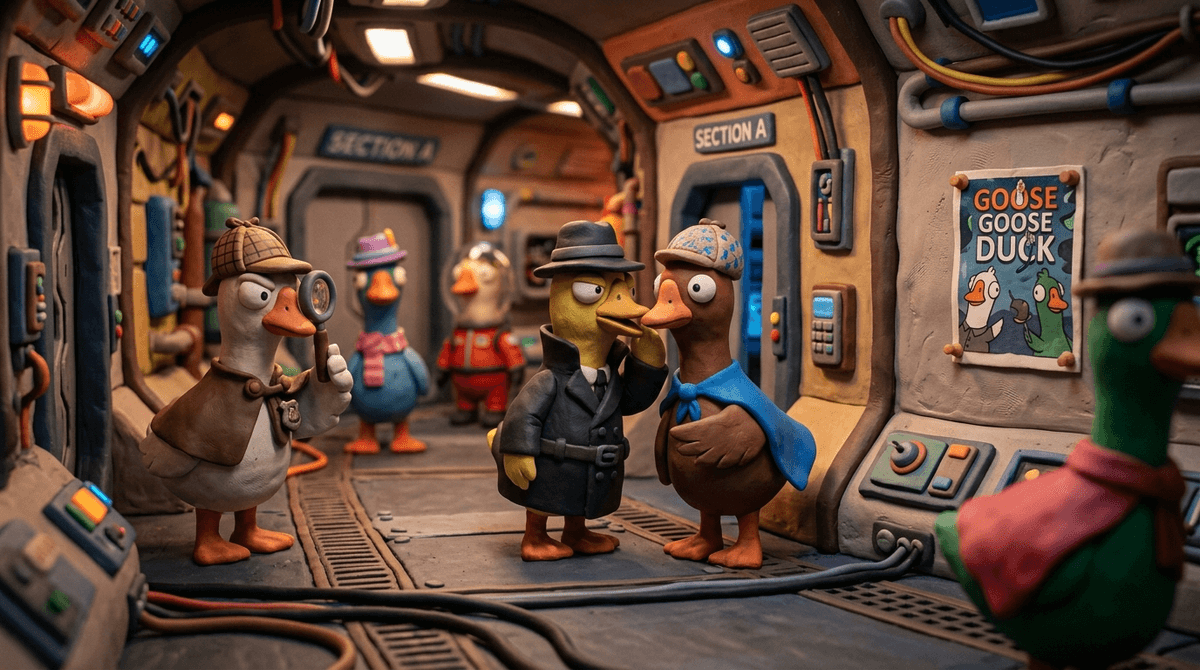
TL;DR
Goose Goose Duck is essentially the "pro" version of Among Us. It’s a social deduction game where players complete tasks while trying to figure out who the "impostors" (ducks) are before they kill everyone. It’s wildly popular because it adds dozens of complex roles and proximity voice chat, making it much more social—and potentially much more toxic—than its predecessors.
Quick Links:
If you lived through the 2020 era of Among Us obsession, you already know the basic rhythm. A group of players (Geese) runs around a map fixing things. One or more players (Ducks) are secretly trying to murder them. When a body is found, everyone jumps into a meeting to argue about who did it.
Goose Goose Duck takes that foundation and cranks the complexity up to eleven. Developed by Gaggle Studios, it’s a free-to-play title available on PC, iOS, and Android. While it looks like a goofy cartoon about birds, the gameplay is surprisingly deep. There are over 50 different roles, ranging from the "Dodo" (who wins if they get themselves voted out) to the "Pelican" (who can swallow other players whole).
It’s currently a staple on Twitch and YouTube, which is usually where kids first see it. If your child is asking for it, they’ve likely graduated from the simplicity of Among Us and are looking for something with more "strategy"—or they just want to use the proximity chat feature.
The draw here isn't just the "sus" memes. It’s the chaos. In Among Us, you’re either a crewmate or an impostor. In Goose Goose Duck, you might be a "Canadian Goose" who automatically alerts everyone when you’re killed, or a "Snoop" who can hide in corners.
This variety creates a high "replayability" factor. Every round feels different. Plus, the game leans heavily into a specific brand of humor—think Skibidi Toilet levels of absurdity mixed with some slightly dark "bird-on-bird" violence. It’s colorful, it’s fast-paced, and it’s free.
Learn more about why social deduction games are so addictive for kids
This is the biggest differentiator and the primary safety concern. Goose Goose Duck features built-in proximity voice chat. This means that as your character walks closer to another player in the game, you can hear their actual voice through your headset.
While this leads to hilarious gameplay moments (like hearing a faint scream as someone gets "eaten"), it opens a direct door to strangers. Unlike Roblox, where chat is heavily filtered (and often turns into hashtags), live voice chat is impossible to filter in real-time.
In public lobbies, players can—and do—say anything. This includes:
- Harassment and Bullying: Social deduction games are literally built on lying and accusing people. That can turn toxic very quickly.
- Inappropriate Language: It’s a "teen" rated game, but the user base skews older than Roblox.
- Predatory Behavior: Any platform with unfiltered voice chat requires a high level of digital maturity.
Check out our guide on proximity chat risks and how to talk to your kids about them
If you’re going to let your kid play, you need to be aware of the "Gaggle" account system. Players have to create an account to play, and while there are reporting tools, they are reactive, not proactive.
Public vs. Private Lobbies
The "gold standard" for safety in Goose Goose Duck is playing in Private Lobbies. If your child has a group of friends from school or a monitored Discord server, they can play together without any outside interference.
Public lobbies are the "Wild West." I generally don't recommend public lobbies for anyone under 13, as the proximity chat is the core of the experience, and you simply cannot control what a 19-year-old in another state is going to scream into their microphone.
Privacy Settings
The game does allow you to disable voice chat entirely or use "Push to Talk." If your child is younger (ages 10-12), disabling voice chat and sticking to the text-based "Smart Chat" (which uses pre-set phrases) is a much safer bet.
Get a step-by-step guide to Goose Goose Duck privacy settings
Like Fortnite or Roblox, Goose Goose Duck is "freemium." The game is free, but the "drip" is not.
Players can buy "Gold Coins" to purchase:
- Cosmetics: Hats, outfits, and pets (pets follow you around and can be "eaten" too, which is a bit grim).
- Materials: Used for crafting even more specific cosmetics.
- Tokens: Used for the "Claw Machine" in the lounge (basically a loot box mechanic).
The good news? None of this is "pay-to-win." You don't get better at being a Duck because you bought a fancy hat. However, the social pressure to look "cool" in the lobby is real. If your credit card is linked to their Steam or Apple ID, keep a close eye on it.
Read our guide on managing in-app purchases and "skin" culture
Every kid is different, but here is a general breakdown of how the Screenwise community views Goose Goose Duck:
Ages 7-9: Not Recommended
The game is too complex, and the "social deduction" (lying/manipulation) can be stressful. The cartoon violence—while stylized—includes things like decapitation and being eaten, which might be a bit much. Plus, the voice chat risk is far too high. Stick to Minecraft or Toca Life World.
Ages 10-12: Proceed with Caution
This is the age where kids start wanting to play what the "big kids" are playing. If they play, it should be in Private Lobbies only with friends they know in real life. Keep the computer in a common area so you can hear what’s happening. This is a great time to talk about "digital etiquette"—even if the game is about lying, you don't have to be a jerk.
Ages 13+: Generally Okay
At this age, most kids can handle the mechanics and the "lying" aspect of the game. However, the proximity chat in public lobbies still requires a conversation about blocking, reporting, and not sharing personal information.
One thing that catches parents off guard is the nature of the game's "roles." Some roles, like the Dodo Bird, actually encourage the player to act as "weird" or "annoying" as possible so people will vote them off.
If you walk by and hear your kid being intentionally disruptive or "trolling," they might actually just be playing their role effectively. This is a unique quirk of Goose Goose Duck. It rewards behavior that we usually try to discourage in digital spaces. It’s worth asking them, "What role are you playing right now?" before you stage an intervention.
Goose Goose Duck is a clever, high-energy evolution of the social deduction genre. It’s not "brain rot" in the sense that it requires genuine logic, memory, and social engineering to win.
However, the proximity chat feature makes it a "high-supervision" game. If your kid is playing with strangers, they are going to hear things you probably don't want them to hear.
Next Steps:
- Check the platform: If they're on PC, set up Steam Parental Controls.
- Set the "Private Lobby" rule: Encourage them to play with friends from school rather than joining random rooms.
- Play a round: Seriously. It’s actually pretty fun. If you want to understand why they’re obsessed, jump in a game with them. Just be prepared for them to "sus" you immediately.
Learn more about how to have the 'Digital Trust' conversation with your teen