

Getting Toddlers Back on Books: Reclaiming Story Time in the Screen Age
Let's be honest: you used to have a kid who would sit through Goodnight Moon three times in a row. Now they're doing the iPad wiggle-dance the second they wake up, and storytime feels like negotiating with a tiny hostage-taker who only accepts YouTube Kids as currency.
You're not imagining it, and you're definitely not alone. Toddlers are really good at getting hooked on screens because their developing brains are literally wired to love the fast cuts, bright colors, and instant gratification that apps and videos deliver. Books? Books just sit there. They don't sing. They don't have autoplay. They require a grown-up to do all the work.
The thing is, you didn't fail as a parent because your toddler prefers Cocomelon to The Very Hungry Caterpillar. Screens are designed by teams of engineers to be irresistible. Books are designed by authors who assume you'll do the heavy lifting. It's not a fair fight.
But here's the good news: toddler brains are incredibly plastic, and habits at this age are still forming, not cemented. You absolutely can rebuild the reading relationship. It just takes some strategy.
Before we get into the how, let's talk about why this is worth the effort—because you need ammunition when your kid is throwing a tantrum because you dared to suggest a book instead of Blippi.
Reading with toddlers does things screens simply can't:
- Builds attention span and focus - Books require sustained attention. Screens train kids to expect constant stimulation and rapid scene changes.
- Develops language in a different way - The vocabulary in children's books is typically richer and more varied than in kids' videos. Plus, when you read together, you're having a conversation, asking questions, pointing things out.
- Creates genuine connection - Snuggling with a book is bonding time. Handing over a tablet is... not that.
- Teaches delayed gratification - Books have a beginning, middle, and end. You can't skip ahead (well, you can, but it doesn't work the same way). This is actually a crucial life skill.
None of this means screens are evil or that you're ruining your kid. But the research is pretty clear: excessive screen time for toddlers is linked to language delays, attention issues, and sleep problems. Balance matters.
Start with a Cold-Turkey Reset (If You Can Handle It)
The fastest way to get books back in the picture? Take screens completely off the table for 3-5 days. I know, I know—this sounds impossible. But here's the thing: toddlers are experiencing a dopamine withdrawal when they're used to screens and suddenly they're not getting them. It's real, it's uncomfortable, and it passes surprisingly quickly.
The reset looks like this:
- Announce (calmly, matter-of-factly) that tablets/phones/TV are "taking a rest"
- Remove them from sight entirely—out of sight really is out of mind at this age
- Prepare for 48 hours of chaos. Seriously, block off your calendar.
- Have a arsenal of books, but also other engaging activities (play dough, water play, going outside)
- By day 3-4, you'll notice your toddler actually looking at books again
Can't do cold turkey? That's fine. The gradual approach works too, it just takes longer.
Make Books the Most Interesting Thing in the Room
You're competing with algorithms here, so you need to make books exciting:
- Novelty is your friend - Library trips every week mean fresh books constantly. New is exciting.
- Let them choose - Even if they pick the same book 47 times, that's their choice and it matters
- Interactive books are not cheating - Lift-the-flap books, touch-and-feel books, books with buttons (yes, even the annoying ones)—these are gateway drugs back to regular books
- Make it cozy - Create a reading nook with pillows, a special blanket, maybe a little book light. Make it feel like a treat.
Some books that are basically toddler crack (in a good way):
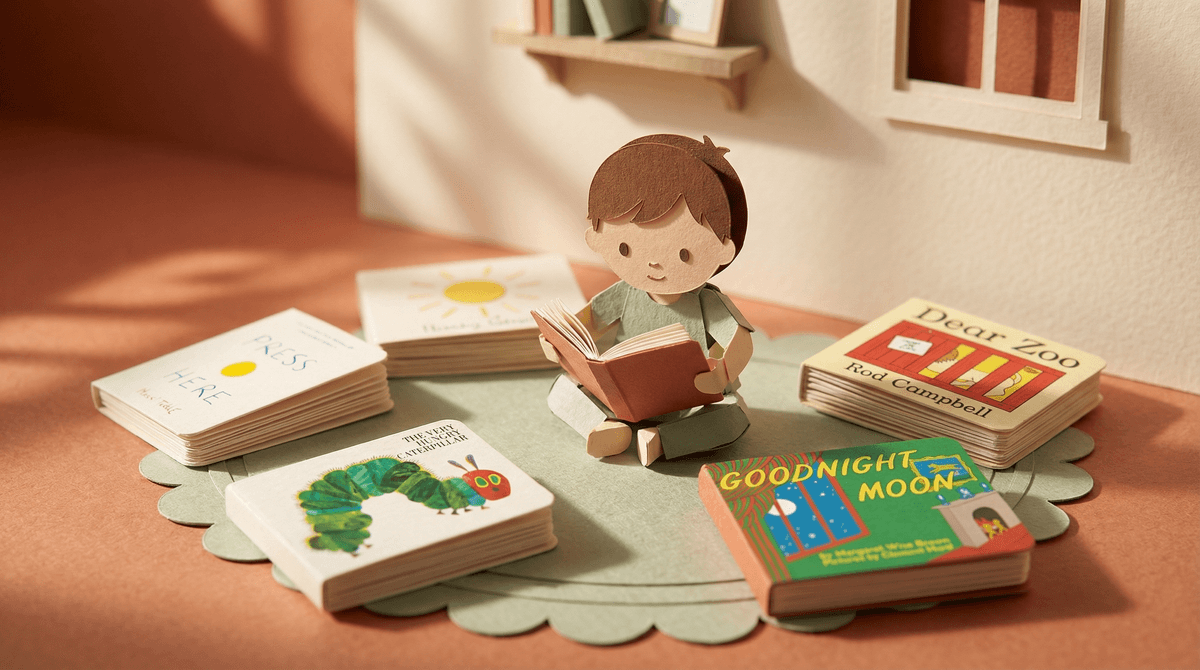
- Press Here by Hervé Tullet - Interactive without being a screen
- Dear Zoo - Lift-the-flap classic that never fails
- The Wonky Donkey - Silly, musical, fun to read aloud
- Anything by Sandra Boynton - Short, funny, rhythmic
Replace Screen Time with Story Time (Strategically)
Figure out when your toddler typically gets screen time, and put books in that exact slot.
- Morning wake-up? Books in bed before getting up.
- Afternoon meltdown hour? Books on the couch with a snack.
- Waiting at restaurants? Books in your bag (not the iPad).
- Bedtime? This one's non-negotiable—make it a sacred book zone.
The key is consistency. Toddlers are creatures of habit. If books become the new routine, they'll adapt faster than you think.
Read the Same Book 500 Times (And Be Okay With It)
Toddlers love repetition because that's how they learn. When your kid wants Goodnight, Goodnight Construction Site for the 87th time this week, they're not trying to bore you to death—they're doing exactly what their brain needs.
Pro moves for repeat reading:
- Change your voice for different characters
- Ask them to point to things ("Where's the blue truck?")
- Let them "read" it to you (even if they're just recalling from memory)
- Celebrate when they know what comes next
Manage Your Own Phone Use
This is the hard one. If you're scrolling while telling your toddler to look at books, they notice. They're not dumb.
Try this: When it's reading time, put your phone in another room. Not face-down on the couch. Another room. Model the behavior you want to see.
Some kids are going to push back harder than others. If your toddler is really dug in on screens, here are some troubleshooting moves:
Try audiobooks as a bridge - Libby has tons of free kids' audiobooks through your library. It's still a screen to access it, but the content is story-based and requires imagination. You can also try old-school CDs in the car.
Don't force it - If reading becomes a battle, everyone loses. Leave books around, read them yourself where they can see you, but don't make it a power struggle.
Acknowledge the feelings - "I know you really want the iPad. We're going to read books right now, and then we can play outside." Name it, validate it, hold the boundary.
Get other caregivers on board - If grandma's still handing over the phone every time she babysits, your efforts at home are getting undermined. Have the conversation.
Getting toddlers back to books after they've discovered screens is absolutely possible, but it requires intentionality. You're not going to accidentally stumble into a kid who loves reading—you have to create the conditions for it.
Start small. Pick one screen-time slot and replace it with books for a week. See what happens. Build from there.
And remember: you don't have to be perfect. Some screen time is fine. The goal isn't zero screens forever—it's balance, and making sure books have a real place in your kid's life.
Your toddler's brain is still forming. The habits you build now—the cozy bedtime stories, the library trips, the "just one more chapter"—those become the foundation for everything else. It's worth the effort, even when it's hard.
- This week: Do a toy/book rotation. Put half the toys away, bring out books you haven't read in a while. Novelty works.
- This month: Commit to one screen-free day per week. Make it a "book day" and see what happens.
- Ongoing: Set up a library card and make it a weekly ritual. Kids love the independence of choosing their own books.
You've got this. And hey, if you need to put on Bluey so you can make dinner? That's fine too. Balance, not perfection.