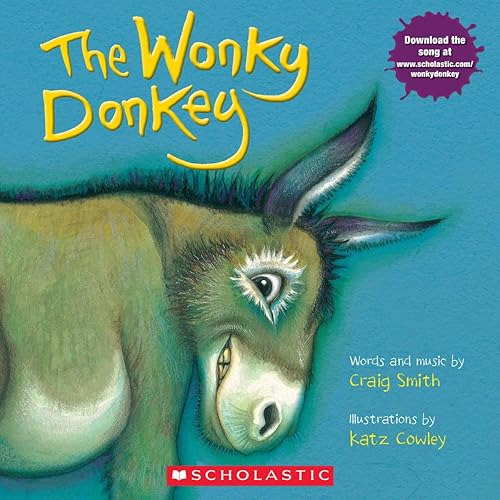
The Wonky Donkey

The Wonky Donkey

book

2010, Children's Books, Animals

WISE
68%

WISE Score

4.8

Amazon

Viral cumulative rhyme that's undeniably fun but maybe teaches kids to laugh at differences—you decide if that's harmless silly or low-key unkind.

Amazon4.8
Common Sense Media

Where to Read

Our reviews and ratings are 100% unbiased, but as an Amazon Associate, Screenwise earns an affiliate fee if you buy a book or game by clicking one of our links. We don't get any credit if you just Google it instead :)

Screenwise Verdict

Look, kids love this book. It went viral for a reason—the wordplay is genuinely fun, the rhythm is infectious, and toddlers through early elementary will giggle their heads off. It's also legitimately good for literacy: rhyme, alliteration, memory, sequencing.

But here's the thing: the entire premise is pointing out everything 'wrong' with the donkey and making it funny. Wonky leg, stinky, lanky, cranky—on and on. Some parents and disability advocates have flagged this as problematic, arguing it models unkind behavior and teaches kids that differences are punchlines. Is it intentionally mean? No. Is it harmless fun? Maybe. Does it depend on your kid and your family's sensitivity to this stuff? Absolutely.

If you're looking for a book with substance, depth, or a meaningful story, this isn't it. It's linguistic cotton candy—delicious in the moment, zero nutritional value beyond the literacy mechanics. But if you want 3 minutes of guaranteed giggles and some solid phonics work, it delivers. Just maybe have a sidebar chat about kindness if your kid starts calling their sibling 'stinky-dinky.'
Age Fit

Best for ages 2-7, when kids are learning rhyme and repetition and find pure silliness hilarious. Older kids will roll their eyes, and some thoughtful parents of any age might skip it due to the 'laughing at differences' dynamic.

WISE Breakdown
Wholesome
65

Fun, silly read-aloud with repetition and rhyme that kids genuinely enjoy. However, web search reveals legitimate concerns about bullying dynamics—the book catalogs the donkey's 'flaws' (wonky leg, stinky, etc.) in a way that some disability advocates and parents find problematic. The humor relies on pointing out differences, which can model unkind behavior even if unintentionally. Still gets credit for being joyful and engaging without malice.

Imaginative
72

Clever cumulative wordplay that builds to 'spunky hanky-panky cranky stinky-dinky lanky honky-tonky winky wonky donkey'—kids love the linguistic gymnastics. The alliteration and rhyme scheme invite participation and memory work. Illustrations are playful. Not groundbreaking conceptually, but the word-stacking mechanic is creative and gets kids thinking about how language builds.

Safe
88

Books are generally safe, and this has no mature content, violence, or scary elements. The bullying concern is real but subtle—it's not overtly mean-spirited, just potentially modeling 'pointing out differences as funny' behavior. Most kids will experience it as pure silly fun. Deducting modest points for the disability-sensitivity issue flagged by advocates.

Enriching
58

Strong on phonemic awareness, rhyme, and language play—genuinely helps early literacy. The cumulative structure teaches memory and sequencing. But beyond linguistic mechanics, there's not much here: no meaningful story arc, character growth, or lesson beyond 'silly words are fun.' It's entertaining brain candy that happens to build reading skills, not a book with deeper takeaways.

Parent Info

Why It Might Be Great

  • Kids genuinely crack up at the escalating wordplay—it's a legitimate crowd-pleaser at storytime
  • Excellent for phonemic awareness, alliteration, rhyme, and memory work in early readers
  • The cumulative structure ('and he was...') is satisfying and invites kids to participate
  • High energy, silly illustrations, and the rhythm makes it fun to read aloud (viral grandma video proves it)
  • Short and punchy—won't lose attention spans

What to Watch For

  • The entire joke is cataloging the donkey's 'flaws'—wonky leg, stinky, etc. Some disability advocates argue this models pointing out differences as funny, which could encourage unkind behavior
  • Zero story arc or meaningful content beyond wordplay—it's pure linguistic entertainment
  • If your kid is sensitive about being 'different' or has been teased, this might land wrong

Conversation Starters

  • "Why do you think the book keeps adding more words to describe the donkey? Is it being mean or just silly?"
  • "How do you think the donkey feels about all these names? Would you want someone making up rhymes about you?"
  • "Can you make up your own silly cumulative rhyme about an animal? What words rhyme with 'cat' or 'frog'?"

Ask Anything

Get a personalized guide on any topic