

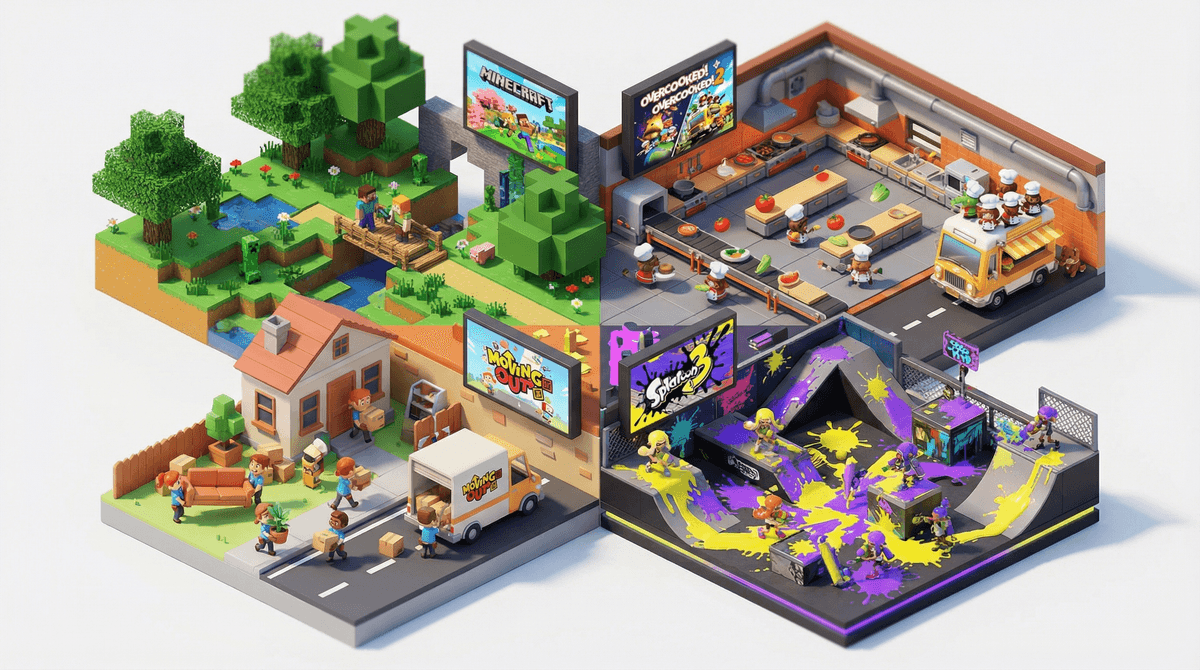
Look, we need to talk about something that might sound counterintuitive: your kid yelling "I'M COMING TO REVIVE YOU!" into a headset at 7pm on a Tuesday might actually be... learning something valuable?
Teamwork games are multiplayer experiences where players literally cannot succeed alone. We're talking about games where communication, coordination, and collaboration aren't just nice-to-haves—they're the entire point. Think Overcooked, where you're frantically chopping vegetables and screaming about onions. Or Minecraft when kids actually work together to build something instead of just griefing each other's houses. Or even Fortnite when played in squad mode with actual strategy instead of just "everyone drop Tilted Towers and die immediately."
The key difference between teamwork games and just "multiplayer games"? Interdependence. In competitive games, your kid is trying to destroy their friends. In teamwork games, they need each other to succeed. And yes, there's a meaningful difference in what they're practicing.
Here's the thing that surprised me when I started paying attention: the skills kids practice in good teamwork games map almost perfectly onto what we want them to learn for, you know, actual life.
Communication under pressure: When your kid is calling out "two enemies on the bridge" in a game, they're practicing clear, concise communication in real-time. That's not nothing.
Role specialization: Many teamwork games require different players to take on different roles. Someone's the healer, someone's the tank, someone's doing crowd control. Kids learn that teams work better when people play to their strengths rather than everyone trying to be the hero.
Failure as feedback: In good co-op games, when the team loses, it's a puzzle to solve together, not a blame game. "Okay what went wrong, how do we adjust?" That's literally the foundation of a growth mindset.
Emotional regulation: Nothing tests a kid's ability to stay calm quite like their teammate making a mistake that costs the whole group. Learning to say "it's okay, we'll get it next time" instead of raging? That's executive function development in action.
The research backs this up too. Studies on cooperative gameplay show improvements in prosocial behavior, communication skills, and even conflict resolution. Not magic, but not nothing either.
Ages 6-8: Couch Co-op Champions
At this age, same-room cooperation works best. Kids are still developing the communication skills for online teamwork, and honestly, you want to be able to supervise.
- Overcooked 2: Chaotic kitchen cooperation. Short rounds, clear goals, lots of laughing and mild arguing.
- Minecraft (Creative/Peaceful mode): Building together without the pressure of monsters. Set a shared goal: "Let's build a zoo together."
- Moving Out: Like Overcooked but you're moving furniture. Surprisingly good for teaching spatial reasoning and coordination.
- Lego games (any of them): Two-player, low-stakes, impossible to actually fail. Great training wheels.
Ages 9-12: Strategic Cooperation
Now they can handle more complexity, longer-term planning, and maybe some online play with friends (with supervision).
- Among Us: Yes, really. When played with actual friends (not randos), it teaches reading social cues, building arguments, and working together to solve problems. Just... monitor the chat.
- Minecraft (Survival mode): Now with actual stakes. Building bases, gathering resources, defending against mobs—all better with teammates.
- Rocket League: Soccer with cars. Requires actual positioning, passing, and team strategy. Quick matches are great for this age's attention span.
- Splatoon 3: Team-based but non-violent (you're shooting ink, not bullets). Requires coordination and role awareness.
Ages 13+: Complex Coordination
Teens can handle games with more complex systems, longer time commitments, and more sophisticated social dynamics.
- Deep Rock Galactic: Four-player co-op where you're space dwarves mining minerals. Different classes, clear roles, genuinely requires teamwork. Also has a great community culture.
- Phasmophobia: Ghost hunting game that requires actual communication and strategy. Scary but not gory. Great for friend groups.
- Fortnite (with strategy): Yes, I'm listing it again. When teens actually use voice chat and coordinate, it's a different game. "You build, I'll shoot" is basic teamwork.
- Valorant: More intense, requires real strategy and communication. Definitely check the maturity level first, but for teens ready for tactical shooters, it's teamwork-heavy.
Not all "multiplayer" games actually teach teamwork. Here's how to tell the difference:
Good signs:
- Players are talking about strategy, not just trash talk
- Roles are differentiated (not everyone doing the same thing)
- Failure leads to "what should we try differently" conversations
- Players are helping each other learn and improve
- There's genuine celebration when the team succeeds
Red flags:
- One player can carry the whole team (not really cooperation)
- Blame culture when things go wrong
- Toxic chat or voice communication
- "Clutch or kick" mentality (kicking players who aren't good enough)
- Your kid is stressed and miserable instead of challenged and engaged
Here's the secret: the game itself doesn't teach teamwork. The reflection does.
Try this: After a gaming session, ask:
- "What role were you playing on the team?"
- "What happened when you tried to do everything yourself?"
- "How did you decide who would do what?"
- "What did you do when someone made a mistake?"
You're not interrogating them. You're helping them notice what they're learning. Most kids have never thought about the fact that they're practicing real skills.
Also: playing with them occasionally is incredibly valuable. You'll see exactly how they communicate, handle frustration, and work with others. Plus, it's genuinely fun. Yes, you'll be terrible. That's kind of the point—they get to teach you something.
Are teamwork games going to teach your kid everything they need to know about collaboration? Of course not. But they're not rotting their brain either.
When chosen intentionally and played with actual friends (not toxic randos on the internet), cooperative games create low-stakes environments to practice high-value skills. Communication, role awareness, handling failure, coordinating under pressure—these are real things.
The key is curation and conversation. Not every multiplayer game promotes actual teamwork. Not every gaming session leads to learning. But when you're intentional about which games, with whom, and you occasionally talk about what they're experiencing? Yeah, that headset yelling might actually be building something useful.
Start here:
- Ask your kid what games they play with friends and whether they're working together or competing
- Try one co-op game together this week—even 20 minutes of Overcooked will show you the dynamic
- Check out our guide to setting up healthy multiplayer gaming
Want to go deeper?
Not every game session needs to be educational. Sometimes kids just want to blow off steam. But when you're looking for games that might actually build skills? Teamwork games are worth a look.