

Look, Angry Birds had its moment. And honestly? It was a pretty good moment. Simple physics-based gameplay, satisfying destruction, quick rounds you could play while waiting for soccer practice to end. The problem is that the Angry Birds franchise has become... a lot. In-app purchases everywhere, constant notifications, ads between every level, and enough spinoffs to make your head spin.
But the core appeal—launch something, watch physics do its thing, solve a puzzle—that's still solid. So if your kid loved the original concept but you're tired of the monetization circus, or you're just looking for similar games that respect your time and wallet, you're in the right place.
These are casual physics-based puzzle games that capture that same pick-up-and-play magic without turning into a second job or a money pit.
Physics-based puzzle games hit a sweet spot:
They're genuinely satisfying. There's something deeply pleasing about watching a carefully aimed shot create a chain reaction of destruction. It's like dominoes, but with more explosions.
They're easy to learn, hard to master. A five-year-old can launch a bird. A ten-year-old can three-star every level. That range is rare.
They have natural stopping points. Unlike open-world games or social apps, these games are built around short levels. You can actually say "one more level" and mean it. (Okay, maybe three more.)
They teach problem-solving. Figuring out the right angle, the right order, which structure to target first—that's legitimate spatial reasoning and planning.
They don't require constant attention. No daily quests, no fear of missing out, no friends waiting for you online. Play when you want, stop when you want.
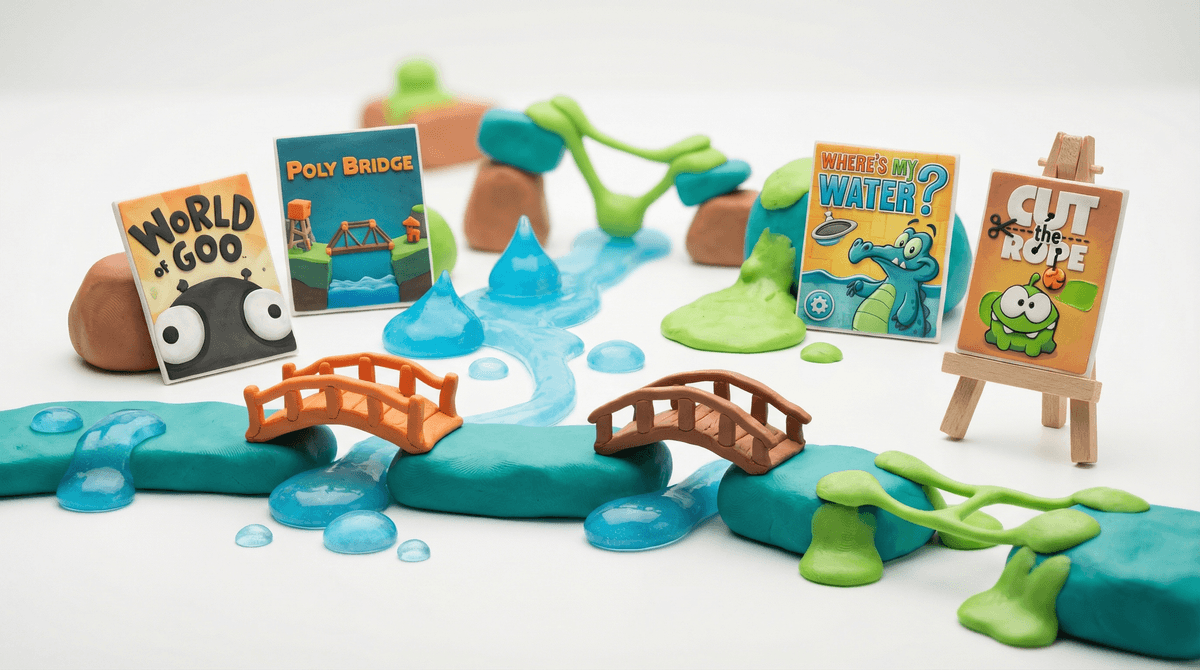
Cut the Rope (Ages 4+)
Instead of launching birds, you're cutting ropes to drop candy into a little green monster's mouth. It's adorable, the physics are spot-on, and the puzzle design is genuinely clever. The original game is still the best, though there are sequels if your kid burns through all the levels.
The catch: There are ads in the free version, but they're not aggressive. The paid version is usually a few bucks and removes them entirely.
Where's My Water? (Ages 6+)
You're digging through dirt to guide water to an alligator's shower. (Yes, really.) The physics feel different—more fluid dynamics than projectile motion—but the puzzle-solving scratches the same itch. Disney made this one, so the production value is high and it's genuinely charming.
The catch: Disney's support has been inconsistent over the years, so check if it's still available on your device before getting your kid excited about it.
Bad Piggies (Ages 7+)
This is actually from the Angry Birds creators, but it's a completely different game. Instead of destroying things, you're building contraptions to get a pig from point A to point B. It's more creative, more engineering-focused, and way less about in-app purchases than modern Angry Birds.
Why it works: Kids who loved Angry Birds for the physics will love this for the building. It's like a gateway to games like Kerbal Space Program (for older kids) or even real engineering concepts.
Fruit Ninja (Ages 5+)
Okay, this isn't physics-based puzzles—it's more reflex and timing. But it has that same casual, satisfying, "just one more round" energy. You're swiping to slice fruit. That's it. That's the game.
The catch: The newer versions have gotten more complicated with power-ups and currencies. Try to find the classic mode if possible.
World of Goo (Ages 8+)
This is for kids ready for something a bit more complex. You're building structures out of goo balls to reach a pipe. The physics are more sophisticated, the puzzles get genuinely challenging, and the art style is weird and wonderful.
Why parents love it: It was an indie darling before mobile gaming became a monetization nightmare. One price, all content, no nonsense. It's also available on Switch and PC if you want to get them off the phone.
Not all "casual" games are created equal. The original Angry Birds was actually pretty parent-friendly. But the mobile gaming landscape has changed dramatically. Many games that look similar are actually designed to maximize engagement and spending. Learn more about how mobile game monetization works so you know what to watch for.
Check the monetization model before downloading. Free games aren't free—they're either ad-supported or have in-app purchases (or both). Sometimes paying $3-5 upfront for a game is the better deal, both financially and for your sanity.
These games are great for waiting rooms, car rides, and downtime. They're not going to teach your kid to code or make them a better student. But they're also not rotting their brain. They're just... games. And that's okay.
The physics are real (enough). Kids playing these games are actually learning about trajectories, momentum, structural integrity, and cause-and-effect. It's not a physics class, but it's not nothing either.
Ages 4-6: Stick with Cut the Rope or Fruit Ninja. The controls are simple, the concepts are clear, and the frustration level is manageable.
Ages 7-10: Bad Piggies and Where's My Water? add more complexity without being overwhelming. They can handle more trial-and-error and strategic thinking.
Ages 11+: World of Goo offers genuine challenge. At this age, they might also be ready for more sophisticated puzzle games like Monument Valley or even physics-based sandbox games like Poly Bridge.
The good news: there are genuinely good games in this category that haven't been ruined by aggressive monetization. The bad news: you have to look for them, because they're buried under a mountain of knockoffs and cash grabs.
Your best bet is to prioritize paid games (even if it's just a few dollars) or older games that were designed before "engagement metrics" became the primary goal. The games listed here are all solid options that respect both your kid's time and your wallet.
And if your kid does want to play regular Angry Birds? That's fine too. Just turn off in-app purchases, ignore the constant upsells, and treat it like the casual time-waster it was always meant to be.
- Check your device's parental controls to disable in-app purchases before downloading anything free
- Try one paid game first to see if your kid even likes this style of gameplay before collecting a dozen free alternatives
- Set a timer if you're worried about screen time—these games are designed to be addictive, even the good ones
- Looking for more game recommendations? Check out our guide to puzzle games for kids or cozy mobile games for other low-stress options