

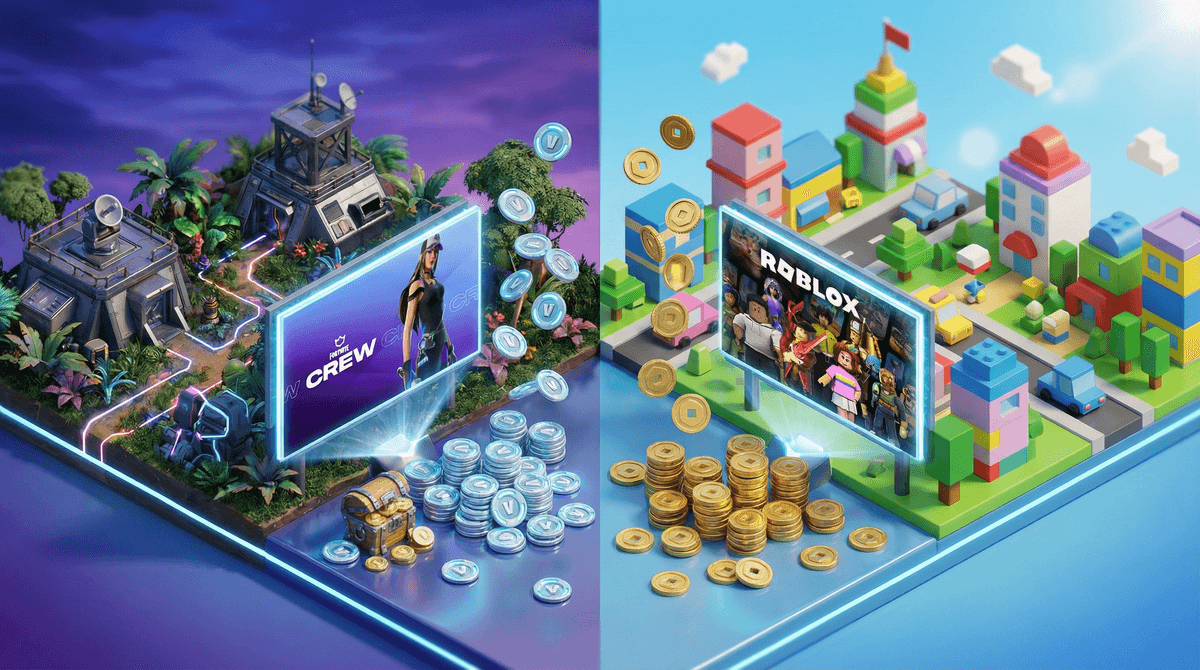
Let's start with the basics: V-Bucks are the in-game currency for Fortnite, and Robux is the currency for Roblox. Think of them like tokens at an arcade, except instead of winning a sad stuffed animal, your kid is buying digital skins, emotes, and accessories that make their character look cooler.
Here's what they actually cost:
V-Bucks:
- 1,000 V-Bucks = $7.99
- 2,800 V-Bucks = $19.99
- 5,000 V-Bucks = $31.99
Screenwise Parents
See allRobux:
- 400 Robux = $4.99
- 800 Robux = $9.99
- 1,700 Robux = $19.99
- Premium subscription: $4.99/month gets you 450 Robux plus perks
The psychological trick here? These currencies intentionally don't match real dollar amounts. A skin costs 1,500 V-Bucks, which sounds way less scary than "$12" to a kid's brain. It's the same reason casinos use chips.
According to our Screenwise data, about 75% of families report their kids use Roblox, with 60% playing on public servers with strangers. Meanwhile, 30% of families have kids playing Fortnite. These aren't niche games — they're where kids socialize.
And here's the thing: in these games, your appearance is your social currency. Showing up in the default skin (what kids call being a "default" in Fortnite or a "noob" in Roblox) can genuinely affect how other kids treat you. It's the digital equivalent of showing up to school in last year's sneakers. Not fair? Absolutely. But real? Also yes.
Kids aren't asking for V-Bucks or Robux because they're greedy. They're asking because:
- Their friends have cool skins and they feel left out
- There's a limited-time item that will "never come back" (FOMO is real)
- They want to support their favorite creator in Fortnite's creator code system
- In Roblox, they want to play certain games that require purchases or make their own games
Here's where it gets tricky. That "just $5" purchase can spiral quickly:
In Fortnite, the Battle Pass costs 950 V-Bucks (about $8) and lasts one season (roughly 10 weeks). It's actually not a terrible deal if your kid plays regularly — they unlock tons of items by playing. But then there are the Item Shop skins that rotate daily, creating constant temptation. A single skin can cost 1,200-2,000 V-Bucks ($10-$16).
In Roblox, kids aren't just buying accessories for their avatar. They're also spending Robux within individual games for advantages, special abilities, or VIP servers. A kid could easily spend 1,000 Robux ($10+) in a single game session across multiple experiences.
Learn more about how these games are designed to encourage spending .
.
The good news: Neither game requires spending money to play. Fortnite is 100% free to play, and all purchases are cosmetic only — they don't make you better at the game. Roblox is also free, though some individual games within Roblox do have pay-to-win elements.
The concerning news: Both platforms are masterclasses in behavioral economics designed to extract money from players. Limited-time offers, rotating shops, battle passes with "fear of missing out," social pressure, and that psychological distance between Robux/V-Bucks and real money.
Important safety note: Be aware of scams. Kids searching for "free V-Bucks" or "free Robux" can end up on sketchy websites that steal account information or worse. If your kid is asking about free currency generators, the answer is: they don't exist, and they're all scams.
Ages 8-10: If your kid is playing these games, consider a hard budget. Maybe they get one Battle Pass per season in Fortnite, or 400 Robux per month. At this age, they're still learning the value of money, so connecting digital currency to real dollars is crucial. Have them use their own allowance or earn it through chores.
Ages 11-13: This is prime Fortnite/Roblox age. Consider teaching budgeting by giving them a quarterly gaming budget they manage themselves. If they blow it all on one skin, that's a learning experience. Some families tie gaming currency to grades, reading goals, or other achievements.
Ages 14+: Teens can start to understand opportunity cost better. Talk about what else that $20 could buy. Some families have success with matching programs — if a teen earns half, parents match it. Others encourage teens to earn their own gaming money through babysitting, lawn mowing, etc.
Set up parental controls ASAP. Both platforms let you require approval for purchases. Here's how to set up Fortnite parental controls and Roblox parental controls.
Use gift cards instead of credit cards. This creates a natural spending limit and teaches budgeting. Your kid can see exactly how much they have left.
Talk about the psychology. Kids are smart. Explain why these companies use fake currency and limited-time offers. Once they understand they're being manipulated, they might think twice.
Consider the Battle Pass model. If your kid plays Fortnite regularly, the Battle Pass is actually decent value. They earn back enough V-Bucks to buy next season's pass if they complete it, creating a one-time purchase that keeps giving. In Roblox, the Premium subscription can work similarly for regular players.
Make them earn it. Whether through chores, good grades, or actual jobs for older kids, connecting gaming currency to real work helps them understand value.
V-Bucks and Robux aren't inherently evil, but they're designed by very smart people to separate you from your money. The key is treating them like any other expense in your family budget and using them as teaching opportunities about money management, delayed gratification, and marketing tactics.
Our Screenwise data shows most families are navigating these same waters — you're not alone in trying to figure out if 1,000 Robux is reasonable or ridiculous. The answer depends on your family's values, budget, and how much your kid plays.
The worst approach? Ignoring it until you get a surprise $200 credit card bill. The best approach? Having clear expectations, teaching financial literacy, and acknowledging that yes, looking cool in a video game actually matters to kids' social lives, even if it seems silly to us.
- Set up purchase approval on both platforms today
- Have a conversation about a monthly or seasonal gaming budget
- Consider using gift cards to create natural spending limits
- Talk with your kid about FOMO and marketing psychology
- Explore alternatives to Fortnite or alternatives to Roblox if spending is becoming a real issue
And remember: every parent who's ever stood in a checkout line with a kid begging for candy understands this dynamic. Gaming currency is just the digital version, with better graphics and more sophisticated manipulation tactics.