

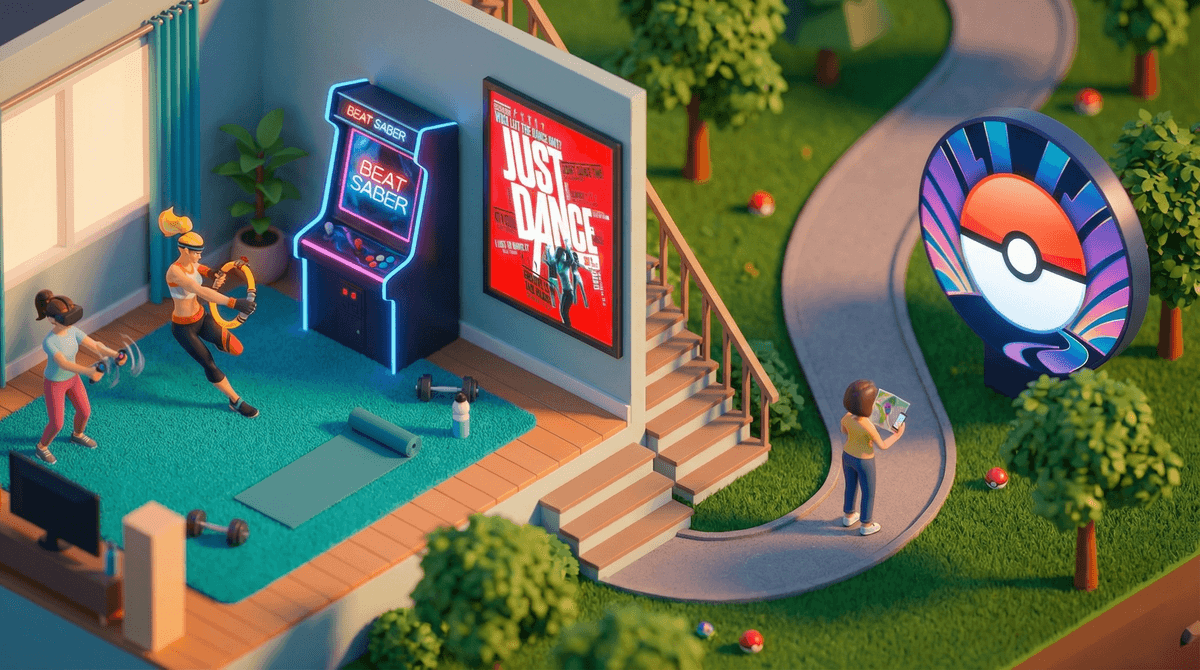
Fitness games are exactly what they sound like—video games that get kids moving. We're talking Ring Fit Adventure on Switch, Just Dance series, Beat Saber in VR, [Pokémon GO](https://screenwiseapp.com/media/pokemon-go-game on phones, and a whole ecosystem of apps that turn exercise into gameplay.
The pitch is compelling: instead of battling screen time, make screens work for movement. Instead of nagging kids to go outside, let them sword-fight their way through a VR workout or dance battle their way to actual cardio.
And honestly? When done right, these games can be legitimately great. But (you knew there was a but coming) the fitness gaming space has also become a minefield of microtransactions, subscription traps, and games that promise exercise but deliver mostly standing-still-and-tapping.
Kids aren't dumb—they know when they're being tricked into exercise. So why do fitness games work?
Immediate feedback loops. Traditional exercise is abstract for kids. "This will make you stronger" means nothing to an 8-year-old. But "you just beat your high score and unlocked a new song"? That's dopamine city.
Social motivation. Many of these games have multiplayer modes or shareable content. Your kid isn't just exercising—they're competing with friends, recording dances for an audience (real or imagined), or collaborating on challenges.
Lower barrier to entry. No equipment needed (mostly), no leaving the house, no being the slowest kid in gym class. For kids who feel self-conscious about traditional sports, fitness games can be a genuine gateway to discovering they actually can enjoy movement.
The gamification actually works. Levels, achievements, character customization, story modes—all the stuff that makes Roblox addictive can also make squats feel less terrible.
The Good
Beat Saber is a legitimate workout disguised as a rhythm game. Teens especially love it because it doesn't feel like exercise—it feels like being a Jedi. Studies show players can burn 6-8 calories per minute on harder levels. That's comparable to tennis.
Ring Fit Adventure turns RPG grinding into actual fitness grinding. You're doing squats to defeat enemies and planks to open treasure chests. It's clever, it's effective, and crucially—it has a real finish line. You can "beat" the game, which means it's not designed to keep kids hooked indefinitely.
Just Dance remains the gold standard for family fitness gaming. It's goofy, inclusive (no "perfect" body type required), and genuinely gets everyone moving. The newer versions have kids' modes with age-appropriate songs and simpler choreography.
Pokémon GO actually gets kids outside and walking. Yes, they're staring at a screen, but they're also moving through real space, sometimes for miles. Learn more about Pokémon GO's outdoor benefits .
.
The Bad
Most fitness apps are subscription traps. That "free" yoga app for kids? It's a 7-day trial before charging $10/month. And good luck finding the cancellation button.
Pay-to-win has infected fitness gaming. Some games lock the best workouts, songs, or equipment behind paywalls. So your kid's "fitness journey" becomes an exercise in nagging you for premium currency.
The fitness is sometimes... questionable. Plenty of games claim to be "active" but mostly involve wiggling a controller while sitting down. If your kid isn't actually breathing hard or sweating, it's not exercise—it's just a regular video game with extra steps (or lack thereof).
Screen dependency for movement is still screen dependency. There's something fundamentally weird about kids who can't imagine exercising without a screen. We're potentially creating a generation that needs gamification to do jumping jacks.
What Parents Should Know
Ages 5-8: Look for simple, supervised options. Just Dance Kids works great. Avoid anything with in-app purchases they can access. At this age, fitness games work best as family activities, not solo screen time.
Ages 9-12: This is the sweet spot. Kids are coordinated enough for more complex games but haven't yet decided exercise is uncool. Ring Fit Adventure, Nintendo Switch Sports, and supervised VR sessions can be genuinely beneficial. Watch out for social comparison—some kids get discouraged if they can't match online leaderboards.
Ages 13+: Teens will see through anything that feels like "tricking them into exercise." But games like Beat Saber, competitive Fortnite creative modes with parkour, or even Zombies, Run! (an audio running game) can work because they're actually fun first, fitness second.
🚩 The game requires constant purchases to access workouts. If the base game is essentially a demo, pass.
🚩 It's pushing body image messaging. Games that focus on "burning calories to look better" rather than "getting stronger to feel better" are not it.
🚩 Your kid is "exercising" but barely moving. Watch an actual session. Are they sweating? Out of breath? Or just wiggling their wrists?
🚩 The game has social features without proper safety controls. Some fitness apps have leaderboards, chat, or video sharing. Make sure you know what's public.
🚩 It's replacing all other physical activity. Fitness games should supplement movement, not replace actual outdoor play, sports, or free-range running around.
Fitness games can be a legitimate tool in the parenting toolkit—especially for kids who resist traditional exercise, live in areas with limited outdoor space, or just genuinely enjoy the gamification.
But they're not magic. A kid who does 20 minutes of Ring Fit Adventure but then sits for 6 hours isn't getting "enough" movement. Think of fitness games as a gateway or supplement, not a replacement for varied physical activity.
The best approach? Set clear boundaries around which games are worth the money (one-time purchases > subscriptions), use them as family activities when possible, and keep emphasizing that bodies are cool because of what they can DO, not how they look.
Also, maybe occasionally just... go outside and kick a ball around? Revolutionary, I know.
-
Check what you already own. Many games you have can be "fitness games" with the right approach—Minecraft with a rule that everyone has to do 10 jumping jacks between deaths, anyone?
-
Try before you buy. Many fitness games have demos. Test them with your kids before committing to subscriptions.
-
Set the "sweat test" standard. If a game claims to be fitness but doesn't make your kid sweat or breathe hard, it's just a regular game. Which is fine! But call it what it is.
-
Explore alternatives to screen-based movement. Check out non-digital active games
for balance.