

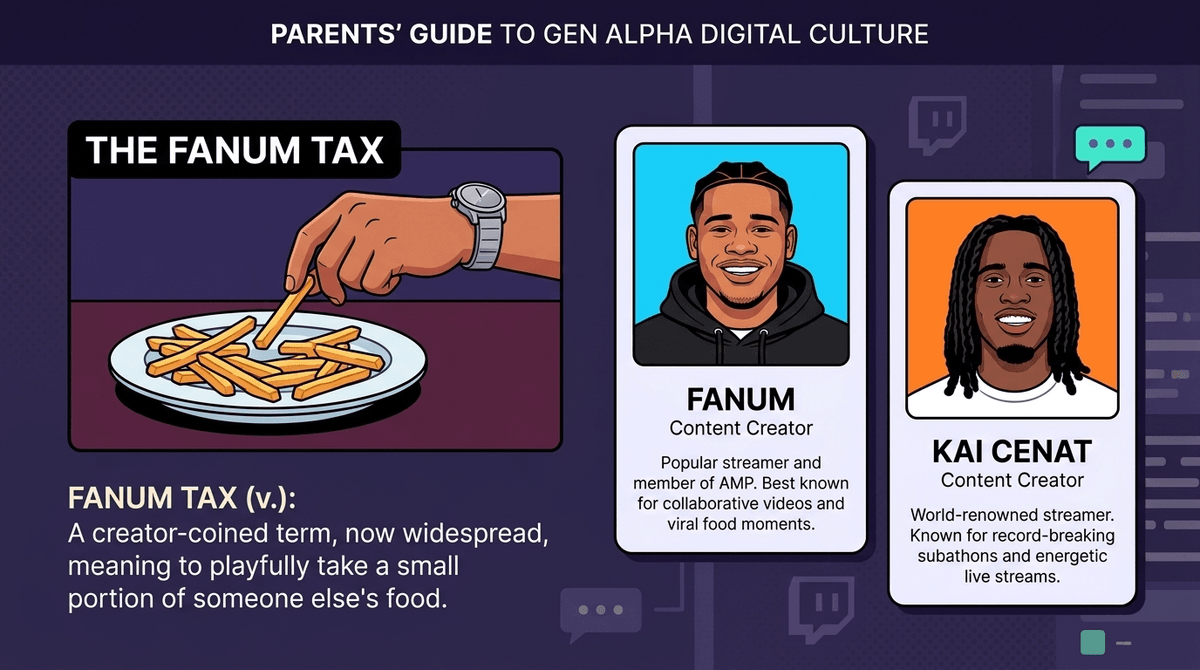
TL;DR: "Fanum Tax" is Gen Alpha slang for stealing a bit of someone else’s food. It originated from a popular Twitch streamer named Fanum who "taxes" his friend Kai Cenat by taking a percentage of whatever he's eating. It’s mostly harmless, though it can be annoying at the dinner table. If your kid is saying this, they are likely spending time on YouTube, TikTok, or Roblox.
See explanations for other Gen Alpha slang terms
If you’ve recently had a french fry snatched from your plate while your middle-schooler shouted "Fanum Tax!" into the void, congratulations: you’ve officially been initiated into the world of Gen Alpha digital culture.
It’s easy to feel like you need a Rosetta Stone to understand what's happening in your own living room these days. Between things being "Ohio" (weird/bad), having "Rizz" (charisma), or whatever is happening with Skibidi Toilet, the linguistic barrier between parents and kids is getting thicker.
But "Fanum Tax" is one of those rare trends that actually has a very specific, traceable origin story. It’s not just "brain rot"—it’s a reference to a specific creator subculture that dominates the attention of millions of kids between the ages of 9 and 15.
At its simplest, Fanum Tax is the act of taking a portion of someone else's food.
In the real world, we used to call this "the dad tax" or "the sibling bite." In the digital world of 2025, it’s named after Fanum, a member of the massive creator collective known as AMP (Any Means Possible).
The "tax" became a viral meme because of Fanum’s frequent appearances on Kai Cenat’s live streams. Fanum would burst into Kai’s room—often while Kai was mid-meal—and demand a "tax" of whatever was on the plate. It usually results in a chaotic, high-energy physical comedy bit where Kai tries to defend his dinner and Fanum walks away with a literal handful of pizza or chicken wings.
For kids, "taxing" a friend or parent is a way of participating in that joke. It’s a verbal "I see you, I know the meme, and I’m part of the club."
To understand why a kid would yell "Fanum Tax" while stealing your cookie, you have to understand the sheer gravity of Kai Cenat and the AMP crew.
For boys in particular, these streamers are the new Saturday Night Live, the new sports stars, and the new big brothers all rolled into one. According to recent Screenwise community data, nearly 65% of boys in grades 6-8 interact with content related to these streamers weekly.
Kids love "Fanum Tax" because:
- It’s Physical Comedy: It’s basically a modern version of a Three Stooges bit.
- It’s Social Currency: Using the slang correctly proves you are "tapped in" to what’s trending on Twitch.
- It’s Low-Stakes Rebellion: It’s a "legal" way to be a little bit annoying to parents or siblings while framing it as a joke.
Fanum (Roberto Silva) is a 20-something Dominican-American creator from New York. He’s known for his high energy, his love of food, and his chemistry with his roommates in the AMP house.
While Fanum himself is generally seen as one of the more "chill" members of the group, the content he participates in—especially on Twitch—can be loud, chaotic, and occasionally features mature language or suggestive themes.
If your child is a fan of Fanum, they are likely also watching:
- Kai Cenat: The biggest streamer in the world, known for massive celebrity cameos and high-octane energy.
- MrBeast: The gold standard for high-production YouTube challenges.
- IShowSpeed: A much more controversial, loud, and often problematic creator that we generally recommend parents keep a closer eye on.
Check out our guide on the difference between Twitch and YouTube for kids
You’ve probably heard the term "brain rot" used to describe Gen Alpha’s media diet. It’s a self-deprecating term the kids use themselves to describe content that is nonsensical, fast-paced, and seemingly meaningless to anyone over the age of 20.
Is "Fanum Tax" brain rot? Technically, yes. It’s a repetitive, low-substance meme. However, it’s also a form of linguistic bonding. Every generation has its "brain rot"—from Beavis and Butt-Head to SpongeBob SquarePants to the early days of "Charlie Bit My Finger."
The danger isn't the slang itself; it’s the sheer volume of time spent in the "algorithmic loop" required to stay current with these jokes.
While stealing a chicken nugget is harmless, the platforms where "Fanum Tax" lives require some intentionality.
1. The Twitch Factor
Most "Fanum Tax" moments happen on Twitch. Unlike YouTube, Twitch is live. There are no edits, no "oops" cuts, and the chat moves at the speed of light. Live chat can often be a cesspool of toxicity, even if the creator themselves is trying to be positive.
2. The Commercialization of Everything
Streamers like Fanum and Kai Cenat are master marketers. Whether they are promoting Prime Hydration or their own merch, the line between "entertainment" and "infomercial" is non-existent.
3. Food Boundaries
In some cases, the "taxing" can go from a funny one-time joke to a genuine annoyance at mealtime. It’s worth setting a boundary: "The Fanum Tax is funny on the first fry, but after that, I’d like to eat my dinner in peace."
Read our guide on setting healthy boundaries for gaming and streaming
If you want to blow your kid's mind (and maybe earn a little "rizz" yourself), try using the term back at them. The next time they have a bag of chips, walk over, take one, and say, "Just collecting the Fanum Tax."
Once the initial shock wears off, use it as an opening to talk about their media diet:
- "I know that's a Fanum thing—what else do you like about his videos?"
- "Do you actually watch his live streams on Twitch, or do you just see the clips on YouTube Shorts?"
- "I noticed the chat in those videos moves really fast. Do you ever read it, or do you just ignore it?"
"Fanum Tax" is a harmless piece of cultural shorthand. It’s a sign that your child is engaging with the dominant social ecosystem of their peers. While the content that birthed the meme can be loud and chaotic, the meme itself is just the 2026 version of an inside joke.
Unless your kid is actually stealing your entire dinner or spending their life savings on "donations" to streamers, you can probably just laugh this one off—and maybe hide your favorite snacks.
Next Steps for Intentional Parents:
- Check the History: Take a quick look at your child's YouTube or TikTok history to see if they are watching the original creators or just the meme compilations.
- Set "Tax" Limits: Keep the joke fun by ensuring it doesn't turn into actual sibling bullying or mealtime disruption.
- Explore Better Content: If they like the comedy of Fanum, they might enjoy more structured shows like The Unlisted or MythBusters which offer high energy without the "brain rot" tag.