

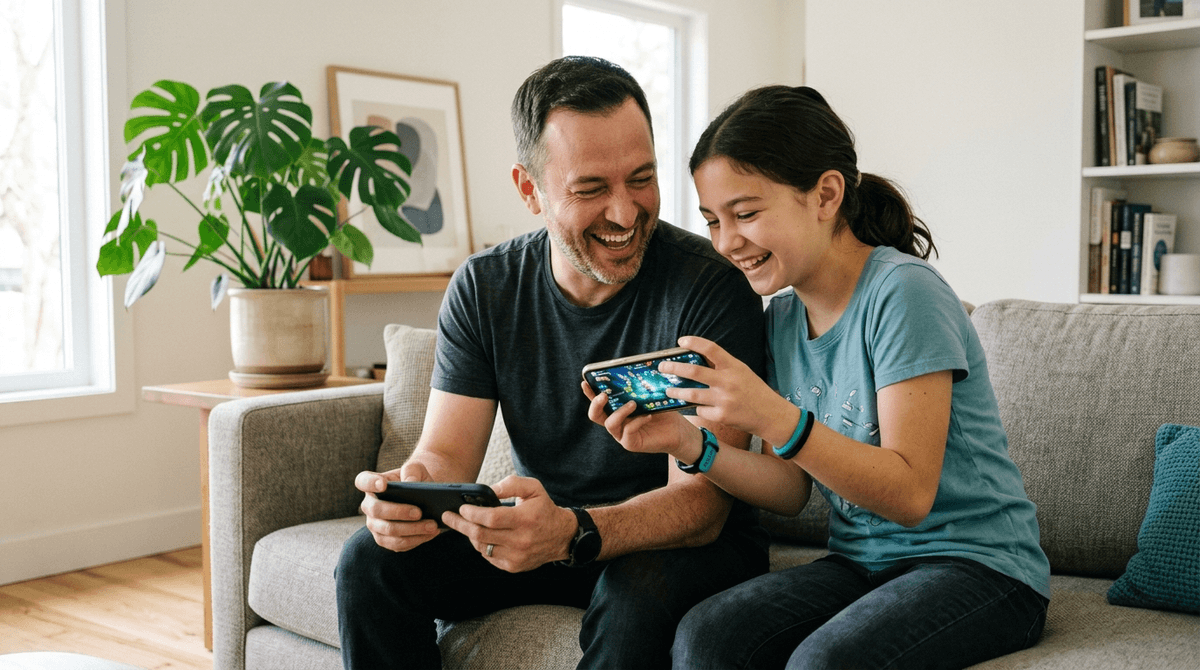

How you respond to your child’s gaming habits impacts their emotional health far more than the total minutes logged on a screen. High-handed control often pushes kids into hiding their virtual lives, while co-playing builds trust and emotional self-regulation.
Parental engagement shapes whether mobile gaming builds resilience or breeds secrecy. Strict rules paired with low trust drive preteens to hide their digital habits and seek emotional validation exclusively from online peers, while sitting down to play alongside your child transforms a solo screen habit into a bridge for emotional self-regulation.
Setting strict time limits feels like responsible parenting, but hyper-focusing on the clock often backfires. When parents rely solely on rigid bans and constant surveillance without taking an interest in the game itself, preteens learn to conceal their behavior rather than manage their gaming distress.
If your goal is raising a child who can navigate frustration, online social pressure, and digital balance, your relationship around the screen matters significantly more than the daily hour cap.
Public discussion around kids and video games usually centers on screen time limits and addiction fears. Researchers wanted to look past the timer to examine how daily household communication styles alter the way preteens process emotional highs and lows inside mobile gaming environments.
Family relational dynamics divide into three distinct gaming patterns, each shaping how 10- to 12-year-olds handle in-game stress:
- Heavy monitoring backfires. High-control parenting marked by low trust correlates directly with kids concealing their gaming habits and shifting their primary social focus toward virtual peers.
- Co-playing builds emotional skills. Shared play creates a natural bridge between kids' digital and offline lives, helping preteens better regulate emotional spikes like frustration or defeat.
- Siblings serve as digital buffers. In nearly a third of households, older siblings act as informal emotional guides, managing gaming stress and regulating younger brothers and sisters without parental involvement.
- Gaming itself is rarely the root cause. Across all observed family dynamics, gaming on its own did not generate severe emotional distress or deep household conflicts.
Kids do not retreat into hidden digital worlds purely because games are addictive; they hide because the home environment penalizes transparency. When a child faces immediate criticism or restriction every time a game opens, they turn to online teammates for the social validation and emotional support they feel is missing at home.
This study tracked just 10 families, all living in urban, suburban, or rural China. The findings rely entirely on self-reported mother and child interviews rather than direct, real-time observation of gameplay. While these dynamics offer clear patterns worth reflecting on, they are illustrative snapshots rather than universal laws.
- If you catch your preteen hiding their gaming or minimizing app usage... drop the harsh penalties and focus on restoring open dialogue, as high-surveillance approaches directly drive secrecy.
- If your child gets frequently frustrated or angry while playing... sit beside them for a 10-minute session to turn an isolating struggle into a co-regulated experience.
- If you have multiple children who play mobile games... encourage them to play together as teammates, allowing horizontal peer support to build organic emotional regulation.
Stop worrying exclusively about the clock and start paying attention to the connection. Joining your child in their digital world—even for a few minutes a week—does more to build healthy emotional regulation and trust than any strict monitoring app ever could.
Pang L, Mustafa SE, Gong J et al. (2026). Social connectedness in mobile gaming: how family dynamics shape children's virtual interactions. Frontiers in psychiatry. doi:10.3389/fpsyt.2026.1850835 — pubmed.ncbi.nlm.nih.gov