

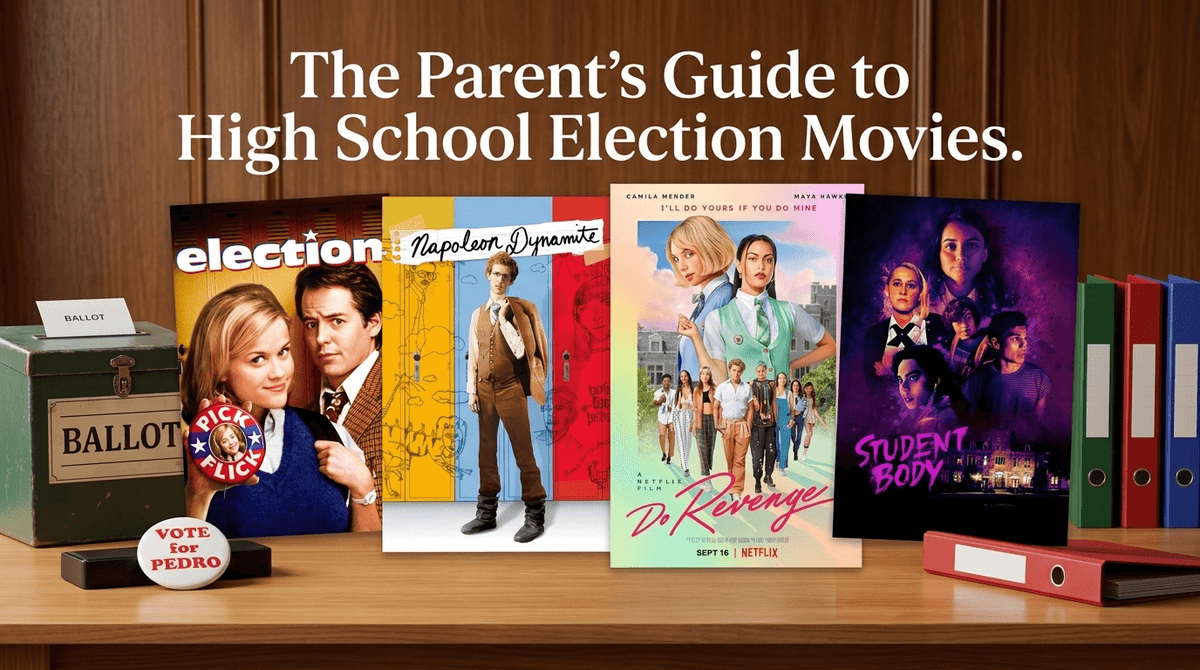
TL;DR: Election movies like the 1999 classic Election aren't just about student council; they are masterclasses in high school noir that expose the raw nerves of ambition and adult pettiness. If your teen is feeling the pressure of the "college resume arms race," these films are the perfect (and often hilarious) entry point for talking about ethics versus winning.
Quick Picks:
- The Gold Standard: Election (1999)
- The Modern Binge: The Politician (Netflix)
- The Social Satire: Do Revenge
- The Absurdist Take: Napoleon Dynamite
If you haven't seen Election since you were in college, it’s time for a rewatch. Tracy Flick (played by Reese Witherspoon) is the overachieving high school junior who will stop at nothing to become student body president. She’s the person who has the colored-coded binders, the three-year plan, and a terrifyingly sharp sense of entitlement.
The "Tracy Flick Effect" is that specific brand of hyper-ambition we see in digital spaces today—the LinkedIn-ification of childhood. In a world where 15-year-olds feel like they need a "personal brand" and a non-profit startup to get into a state school, Tracy Flick isn't a villain anymore; she’s a mirror.
These movies matter because they take the "Ohio" (weird/cringe) energy of school politics and show kids that the systems they are fighting so hard to win are often rigged, ridiculous, or just plain sad.
Find movies about high school social hierarchies
High school is a power struggle. Whether it’s who sits at the "cool" table or who gets the solo in the choir, teens are constantly navigating micro-politics. Election movies dial this up to eleven.
Kids love these stories because they validate the intensity of their feelings. To a 16-year-old, losing a school election can feel like the end of the world. Seeing a movie where a teacher (like Matthew Broderick’s Mr. McAllister) loses his entire mind trying to stop a student is both a cautionary tale and a hilarious acknowledgement that adults don't always have it together either.
Ages 16+ This is the "Citizen Kane" of high school movies. It’s dark, it’s biting, and it’s surprisingly cynical. It deals with teacher-student boundaries, sabotage, and the total collapse of a man’s moral compass. It’s not a "feel-good" movie, but it is a "think-hard" movie. Note: This is rated R for sex and language. It’s definitely for the older teen crowd.
Ages 15+ This Netflix series takes the Election vibe and turns the saturation up. It follows Payton Hobart, a wealthy kid who has known he’s going to be President of the United States since he was seven. To get there, he has to win the election at Saint Sebastian High School. It’s glossy, fast-paced, and perfectly captures the "main character energy" of the Gen Z era.
Ages 10+ If you want something lighter that still hits the "election" theme, this is it. It’s the story of the ultimate underdog. While it’s mostly known for its "Vote for Pedro" shirts and awkward dancing, it’s a great way to talk to younger kids about why we root for the people who don't fit the "perfect candidate" mold.
Ages 14+ Think Heathers meets Mean Girls. While not strictly about a ballot box, it’s about the politics of reputation. In the digital age, your "vote" is your follow, your like, and your social standing. This movie explores what happens when ambition turns into a weapon.
Ages 14+ Not the drug movie—the Australian film about a school election (often titled Candy or found in specific indie circles). Actually, let's look at Student Body instead for a more modern, slasher-adjacent take on the high-stakes world of school prestige.
Check out our guide on the best satirical movies for teens
Most "election" movies fall into the Satire category, which means they use exaggeration and irony to make a point.
- The Rating Gap: Many of the best films in this genre (like Election or Heathers) are rated R. This isn't usually because of "brain rot" violence, but because they deal with complex themes like sexual politics, suicide, and deep-seated adult unhappiness.
- Cynicism Overload: If your teen is already feeling burnt out by school, a movie like Election might feel a bit heavy. It doesn't offer a "happily ever after."
- Digital Context: Modern versions like The Politician show how social media is used to smear opponents. This is a great time to talk about digital footprints and how "cancel culture" plays out in school hallways.
These movies provide a "safe" way to talk about some pretty heavy ethical dilemmas without it feeling like a lecture. Here are a few ways to break the ice after the credits roll:
- "Who was the actual villain?" In Election, is it Tracy for being ruthless, or Mr. McAllister for being a grown man obsessed with sabotaging a teenager? (The answer is usually "everyone," which is a great lesson in nuance).
- "Is winning worth it?" Ask your teen if they’d rather be the person who wins by cheating or the person who loses but keeps their integrity. It sounds cliché, but in the context of these movies, it’s a real question.
- "The Resume Trap." Talk about the pressure to be "President of everything." Is Tracy Flick happy? Does she even like the things she’s doing, or is she just checking boxes?
Learn more about helping teens manage academic pressure and digital burnout
We live in an era where "success" is often measured by metrics—likes, followers, GPA, and leadership titles. Movies like Election and The Politician act as a pressure valve. They allow us to laugh at the absurdity of the "hustle" while acknowledging how much it actually hurts to be in the middle of it.
Watching these with your teen isn't just about entertainment; it’s about giving them permission to be something other than a "Tracy Flick." It’s about showing them that while ambition is great, your character is what actually stays on the ballot long after graduation.
Next Steps:
- Schedule a double feature: Pair Napoleon Dynamite with Election to see the two extremes of school politics.
- Check the "Community Data": Use Screenwise to see if other parents in your district are letting their 14-year-olds watch R-rated satires, or if they're sticking to the PG-13 stuff like Mean Girls.
- Talk about the "Real" World: Use the movie as a bridge to discuss how actual local elections work. Maybe it’s time to look at a civics website together.