

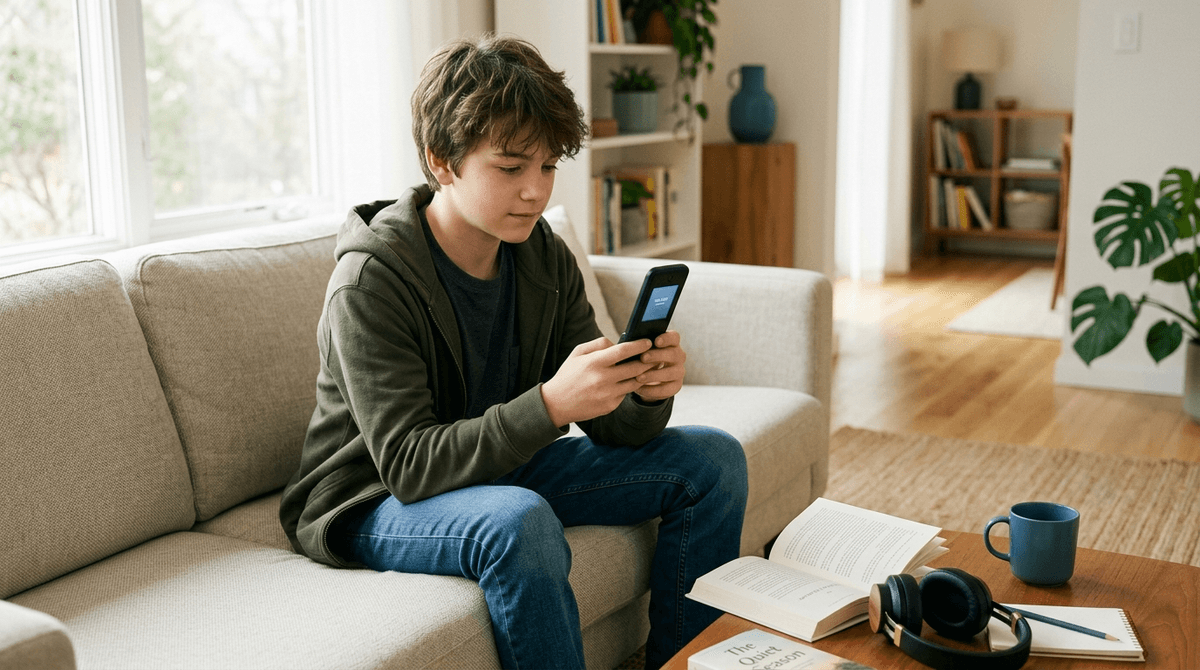
Kid phones have split into five kinds, and the right one depends on how far your kid goes without you.
- Ages 5 to 9, calling home and Grandma: a home landline. Tin Can ($100) started the trend, and Pinwheel Home, Ooma MyPhone and Wiley now make their own.
- Ages 7 to 11, out the door on their own: a kid watch like the Gabb Watch 3e or Apple Watch SE 3, or the new Freckle, a $199 phone built around going outside that ships in December.
- Ages 10 to 14, a real first phone: a locked-down smartphone that opens up as they grow: Pinwheel, Troomi, Gabb or Bark. Or a Wisephone II if they want it to look like everyone else's phone.
- Teens and adults quitting the scroll: the Light Phone III, Punkt MP02, Mudita Kompakt or Commodore Callback 8020.
Quick answers:
- Cheapest way to keep a young kid reachable? A home landline with free calls on its own network: Pinwheel Home from $68, or Tin Can at $100.
- Which ones have no web browser at all? Tin Can, Freckle, Gabb Phone 4, Wisephone II, Sunbeam, Light Phone and every kid watch here.
- What is the monthly cost? From $0 (Tin Can to Tin Can) to about $80 (Bark's unlimited plan). Most kid phone plans land between $25 and $40.
- Which is newest? Freckle, which opened preorders on September 30, 2026.
Parents stopped waiting for the smartphone to get safer and started buying around it. Tin Can raised $12 million from Greylock after selling out batch after batch of a screen-free home phone. Pinwheel, Ooma and a Utah startup called Wiley answered with landlines of their own in 2026. AT&T became the first big carrier to sell its own kid smartphone. And on September 30, 2026, a New York startup backed by Alexis Ohanian's Seven Seven Six launched Freckle, a square phone designed to get kids outdoors.
The common thread is time. Most of these devices do less than a hand-me-down iPhone, and they cost about as much each month, because what you are paying for is a few more years before your kid carries the open internet.
Tin Can is a colorful corded phone that plugs into home Wi-Fi and does one thing: calls to and from numbers a parent approves. There is no screen, not even caller ID, no texting, no apps and no camera. It costs $100. Calls to other Tin Cans and to 911 are free with no subscription, and the $9.99-a-month Party Line plan lets it call regular phone numbers. A parents-only app sets approved callers and quiet hours.
It is also the most-bought device on this list, which cut both ways on Christmas 2025: a hundredfold spike in calls took the service down, and Tin Can paused billing until it was fixed. Like every Wi-Fi phone, it stops working when the power or internet goes out, 911 included.
Three newer landlines work the same way:
- Pinwheel Home (July 2026): $68 for the small Spark or $79 for the trimline Classic, both on sale from $79 and $99. Calls to other Pinwheel Home phones are free, and outside numbers cost $6.99 a month (up to five) or $9.99 (any). Pinwheel pitches it at ages 5 to 10.
- Ooma MyPhone (May 2026): $99.99 (Walmart launched it at $79.99) plus $7.99 a month, with no free tier. That plan calls anyone in the US, Canada and Mexico. Calls are limited to a "Trusted Circle", 911 sends the home address, and up to three adults get a text or email when someone dials 911.
- Wiley Buddy (shipped April 2026): $89 plus $9.95 a month, with no free tier, unlimited US calls, approved-only calling and quiet hours. It comes from a small Utah startup, and early reviews found bugs it has since fixed.
A landline keeps a kid reachable at home and nowhere else. For the walk to school, look at the watches below.
Freckle is the newest phone here and the most unusual. It is a square about 3 by 3 inches with a 3.1-inch screen, worn on a strap, and it has no browser, no app store, no social media and no YouTube. What it has instead is aimed at an afternoon outdoors: a Discovery Camera that names bugs, birds and plants, maps built for kids, a walkie-talkie that pairs when two Freckles tap together, Quests that a parent or Freckle sends ("photograph three different bugs in the backyard"), and Freckle Pay, a tap-to-pay card with limits a parent sets. Calls, texts and video chat go only to approved contacts.
The phone is $199 and service is $25 a month through Freckle's own network, with 2 GB of data and the first month free. A $25 deposit holds one, and the first units ship in the US in December 2026. Two things to weigh: nobody outside the company has used one yet, and it includes an AI chat, built on Google's Gemini and a small on-device model, that answers a kid's questions and passes the hard ones to a parent. Each tool can be switched off in the parent app. Freckle fits 8 to 11 best; by 12 or 13, kids whose friends plan everything in group chats will want more.
A cellular watch is the most common first device for 7- to 10-year-olds: calls and texts to approved contacts, location for parents, and nothing to scroll. All of them need a monthly plan.
- Gabb Watch 3e: $169.99 plus a $30 activation fee, and $12.99 to $17.99 a month depending on contract length. Up to 100 approved contacts, safe-zone alerts, no camera. Gabb says ages 5 to 12.
- Apple Watch SE 3 with Apple Watch For Your Kids: $299 for the cellular model, which the kid setup requires, plus a watch line on AT&T, Verizon or T-Mobile, typically $10 to $15 a month. It needs a parent's iPhone. The most capable watch here, with Schooltime mode, Apple Pay through Apple Cash Family and fall detection; the controls are spread across three Apple apps.
- Bark Watch: rebuilt in September 2026 on the Samsung Galaxy Watch8. $10 a month for 24 months for the watch plus a $15-a-month plan that includes Bark's AI monitoring of texts. No camera.
- TickTalk 6: $169.99, shipping in early October 2026, with plans at $9.99 or $19.99 a month on AT&T or T-Mobile (not Verizon). It has a camera, video calls, a walkie-talkie mode and parent-controlled kids' radio. The TickTalk 5 stays on sale at $159.99.
- Fitbit Ace LTE: $179.95 plus $9.99 a month. Built around movement games, but it has no phone number and cannot call 911, and everyone it calls needs a Google account and the Fitbit Ace app.
- Verizon Gizmo Watch 4 (July 2026, about $10 a month, Verizon only) and Garmin Bounce 2 ($299.99 plus $9.99 a month) round out the field.
These look like a regular Android phone, and that matters to a 12-year-old. The difference is the software: every app, contact and website goes through a parent, and the controls loosen as the kid proves ready. For a side-by-side on the three best known, see Pinwheel vs Gabb vs Troomi.
- Pinwheel: three phones from $119 to $299, and the only one here that works on any major carrier. Controls cost $17.99 a month, or Pinwheel Wireless is $29.99 a month with 5 GB and the controls included. There is no browser by default and no social media, apps come from a library of 1,200-plus rated apps (parents can open the Play Store later, with social media still blocked), and parents can read texts. It includes PinwheelGPT, a filtered AI chatbot whose chats parents can read.
- Troomi: a Samsung Galaxy A17 5G for $249.95, on Troomi's own service over AT&T at $24.95 to $34.95 a month. It has no social media, runs AI monitoring of texts and images, and on the top plan adds a filtered browser with a YouTube limited to channels a parent approves.
- Gabb Phone 4: $169.99 plus activation, with plans from $34.99 a month without a contract. No browser, no app store, no social media and no YouTube, only Gabb's own messaging, music and maps. Gabb says ages 9 to 14.
- Bark Phone: a Samsung Galaxy A16 for $10 a month over 24 months, with plans from $29 (talk and text) to $79 (unlimited) on T-Mobile. It is the least locked-down: parents can open the Google Play Store app by app, and Bark's AI scans texts, photos and 30-plus apps for trouble. Bark says ages 8 to 17.
- AT&T amiGO Jr. (February 2026): a Samsung Galaxy A16 5G for $259.99 (it launched at $209.99), or $2.99 a month over 36 months on a new line with an eligible AT&T unlimited plan. It only works on AT&T. Calls and texts go only to contacts a parent adds, websites open only once a parent approves them, apps and the camera start off, and parents can read texts.
The Wisephone II by Techless solves the problem that sinks a lot of first phones: kids won't carry something that looks like a toy. It runs on a Samsung Galaxy A-series phone, so it looks like any other, with a locked system on top: no web browser, no email, no social media, no games and no Play Store. A parent or "device manager" switches features on from a web portal and approves apps for the Tool Drawer, a short list that includes WhatsApp, Signal, Spotify and Waze.
It costs $399 plus a $39 activation fee, and the WiseOS subscription is required: $14.99 a month on your own carrier, or included in Techless's plans from $24.99 a month. Since October 1, 2026, a Wisephone without a subscription only makes emergency calls and texts, and after 90 days it is reset to plain Android. The portal has no approved-contacts list, message monitoring or location tracking, and Techless markets it to teens and adults, so it suits a 13-year-old better than a 9-year-old.
The Sunbeam F1 is a durable flip phone sold as bird-named models tiered by features. The most basic do calls and texts; the top models add a camera, offline music and Waze. None have a browser, social media or an app store. The flip form does real work: it is harder to check compulsively something you have to open.
Two catches. The Horizon models ($279 to $309) are out of stock on Sunbeam's site, and the rugged F1 Pro line ($359 to $389) is on backorder. And Sunbeam is a phone for minimalists, not a kid product: there are no remote parental controls or location sharing, and it works on your own carrier. On the phone itself you can limit incoming calls to saved contacts.
These four have no parental dashboard, or a thin one, so they work for a kid only if the kid wants the limits. They are for a parent quitting the scroll, or an older teen who asks for one.
The Commodore Callback 8020 is the resurrected Commodore name on a $499 flip phone that calls itself "the phone between dumb and smart." It runs Sailfish OS and many Android apps and shoots 48MP photos, then blocks social media and web browsers at the operating-system level, with patent-pending tech that stops them being sideloaded and DNS blocking as a backstop. The blocks cannot be switched off. Sailfish's multi-user mode lets a parent stay the admin and give a teen a separate profile with call, text and app controls. Other apps, like games and school tools, can still be sideloaded, so it is less locked down than a Wisephone.
If you are looking for a Commodore Callback alternative, the choice turns on what you want to keep:
- Light Phone III: the design world's favorite. Calls, texts, a camera, maps, music and podcasts as opt-in tools, with no browser, email or social media. It now costs $899 unlocked, or from $59 a month on a two-year Light plan, and new orders ship in late December 2026. A parent can own the account and choose the tools, but it has no location sharing, and Light's own service requires a subscriber 18 or older.
- Punkt MP02: a Jasper Morrison design for about $379 with calls, T9 texts and encrypted messaging through a built-in Signal client. No browser, app store, social media or camera. A hotspot lets you tether a laptop when you need the web.
- Mudita Kompakt: a 4.3-inch E Ink screen that is hard to scroll and easy on the eyes at night, a de-Googled system with an e-reader, offline maps and a meditation app, for about $439. Android apps can be sideloaded from a computer, though apps not built for E Ink run poorly.
- Ages 5 to 9, at home: Tin Can or Pinwheel Home if their friends will have one too, Ooma MyPhone if they mostly call relatives.
- Ages 7 to 11, walking to school or a friend's house: a kid watch, or Freckle if you want a camera, maps and something to do outside, and are willing to wait for December.
- Ages 10 to 14, a real first phone: Gabb for the tightest limits, Pinwheel or Troomi to open apps over time, Bark if you want a full smartphone with AI monitoring, or the AT&T amiGO Jr. if your family is already on AT&T.
- 13 and up, wants a normal-looking phone: Wisephone II, or a Sunbeam flip for a kid who wants less.
- You: Light Phone III, Punkt, Mudita or Commodore.
None of them is cheap over time. The device is usually the small part: $25 a month for two years is $600, more than most of these phones cost. The adult calm phones have little or no parental control, so they hold only as long as the kid wants them to. Flip phones and landlines make texting slower and group chats harder, which is a real social cost for a 13-year-old even when it is the point for you. And a phone does not do the parenting: it buys time and friction while the habits get built at home.
For more on choosing, see dumb phones and flip phones for kids and smartphone alternatives by age.
What is the difference between a dumbphone and a kids' safe phone? A dumbphone (Light Phone, Punkt, Mudita) removes the internet and apps for anyone, usually an adult choosing focus, with no parent dashboard. A kids' safe phone (Freckle, Gabb, Pinwheel, Troomi, Bark, Wisephone) is built for families, with parent controls from the start. Tin Can and the other landlines are home phones, and kid watches sit in between.
Which is the cheapest? Pinwheel Home, at $68 with free calls to other Pinwheel Home phones. Tin Can works the same way at $100. Among devices a kid carries, most kid watches cost about $170 plus $10 to $18 a month.
Which kid phones have AI chatbots? Freckle has Why Chat, which parents can switch off. Pinwheel has PinwheelGPT, whose chats parents can read. On a Bark Phone, a parent can allow AI apps from the Play Store, and Bark monitors ChatGPT chats. Gabb and Tin Can have none.
Will my kid be embarrassed to carry one? It depends on the device and the kid. A flip phone or a square Freckle reads as different, which some kids mind and some wear as a badge. Pinwheel, Troomi, Bark and the Wisephone II look like any other Android phone.
Can a kid get around the limits? On the phones with no browser or app store (Freckle, Gabb, Wisephone), there is little to get around. On phones that open apps over time, the limits are only as tight as the settings a parent picks, and determined kids do find gaps. The watches and landlines have nothing to break into.
The right phone comes down to where your kid goes without you. A Tin Can keeps a young kid reachable at home. A kid watch, or a Freckle once it ships, covers the walk to school and the afternoon at the park. A locked-down smartphone like Pinwheel, Troomi or Gabb is the first real phone. And the Light Phone, Punkt, Mudita or Commodore is for the grown-up who wants their attention back.
Not sure which fits your kid's age and your family's rules? Take the 5-minute family survey and see the phone, or the no-phone-yet plan, that fits.