

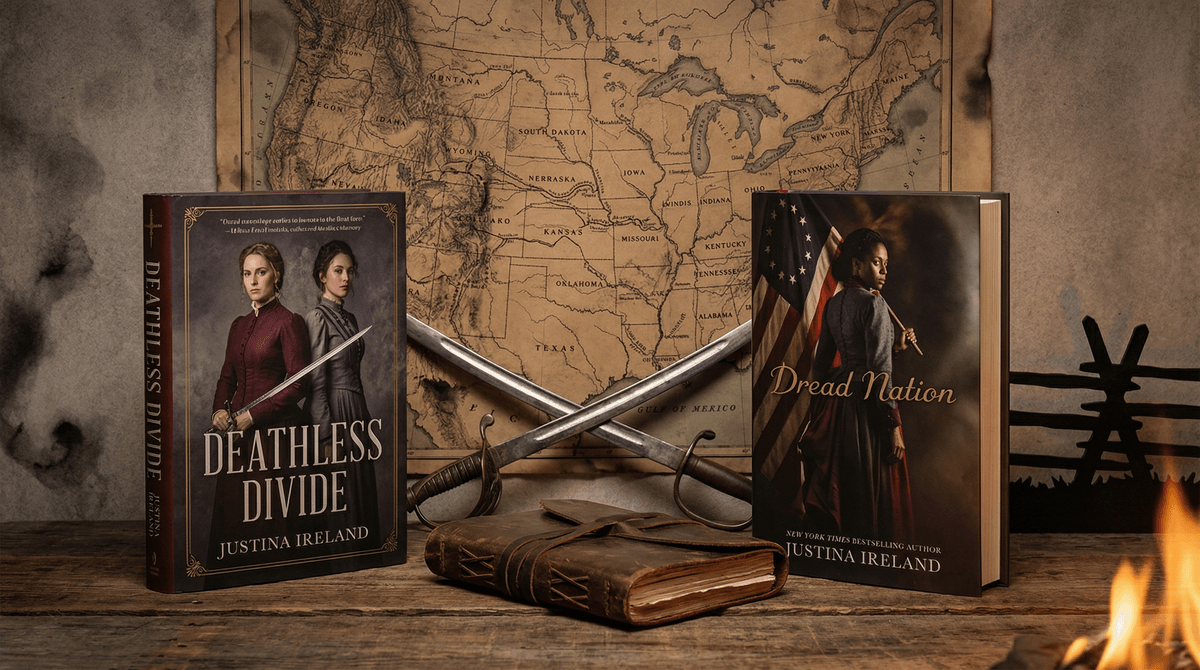
Deathless Divide: The Zombie-Western Sequel That Tackles Race, Violence, and Resilience
TL;DR: Deathless Divide by Justina Ireland is the sequel to Dread Nation, and it's even better than the first book. If your teen loved the zombie-slaying action of the original, this one doubles down with more horror, more historical commentary, and a road trip across a post-apocalyptic American West. Ages 14+ for graphic violence, racial slurs in historical context, and some mature themes around trauma and survival.
Justina Ireland's Deathless Divide picks up right where Dread Nation left off. In an alternate history where the Civil War dead rose as zombies (called "shamblers"), Black and Indigenous people were forced into combat schools to protect white communities. The first book followed Jane McKeene, a biracial girl trained at Miss Preston's School of Combat, as she uncovered corruption in a supposed "safe town" called Summerland.
Deathless Divide shifts the spotlight to Katherine Deveraux, Jane's frenemy from the first book. After Summerland literally burns to the ground, Katherine and Jane are separated and must each navigate their own brutal journeys across a zombie-infested West. The book alternates between their perspectives as they fight their way toward survival, reunion, and maybe—just maybe—a place where they can actually live instead of just survive.
Think: The Walking Dead meets True Grit, but with sharp commentary on how America has always sacrificed marginalized people to protect white comfort.
Most YA fantasy and horror treats historical oppression as window dressing. Deathless Divide makes it the whole point. Ireland doesn't let readers escape into zombie action without confronting the real monsters: systemic racism, exploitation, and the lie of "safe" communities built on the backs of the vulnerable.
Katherine's arc is the heart of the book. In Dread Nation, she was the "proper" Black girl who played by white society's rules, convinced that respectability would protect her. Deathless Divide systematically destroys that illusion. Katherine watches everything she believed in crumble, and her transformation from someone who seeks white approval to someone who burns it all down is visceral and earned.
Jane remains the snarky, sword-wielding badass, but Ireland doesn't let her off easy either. Jane's recklessness has consequences. Her trauma manifests in ways that feel real—not the sanitized "strong female character who never breaks" version we often get in YA.
The book also doesn't shy away from showing how survival under oppression creates impossible moral choices. Characters do terrible things. They betray each other. They make decisions that haunt them. And the book never pretends there are easy answers.
Let's be clear: this book is violent. Like, really violent. Zombies get their heads chopped off. People die in gruesome ways. There's a scene involving a baby that will wreck you emotionally. Ireland doesn't pull punches because the reality she's depicting—both the zombie apocalypse and the historical violence of racism—doesn't pull punches.
This is not The Hunger Games violence, where the camera tastefully pans away. This is horror-movie violence. If your teen is squeamish about gore, this might not be their book.
But here's why the violence matters: Ireland uses it to show how America has always been violent toward Black and Indigenous people. The zombies are just the most obvious threat. The real horror is how quickly white communities reinstate slavery and exploitation when social order collapses. The violence isn't gratuitous—it's making a point about whose bodies get sacrificed and who gets to feel safe.
Best for ages 14+, and honestly, some 14-year-olds might not be ready. Consider your teen's:
- Tolerance for graphic violence: Decapitations, dismemberment, and some truly disturbing zombie kills
- Ability to handle historical racial slurs: Used in context to show the reality of racism, not for shock value
- Emotional maturity around trauma: Characters deal with PTSD, survivor's guilt, and moral injury
- Interest in social commentary: This isn't escapist fantasy—it's using fantasy to talk about real oppression
Good fit for teens who:
- Loved Dread Nation and want more
- Are ready for horror movies like A Quiet Place or mature zombie content
- Enjoy historical fiction that doesn't sanitize the past
- Want fantasy that has something to say beyond "good vs. evil"
- Are reading books like The Hate U Give or Children of Blood and Bone
Not a good fit for teens who:
- Get nightmares from horror content
- Aren't ready for frank discussions about racism and violence
- Prefer lighter, more escapist fantasy
- Haven't read Dread Nation (seriously, read that first)
The racial commentary is unflinching. White characters in this book range from well-meaning but useless to actively monstrous. If your family is white, this might be uncomfortable. That's kind of the point. Ireland is writing for Black readers first, and she's not interested in making white readers feel comfortable about racism.
The book includes racial slurs used by white characters toward Black and Indigenous characters. These aren't gratuitous—they're historically accurate and used to show the reality of racism. But it's worth knowing they're there, especially if you want to prep your teen for that content.
There's some romantic content, but it's pretty tame by YA standards. A few kisses, some tension, nothing explicit. The violence is way more intense than any romantic content.
The ending is... complicated. Without spoilers: this isn't a happily-ever-after book. Characters get something resembling hope, but Ireland doesn't pretend that individual survival fixes systemic problems. Some readers find this unsatisfying. Others find it refreshingly honest.
If you're the kind of parent who reads what your teen reads (or wants to understand what they're into), Deathless Divide is worth your time. It's genuinely well-written—Ireland can craft an action scene and also make you think about how America's foundational violence never really went away.
Plus, it's a great conversation starter about:
- How societies decide whose lives matter during crises (hello, COVID parallels)
- The myth of "respectability politics" and why playing by the rules doesn't protect marginalized people
- How horror and fantasy can be tools for social commentary
- What survival costs when the system is designed to exploit you
If your teen devours Deathless Divide, try:
- Dread Nation (obviously—read this first!)
- Ring Shout by P. Djèlí Clark: Ku Klux Klan members are literal monsters, and a Black woman hunts them in 1920s Georgia
- The Ballad of Black Tom by Victor LaValle: Lovecraftian horror that confronts Lovecraft's racism head-on
- Legendborn by Tracy Deonn: King Arthur mythology meets Black girl magic and historical trauma
- Pet by Akwaeke Emezi: A trans girl discovers monsters hiding in a "perfect" town (lighter on violence, heavier on social commentary)
For more books that blend fantasy with social justice themes, check out YA fantasy books with social commentary.
Deathless Divide is not a comfortable read. It's not meant to be. Justina Ireland wrote a zombie-western that forces readers to confront how America has always treated Black and Indigenous bodies as expendable. It's horror that means something.
If your teen is ready for graphic violence, historical racism, and complex moral questions wrapped in a fast-paced adventure, this is one of the best YA books they're probably not reading. Katherine and Jane's journey is brutal, heartbreaking, and ultimately about finding agency in a world designed to deny it.
Just maybe read it yourself first, so you're ready for the conversations that follow. Because this book will spark them.
Want to explore more books that don't pull punches? Check out books about systemic racism for teens or historical fiction that tells hard truths.