

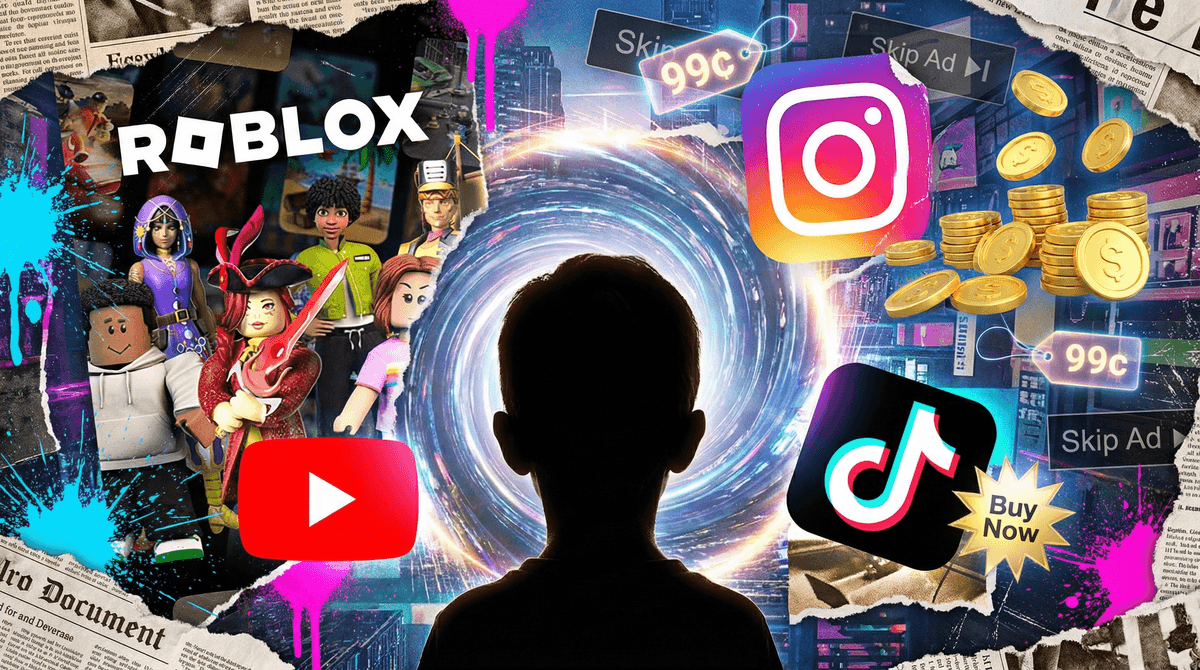
Dealing with Ads Kids See Everywhere: A Parent's Guide
Remember when ads were just...commercials? Like, your kid watched Saturday morning cartoons, saw some cereal ads, maybe begged for Lucky Charms at the grocery store, and that was it?
Yeah, those days are gone.
Today's kids are swimming in advertising that's so sophisticated, so integrated, and so personalized that half the time they don't even know they're being marketed to. And honestly? Half the time parents don't either.
We're talking about:
- YouTube influencers doing "unboxing videos" that are basically 20-minute toy commercials
- Roblox games that are literally just branded experiences (yes, there's a Chipotle Roblox game)
- TikTok videos where you can't tell if someone genuinely loves that Stanley cup or is getting paid
- In-app purchases disguised as "special offers" and "limited time deals"
- Sponsored content that looks exactly like regular content
- Ads that follow your kid around the internet based on their browsing history
- AI-generated content that's designed to keep kids watching (and clicking) longer
The average kid sees thousands of ads per day across their devices. And unlike the commercials we grew up with, these ads are designed by teams of psychologists and data scientists who know exactly how to trigger the "I NEED THAT" response in a developing brain.
Fun times.
Look, I'm not here to tell you that seeing an ad will ruin your kid. We all survived Saturday morning commercials (though we also all begged our parents for a Furby, so...).
But here's what's different now:
The ads are invisible. When your kid watches their favorite Minecraft YouTuber play with a new toy, they're not thinking "this is an advertisement." They're thinking "my favorite person loves this thing, so I should too." That's influencer marketing, and it's incredibly effective precisely because it doesn't feel like an ad.
The ads are personalized. If your kid searched for "slime videos" once, they're going to see slime ads everywhere. The algorithm knows what they want before they do. This creates a feedback loop of desire that's really hard for kids (and adults!) to resist.
The ads are designed to create urgency. "Limited time offer!" "Only 3 left!" "Your friends already have this!" These tactics work on adults, but they're especially powerful for kids who don't yet have the cognitive tools to recognize manipulation.
The ads blur reality. When a game itself IS an ad (looking at you, branded Roblox experiences), or when influencers seamlessly integrate products into their content, kids lose the ability to distinguish between entertainment and marketing.
And perhaps most importantly: Constant exposure to advertising can shape kids' values, self-image, and sense of what they "need" to be happy. Research shows that heavy exposure to advertising is linked to materialism, decreased self-esteem, and increased parent-child conflict. Not exactly what we're going for.
Ages 4-7: Building Awareness
Young kids literally cannot distinguish between advertising and content. Like, their brains aren't developed enough to understand persuasive intent. This is why there are laws about advertising to young children (though digital platforms have found plenty of loopholes).
What to do:
- Watch content with them and point out ads: "See how they're trying to make you want that toy?"
- Use shows with minimal advertising like Bluey on Disney+ or PBS Kids content
- Set up YouTube Kids with restricted mode, though know that even "kid-friendly" content can be heavily commercialized
- Create a simple rule: "We don't buy things we see in videos without talking about it first"
Ages 8-11: Developing Critical Thinking
This age can start to understand that ads are trying to persuade them, but they still struggle to recognize subtle marketing (like sponsored content or influencer partnerships).
What to do:
- Play "spot the ad" as a game while they're watching content
- Explain how influencers make money: "When someone shows a product in their video, they might be getting paid for that"
- Talk about how ads make us feel: "Notice how that made you really want something you didn't even know existed five minutes ago?"
- Introduce ad blockers for web browsing (though they don't work on apps or most mobile content)
- Check out this guide on YouTube vs. YouTube Kids to understand what they're actually seeing
Ages 12+: Real Conversations
Tweens and teens are sophisticated enough to understand marketing tactics, but they're also at peak susceptibility to social pressure and FOMO (fear of missing out). Plus, they're on platforms like TikTok and Instagram where the line between content and advertising is basically nonexistent.
What to do:
- Have honest conversations about influencer culture and authenticity
- Discuss how algorithms work and why they keep seeing ads for things they mentioned once
- Talk about data privacy and why they're seeing personalized ads
- Help them understand that what they see on social media is often paid promotion, not genuine recommendations
- Set boundaries around in-app purchases and discuss the psychology of "limited time offers"
- Understand what they're actually doing on TikTok so you can have informed conversations
The Platforms Are Not Your Friends
YouTube, TikTok, Roblox, Instagram—these platforms make money from advertising. They are financially incentivized to keep your kid watching and clicking. Their business model depends on it.
This doesn't make them evil, but it does mean you can't trust them to have your kid's best interests at heart. The parental controls exist to protect the platform from liability, not to protect your kid from manipulation.
"Free" Content Isn't Free
If your kid is watching free content or playing free games, they're paying with their attention and their data. That's the deal. The more time they spend, the more ads they see, the more data is collected, the more personalized (and effective) the advertising becomes.
This is especially true for games like Fortnite or Roblox, where the game itself is free but everything in it costs money. The entire experience is designed to make kids want to buy things.
In-App Purchases Are Real Money
I know Robux and V-Bucks don't feel like real money, but they are. They absolutely are. And games are designed with sophisticated psychological techniques to make kids want to spend them.
Set up purchase controls on every device. Require a password for purchases. Consider using gift cards instead of linking a credit card. And have regular conversations about the difference between wanting something and needing it.
Your Kid's Favorite YouTuber Is Running a Business
This isn't a criticism—it's just reality. Content creators need to make money, and sponsorships and affiliate links are how they do it. But your kid doesn't necessarily understand that their favorite person is being paid to promote products.
Help them understand the business model without making them feel cynical about everything they watch. You can appreciate someone's content while also recognizing when they're selling something.
The goal isn't to make your kid paranoid or cynical about all media. It's to help them develop advertising literacy—the ability to recognize when they're being marketed to and make conscious decisions about how they respond.
Try these conversation starters:
"I noticed you really want that thing from the video. What made you want it? Do you think you'd have wanted it if you hadn't seen that video?"
"How do you think your favorite YouTuber makes money? Do you think they get paid when they show certain products?"
"Have you noticed how after you search for something, you start seeing ads for it everywhere? How does that make you feel?"
"What do you think the game designers want you to do when they show that 'limited time offer'? Why do they make it feel urgent?"
Make it collaborative, not confrontational. You're not trying to catch them being manipulated—you're helping them develop skills to navigate a complex media landscape.
1. Audit what they're actually seeing
Sit down and watch what your kid watches for 30 minutes. Count how many ads or sponsored moments you see. You'll probably be shocked.
2. Set up technical protections
- Ad blockers for web browsers (uBlock Origin is solid)
- Purchase controls on all devices and accounts
- Privacy settings that limit data collection and personalized ads
- Consider paying for ad-free versions of services they use frequently (YouTube Premium, Spotify Premium, etc.)
3. Create family guidelines
- "We wait 24 hours before buying anything we see in an ad or video"
- "We talk about in-app purchases before making them"
- "We don't click on ads without checking with a parent first"
- "We question why we want something before we ask for it"
4. Build media literacy skills
Make it a regular practice to discuss what you're seeing together. Point out advertising techniques. Talk about how you make purchasing decisions. Help them understand that wanting something because of an ad is normal—and that recognizing that feeling is the first step to making intentional choices.
5. Model good behavior
Kids learn from watching us. If you're constantly impulse-buying from Instagram ads or letting targeted marketing drive your decisions, they'll learn that's normal. Talk about your own experiences with advertising: "I almost bought this thing from an ad, but then I realized I don't actually need it."
You cannot completely protect your kid from advertising. It's everywhere, it's sophisticated, and it's not going anywhere.
But you can help them develop the critical thinking skills to recognize it, question it, and make intentional decisions about how they respond to it.
That's actually a really valuable life skill—one they'll use long after they've aged out of YouTube unboxing videos.
The goal isn't to raise kids who never want anything or who are cynical about all media. It's to raise kids who can distinguish between genuine enthusiasm and manufactured desire, who understand when they're being marketed to, and who can make conscious choices about what they consume and purchase.
Start the conversations early. Make them ongoing. And remember: you're not trying to be perfect at this. You're just trying to be intentional.
Want to dig deeper? Learn more about how to set up parental controls on the platforms your kids actually use or explore alternatives to ad-heavy platforms.