

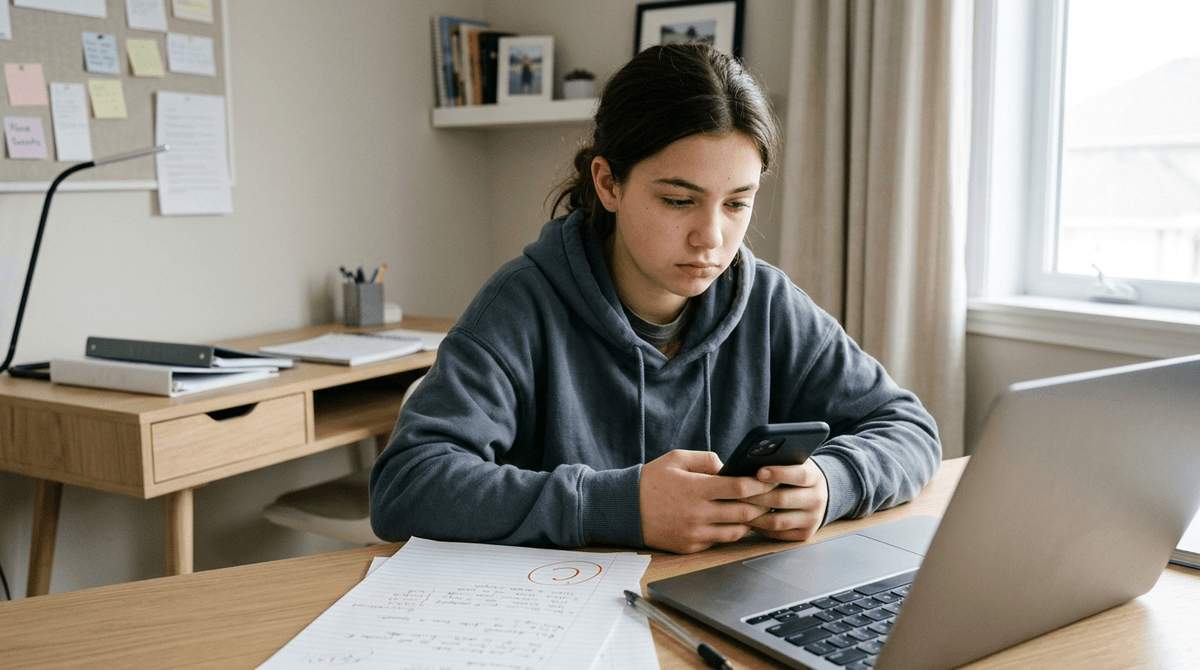
Middle schoolers experiencing escalating online harassment suffer noticeable hits to their GPA and skip school at higher rates—even when they do not have pre-existing mental health challenges or high screen time.
Increasing online harassment tanked middle school academic focus, bumping up a child's odds of lower grades and unexcused absences by over 40 percent even when offline bullying and underlying mental health conditions were taken out of the equation.
Sudden drops in grades or unexcused absences in early adolescence are usually treated as academic discipline problems or learning issues, but they frequently signal hidden online harassment.
Treating an academic slump strictly with tutoring or grounded privileges misses the root cause if harassment is quietly unfolding in group chats or social feeds. Online safety is a direct academic priority, not just a social one.
While the link between face-to-face bullying and poor school performance is well documented, digital harassment follows kids home and operates outside the view of teachers and parents. Researchers wanted to know if escalating cyberbullying specifically triggers academic decline over time, or if underlying issues like depression, ADHD, family income, or total screen time were the actual drivers behind falling grades.
Escalating online harassment inflicts a distinct, measurable penalty on middle school performance.
- About 1 in 20 adolescents follow a path of steadily increasing cyberbullying between ages 12 and 14.
- Adolescents on this escalating harassment path face 40% higher odds of earning lower grades by age 15 compared to peers with little to no online conflict.
- Victimized teens are 45% more likely to accumulate unexcused absences.
- The academic hit persists even after controlling for traditional in-person bullying, household income, screen time, depression, and ADHD symptoms.
Online harassment acts as a silent tax on cognitive bandwidth. When kids spend their evenings managing persistent digital hostility, their mental energy goes toward navigating social survival rather than focusing on schoolwork. Because the academic slump hits months or years after the online conflict begins, parents and schools rarely connect a falling GPA to a group chat that blew up six months prior.
While this study tracked over 10,000 teenagers over four years, it remains observational—meaning researchers identified a strong link, but cannot prove that cyberbullying directly caused the grade drops. Additionally, academic performance and attendance were reported by parents rather than pulled from official transcript records, and the group experiencing increasing cyberbullying represented a relatively small subset (about 5%) of the total population.
- If your middle schooler's grades drop unexpectedly, look into their digital group chats and social accounts for escalating conflict alongside checking their homework completion.
- If your child begins complaining of vague physical symptoms to skip school, ask direct questions about their online social circles before assuming schoolwork anxiety.
- If you discover your child is facing online harassment, treat the situation as an academic threat requiring immediate boundary-setting rather than a minor rite of passage.
Unexplained academic slumps in early adolescence are frequently social alarms in disguise, so protect your teen's school performance by stepping in early on digital harassment before it shows up on a report card.
Nagata JM, Wong JH, Sajjad OM et al. (2026). The prospective association between cyberbullying trajectories and poorer academic outcomes in adolescents. Academic pediatrics. doi:10.1016/j.acap.2026.103348 — pubmed.ncbi.nlm.nih.gov