

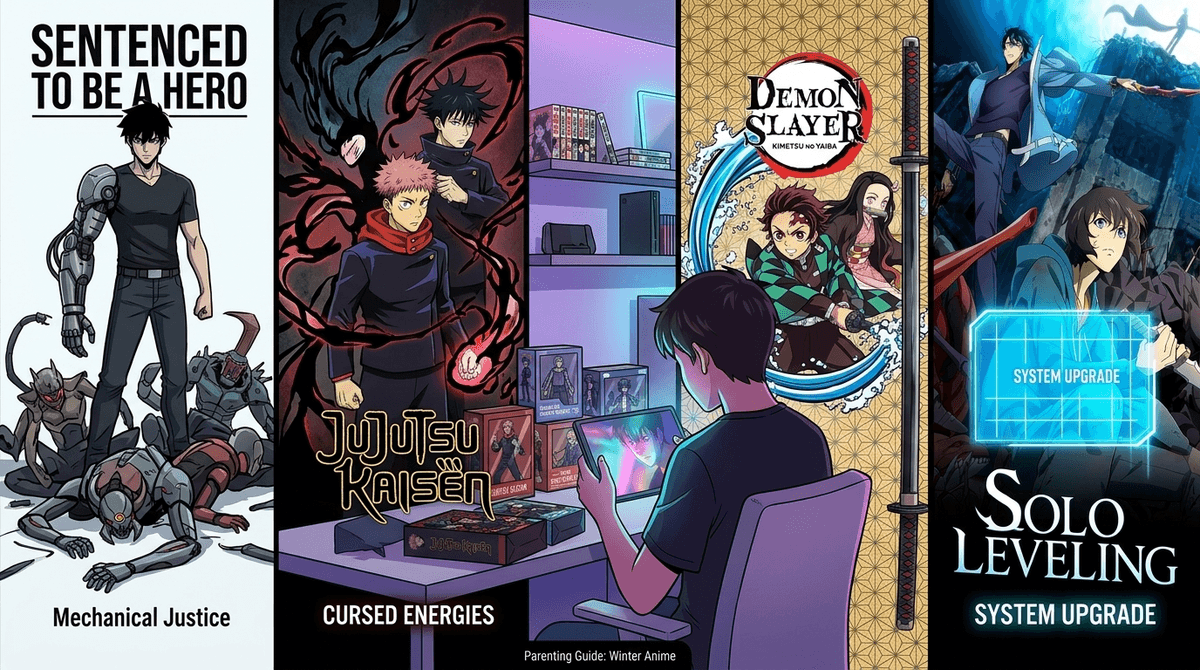
TL;DR: The Action Anime Your Teen Is Actually Watching
Your 14-year-old wants a Crunchyroll subscription, and honestly? It's not the worst ask. Here's what's dominating their watch lists in early 2026:
The Big Three Right Now:
- [Sentenced to Be a Hero](https://screenwiseapp.com/media/sentenced-to-be-a-hero-youtube - The breakout hit where criminals get superpowers instead of jail time (TV-14, intense but thoughtful)
- Jujutsu Kaisen Season 3 - The curse-fighting phenomenon is back and it's everywhere (TV-MA for violence, but most teens are watching)
- Demon Slayer: Infinity Castle Arc - Gorgeous animation, demon-slaying siblings, emotional gut-punches (TV-14)
Also Worth Knowing About:
- My Hero Academia Season 8 - Still going strong, superhero academy vibes (TV-14)
- Solo Leveling Season 2 - Video game-style power progression that hooks hard (TV-14)
About 92% of families in our community report their kids use streaming TV services, and anime has become the default genre for a huge chunk of teens. If your kid doesn't have Crunchyroll yet, their friends definitely do.
Crunchyroll is basically the Netflix of anime - it's a streaming service dedicated almost entirely to Japanese animation. It has both subtitled (original Japanese audio with English text) and dubbed (English voice acting) versions of most shows.
The platform has exploded in the past few years as anime moved from niche interest to mainstream teen culture. Your 14-year-old isn't asking for something weird - they're asking for what a significant chunk of their peers are watching.
Key things parents should know:
- Ratings vary wildly - from kid-friendly shows to genuinely mature content
- Most popular action shows are TV-14 or TV-MA - which doesn't mean they're inappropriate, but does mean you should know what you're signing off on
- The app has parental controls - you can set maturity ratings and require a PIN for certain content
- Subtitles vs. dubs is a whole thing - many teens prefer subtitled versions because the voice acting is "better," which means they're actually reading while watching (silver lining!)
Action anime isn't just "cartoons with fighting." The genre has evolved into genuinely sophisticated storytelling that resonates with teens in ways that traditional American shows often don't.
What makes it work:
- High stakes with emotional depth - Characters face real consequences, process trauma, deal with moral complexity
- Underdog narratives - Protagonists often start weak and earn their strength through genuine effort and failure
- Found family dynamics - Strong themes of friendship, loyalty, and chosen communities
- Visual storytelling - The animation style conveys emotion and action in ways live-action can't match
- Serialized storytelling - Complex plots that reward attention and discussion (your teen will absolutely want to talk about these shows)
The violence in action anime is stylized and often less graphic than what you'd see in a Marvel movie, though it can be intense. Think of it more like comic book violence than realistic gore - though there are exceptions.
[Sentenced to Be a Hero](https://screenwiseapp.com/media/sentenced-to-be-a-hero-youtube
The phenomenon of 2026. This show came out of nowhere in January and became the thing every teen is watching. The premise: instead of going to prison, convicted criminals are given superpowers and forced to work as heroes under strict government supervision. If they refuse or fail their missions, they die.
Why it's everywhere: It's basically "what if we gave powers to bad people and watched them try to be good," which creates genuinely interesting moral dilemmas. The main character is a reformed thief who's trying to protect his younger sister while navigating a system designed to kill him if he screws up.
Parent concerns: It's rated TV-14, and that's accurate. There's violence (people die, but it's not gratuitous), some language, and mature themes about justice, redemption, and systemic corruption. The show actually asks smart questions about whether people can change and what society owes to people who've made mistakes.
The real talk: This is the show your kid's friends are all watching. It's well-written, the animation is solid, and it's sparking actual conversations about ethics and justice systems. If you're going to let your teen watch one new action anime this year, this is probably the one.
The curse-fighting series is back and it's darker than ever. If your teen watched Seasons 1 and 2, they're watching Season 3 - that's just how it is. The show follows high schoolers who fight supernatural curses using cursed energy and martial arts.
Why teens love it: The power system is complex and interesting, the fights are choreographed brilliantly, and the characters are genuinely compelling. It also doesn't pull punches - major characters die, heroes fail, and victories feel earned.
Parent concerns: It's rated TV-MA for good reason. The violence is more intense than most anime, there's blood, and the horror elements can be genuinely disturbing. Characters are dismembered, eaten by curses, and killed in ways that matter to the plot. The show also deals with themes of death, sacrifice, and the cost of power.
The real talk: This is probably the most violent show on this list, but it's also one of the most popular. If your teen has been watching since Season 1, they're invested in these characters and the story is reaching its climax. The violence serves the narrative rather than existing for shock value. That said, if you're uncomfortable with TV-MA content, this is the one to push back on.
The show with the most breathtaking animation you'll ever see. Seriously, even if you don't care about anime, watch five minutes of this show and you'll understand why teens are obsessed. The story follows a boy whose family was killed by demons, and who now hunts demons while trying to turn his demon-transformed sister back into a human.
Why it works: It's emotionally devastating in the best way. The show balances intense action with genuine heart - characters have backstories that make you care, and even the demons get humanizing moments before they die. Plus, the sibling relationship at the core of the story is actually healthy and loving, which is refreshing.
Parent concerns: Rated TV-14. There's violence (demon slaying involves beheading demons, though it's stylized), some blood, and intense emotional scenes. The show deals with grief, loss, and trauma in ways that can be heavy.
The real talk: This is probably the "safest" of the big three for most parents. The violence is less graphic than Jujutsu Kaisen, the themes are more straightforward (demons bad, protecting family good), and the emotional core is genuinely beautiful. If you're looking for an action anime to watch with your teen, start here.
The superhero academy show that's been running since 2016 is in its final season. If your teen has been watching since middle school, they're seeing it through to the end. The show follows kids training to become professional heroes in a world where 80% of people have superpowers (called "Quirks").
Why it's lasted: It's essentially X-Men meets Harry Potterr](https://screenwiseapp.com/guides/the-ultimate-parent-guide-to-harry-potter-film-age-ratings) - a school setting with superpowers, clear good vs. evil dynamics, and characters who grow and change over time. The show has always been about effort, friendship, and becoming your best self, which resonates across age groups.
Parent concerns: Rated TV-14. The violence has increased as the series has gone on - this final season features a full-scale war between heroes and villains. There's blood, characters are seriously injured, and the stakes are life-or-death. That said, it's still less graphic than many live-action superhero shows.
The real talk: If your teen has been watching for years, let them finish it. The show has been a positive influence for most kids - it's about working hard, supporting friends, and standing up for what's right. Season 8 is intense, but it's wrapping up storylines they've been invested in for potentially years.
This is the "video game power fantasy" anime, and it's catnip for teens who game. The main character starts as the weakest hunter in a world where people fight monsters in dungeon-like gates, but gains a unique ability to level up like a video game character - getting stronger after every fight.
Why teens are hooked: It's pure power progression. The main character goes from pathetic to overpowered, and watching him systematically become stronger is deeply satisfying. It's also gorgeously animated and moves at a fast pace.
Parent concerns: Rated TV-14. There's monster violence, some blood, and the main character can be ruthless to enemies. The show also deals with death - the main character's motivation comes from nearly dying and watching other hunters get killed.
The real talk: This is the most "popcorn entertainment" show on the list. It's not trying to make deep philosophical points - it's just a well-executed power fantasy. If your teen plays RPGs or games like Elden Ring, they'll love this. It's not going to teach them anything profound, but it's also not going to rot their brain.
Let's address the elephant in the room: several of these shows are rated TV-MA, which technically means they're for audiences 17+. Your 14-year-old is asking to watch them anyway.
Here's the context: TV-MA anime ratings are often more conservative than American TV-MA ratings. A show gets TV-MA for:
- Stylized violence (even if it's not realistic)
- Blood (even small amounts)
- Mature themes (death, war, moral complexity)
- Occasional strong language
Meanwhile, your teen can watch The Hunger Games (rated PG-13) where kids literally murder each other on screen, or Marvel movies where cities are destroyed and thousands die off-screen.
The real question isn't "is this rated appropriately?" - it's "does my specific teen have the emotional maturity to process this content?"
Things to consider:
- How does your teen handle intense emotions and violence in other media?
- Can they separate fiction from reality?
- Do they understand that anime violence is stylized and not realistic?
- Are they watching because everyone else is, or because they're genuinely interested?
- Can you have conversations about what they're watching?
For most 14-year-olds, shows like Demon Slayer and [Sentenced to Be a Hero](https://screenwiseapp.com/media/sentenced-to-be-a-hero-youtube are fine. Jujutsu Kaisen is the edge case - it's genuinely more intense and might not be right for every teen.
If you're saying yes to Crunchyroll, set it up right:
Use the parental controls:
- Set a maturity rating limit (TV-14 if you're not comfortable with TV-MA content)
- Require a PIN for accessing mature content
- Review the watch history periodically (not to spy, but to know what they're engaging with)
Have the conversation:
- "These shows have mature content - violence, death, complex themes. Are you ready for that?"
- "If something bothers you or feels too intense, we can talk about it or you can stop watching."
- "The violence in anime is stylized - it's not realistic. We need to keep that separation clear."
Make it a shared experience occasionally:
- Watch an episode of Demon Slayer together (it's genuinely beautiful)
- Ask them to explain the plot of [Sentenced to Be a Hero](https://screenwiseapp.com/media/sentenced-to-be-a-hero-youtube (they'll love explaining it)
- Use their shows as conversation starters about themes like justice, power, responsibility
Set boundaries:
- Screen time limits still apply (remember, average screen time in our community is about 4.2 hours daily)
- No watching during homework/family time
- If grades slip or behavior changes, the subscription can be paused
If you're not ready for Crunchyroll or want to start with something lighter:
Gateway anime on other platforms:
- Avatar: The Last Airbender (Netflix) - Not technically anime but has the same appeal, perfect for younger teens
- Spy x Family (Crunchyroll/Hulu) - Action-comedy about a fake family of spies, much lighter tone
- Haikyu!! (Crunchyroll/Netflix) - Sports anime about volleyball, surprisingly engaging even if you don't care about sports
If they want action but you want less violence:
- My Hero Academia Seasons 1-3 - The earlier seasons are lighter and more school-focused
- One Punch Man - Satirical superhero show where the hero is so strong he ends every fight in one punch (the violence is cartoonish)
Action anime in 2026 is mainstream teen culture. Your 14-year-old asking for Crunchyroll is like teens in the 90s asking for MTV - it's just what their generation watches.
The shows aren't perfect, but they're also not the concern some parents fear. Most popular action anime have:
- Strong themes about friendship, effort, and personal growth
- Complex characters who face real consequences
- Moral complexity that sparks good conversations
- Visual storytelling that's genuinely artistic
The violence is real, but it's stylized and serves narrative purposes. It's not more intense than what teens see in superhero movies, war films, or even the news.
Your role is to be informed, not to panic. Know what they're watching, use the parental controls, have conversations about content, and set reasonable boundaries.
If you say yes to [Sentenced to Be a Hero](https://screenwiseapp.com/media/sentenced-to-be-a-hero-youtube, you're giving your teen access to a show that's sparking genuine discussions about justice and redemption. If you say yes to Demon Slayer, you're letting them experience some of the most beautiful animation ever made while following a story about protecting family. If you say yes to Jujutsu Kaisen... well, that one's more intense, but it's also the one all their friends are watching.
Only you know your teen and your family's values. But if you're looking for permission to say yes to anime? This is it. Just set it up thoughtfully, check in regularly, and remember that being the parent who understands why [Sentenced to Be a Hero](https://screenwiseapp.com/media/sentenced-to-be-a-hero-youtube is different from My Hero Academia will earn you serious credibility points.
See common anime content concerns for teens or explore more age-appropriate streaming options.