

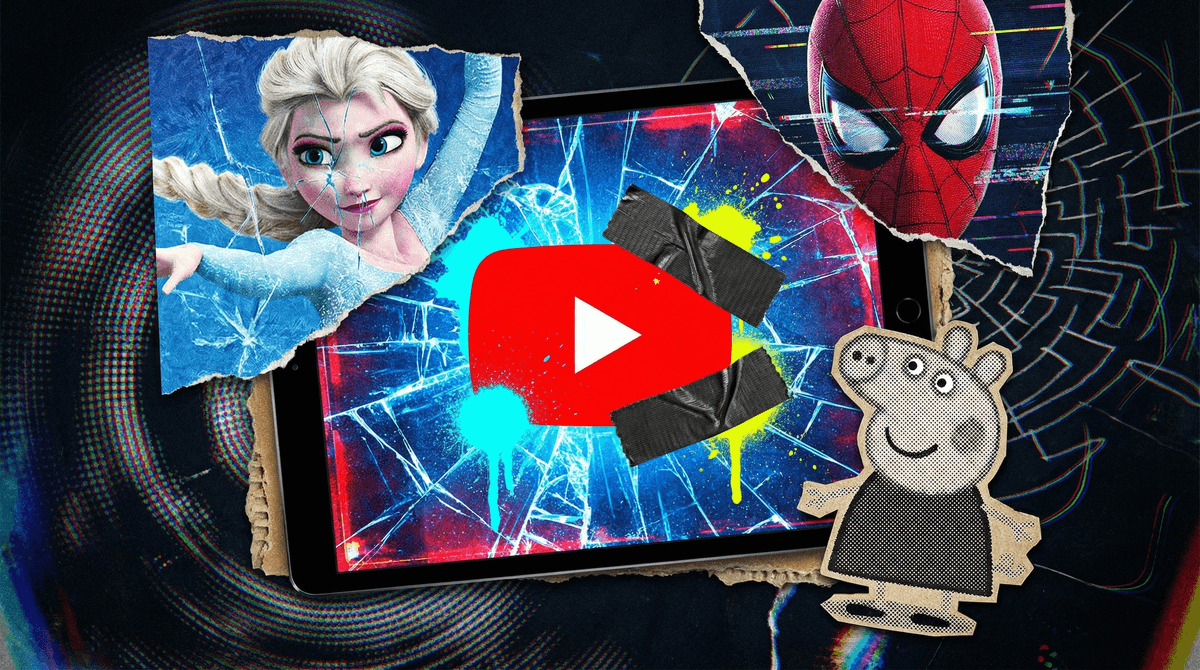
You know that feeling when you walk past your kid watching their tablet and something just feels... off? The colors are too bright, the voices sound wrong, and wait—is that Spider-Man giving Elsa a dental exam in a parking lot?
Welcome to the deeply weird world of fake kids content on YouTube.
These videos masquerade as innocent children's entertainment but are actually algorithmically-optimized nightmares designed to rack up views. They often feature:
- Knockoff versions of popular characters (Peppa Pig, Spider-Man, Elsa) in bizarre, sometimes disturbing scenarios
- AI-generated or poorly animated content that looks "close enough" to fool the algorithm
- Nonsensical plots involving injections, toilets, pregnancy, violence, or other inappropriate themes
- Hypnotic, repetitive music and flashing colors designed to keep kids watching
- Zero educational value and often zero coherent narrative
The term "Elsagate" emerged around 2017 when parents discovered thousands of these videos featuring Disney's Elsa in disturbing situations. While YouTube cracked down hard, the problem hasn't gone away—it's just evolved.
Here's the uncomfortable truth: YouTube's algorithm doesn't care about quality or appropriateness. It cares about watch time.
These videos are specifically engineered to exploit how the recommendation algorithm works:
- They use popular character names and keywords so they appear in searches for "Peppa Pig" or "Spider-Man"
- They autoplay next because they're tagged similarly to legitimate content
- Kids don't click away because they're young enough to not realize something's wrong, or they're mesmerized by the colors and sounds
- The algorithm sees engagement and promotes them further
Content farms (often overseas operations) can pump out hundreds of these videos cheaply using templates, stock animations, and AI voices. A single channel might generate millions of views before getting taken down—and then they just create a new one.
The scale is staggering. Despite YouTube's efforts, new channels pop up constantly. And with AI tools getting better and cheaper, it's actually getting easier to create this garbage at scale.
Beyond just being low-quality, these videos often include themes that are genuinely inappropriate for young children:
- Medical trauma (constant needles, dentist scenarios, hospital settings)
- Bathroom obsession (yes, the "Skibidi Toilet" phenomenon has roots here)
- Pregnancy and bodily functions presented in confusing, sometimes sexualized ways
- Violence disguised as slapstick (characters hurting each other, often in detailed ways)
- Scary imagery (jumpscares, disturbing faces, dark themes)
The really insidious part? Kids often can't articulate what's wrong. A 4-year-old doesn't have the language to say "this content makes me feel anxious and confused." They just keep watching because the algorithm keeps serving it up.
Ages 0-5: Honestly? YouTube shouldn't be a solo activity at this age, period. The risk-to-benefit ratio is just not there.
- Use YouTube Kids in "Approved Content Only" mode (where you manually select channels)
- Better yet, stick to curated platforms like PBS Kids or downloaded episodes of shows you've vetted
- If you're using YouTube, stay in the room and co-watch
Ages 6-8: Kids this age can start to recognize when something feels "wrong," but they need your help building that instinct.
- Teach them the "weird video rule": If something feels strange or makes them uncomfortable, pause it and come get you
- Set up YouTube Kids with "Older" content settings, but still review their watch history weekly
- Consider using content filtering tools
 that block channels by keyword
Ages 9+: By this age, most kids are ready for regular YouTube with guardrails.
- Enable Restricted Mode (it's not perfect, but it helps)
- Have honest conversations about content farms and why they exist
- Teach media literacy: "Does this seem like it was made by real creators who care, or by people just trying to get views?"
YouTube Kids isn't automatically safe. Despite the name, inappropriate content still slips through. The "approved content only" mode is the only way to truly control what they see, but it requires significant upfront work from you.
Watch history is your friend. Check it regularly. You'll spot weird content fast—and you'll also learn what your kid is actually interested in, which helps you find better alternatives.
The algorithm is not your co-parent. Autoplay is designed to maximize watch time, not child development. Turn it off in settings.
Report aggressively. When you find inappropriate content, report it. YouTube's moderation is imperfect, but reports do lead to takedowns. Click the three dots → Report → select "Child safety."
You're not overreacting. If something feels off about what your kid is watching, trust that instinct. You don't need to be able to articulate exactly why a video is problematic to decide it's not allowed in your house.
The creepy fake kids video problem isn't going away—if anything, AI is making it worse. But you're not powerless here.
The single most effective thing you can do? Treat YouTube like you'd treat a public park: fine for kids to explore, but not unsupervised, especially when they're young.
This doesn't mean you need to hover over their shoulder every second. It means:
- Setting up appropriate guardrails for their age
- Checking in regularly on what they're watching
- Teaching them to recognize and avoid garbage content
- Offering better alternatives when you can
And look, I get it—sometimes you just need 20 minutes to make dinner, and YouTube is right there. No judgment. Just maybe queue up a playlist of Bluey episodes or Brains On! instead of letting the algorithm decide what's next.
-
Right now: Check your kid's YouTube watch history (YouTube → Library → History). Anything weird? Time for a conversation.
-
This week: If your young kids use YouTube, switch to YouTube Kids in "Approved Content Only" mode. Yes, it's annoying to set up. Do it anyway.
-
This month: Have a family conversation about what makes content "good" vs. "junk." Help your kids build their own internal filter.
-
Ongoing: Learn about YouTube's parental controls and revisit your settings as your kids get older.
The internet is a weird place, and YouTube is one of its weirdest corners. But with some intentional guardrails and regular check-ins, you can help your kids navigate it without stumbling into algorithmic nightmare fuel.