

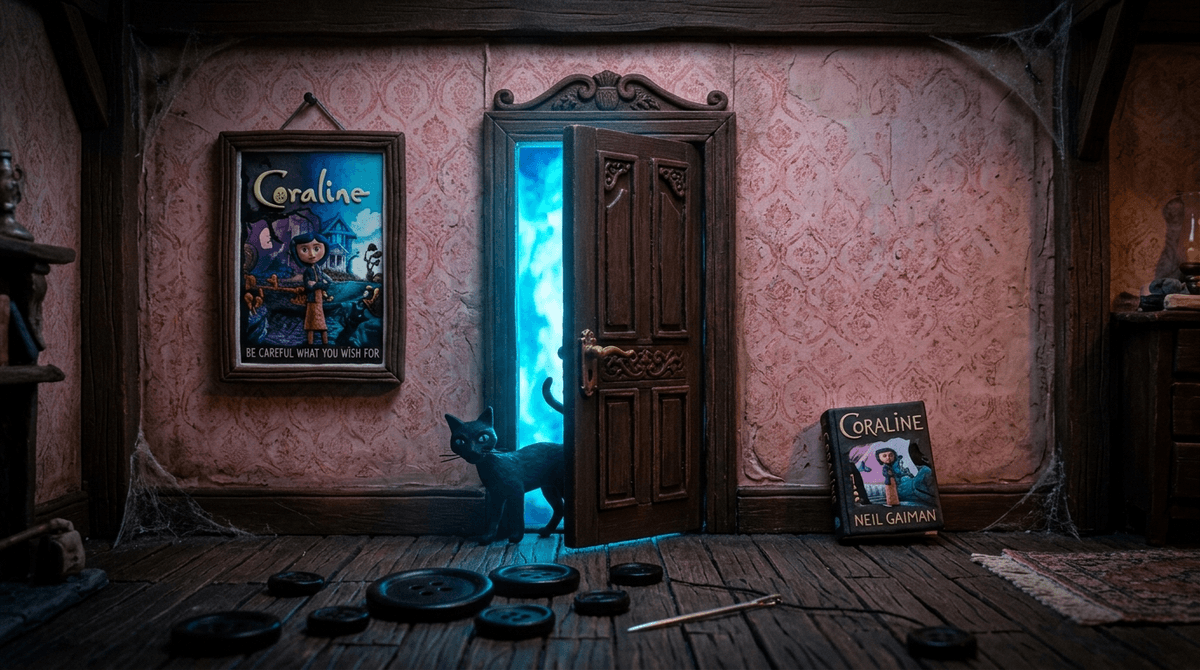
TL;DR: Coraline is the gold standard for "gateway horror"—it’s creepy enough to give them a thrill but meaningful enough to spark a real conversation. It’s a 10/10 masterpiece that explores why a "perfect" world is actually a trap. Best for ages 9+, though brave 7-year-olds might handle it with a parent nearby.
If your kid finishes the movie and wants more, check out:
- Coraline by Neil Gaiman (the book) - Even creepier than the movie.
- ParaNorman - Same studio, great message about being an outsider.
- The Nightmare Before Christmas - The ultimate stop-motion classic.
- Little Nightmares - If they want to play something with the same "creepy doll" aesthetic.
Released in 2009 by LAIKA studios and directed by Henry Selick (the genius behind The Nightmare Before Christmas), Coraline is a stop-motion animated film based on the novella by Neil Gaiman.
The story follows Coraline Jones, a blue-haired, spunky girl who is deeply bored after moving into a quirky apartment building called the Pink Palace. Her parents are stressed, overworked, and—let's be real—kind of dismissive. While exploring, Coraline finds a small, hidden door that leads to the "Other World."
In this alternate reality, her "Other Mother" and "Other Father" are attentive, the food is delicious, and everything is whimsical and fun. The only catch? Everyone has black buttons sewn over their eyes. And, as it turns out, the Other Mother wants to sew buttons onto Coraline’s eyes, too, so she can keep her there forever.
There’s a reason Coraline has stayed relevant for over 15 years, even making a massive comeback on TikTok and Pinterest recently.
First, it respects kids' intelligence. It doesn't sugarcoat the fact that the world can be scary and that adults aren't always perfect. Second, the aesthetic is "dark academia" meets "cottagecore" horror, which is a huge vibe for Gen Z and Gen Alpha right now.
But mostly, it’s about agency. Coraline isn’t a passive princess; she’s a kid who has to use her wits and bravery to save her family. In a world where kids often feel like they have zero control over their schedules or digital lives, seeing a girl outsmart a soul-eating monster is incredibly cathartic.
As a Screenwise guide, I have to point out the glaringly obvious metaphor that makes Coraline a perfect teaching tool for digital wellness.
The "Other Mother" is essentially a human version of a high-engagement algorithm. She watches Coraline, learns exactly what she’s missing in her real life (attention, treats, excitement), and then builds a curated, "perfect" world designed to keep her there.
The Other World is the ultimate "For You" feed.
It’s shiny, it’s colorful, and it tells you exactly what you want to hear. But it isn't real. It’s a hollow shell designed to harvest Coraline’s "life force" (or, in our world, her time and data). When we talk to kids about why Instagram or YouTube feels so good but leaves us feeling so empty, the Other World is the perfect reference point.
While it's rated PG, Coraline is significantly scarier than your average Disney movie.
- Ages 5-7: Generally too intense. The imagery of the "Other Mother" transforming into a spindly, needle-fingered spider-witch is nightmare fuel. Unless your kid is a total horror buff, wait.
- Ages 8-10: This is the sweet spot. They’ll feel the "scary" thrill but are old enough to understand the themes of bravery and trickery.
- Ages 11+: Total green light. At this age, they’ll appreciate the artistry of the stop-motion and the deeper psychological elements.
Safety Considerations: The movie deals with themes of parental neglect (even if it's just "busy parent" neglect) and child endangerment. There are also "Ghost Children" who have had their souls stolen. It’s heavy stuff, but it’s handled with a sense of wonder rather than pure gore.
Also from LAIKA, this movie follows a boy who can talk to ghosts. It’s a great companion piece that deals with bullying and being "different." It’s slightly less "creepy" than Coraline but just as visually stunning.
If your kid liked the "girl enters a magical, dangerous world to save her parents" vibe, this Studio Ghibli classic is a must-watch. It’s beautiful, weird, and deeply emotional.
If they want to keep the "spooky but cool" vibe going in print, this is Gaiman’s take on The Jungle Book, but with a boy raised by ghosts in a graveyard. It’s fantastic for middle-grade readers.
For the gamers, this is a puzzle-platformer that feels like a Coraline fever dream. It’s eerie and atmospheric without being a "jump-scare" fest.
Don't just turn it off when the credits roll. Coraline provides some of the best "teachable moment" openings you'll get from a movie.
-
"Be careful what you wish for." Coraline thinks her "real" parents are boring and annoying. By the end, she realizes their flaws are part of what makes them real. Ask your kids: What would a "perfect" version of our house look like? What would be the catch?
-
The definition of Bravery. There’s a famous quote from the Coraline book: "Being brave doesn't mean you aren't scared. Being brave means you are scared, really scared, badly scared, and you do the right thing anyway." This is a great conversation starter for kids dealing with anxiety or new challenges at school.
-
The "Boredom" factor. The whole story starts because Coraline is bored. In our world, we usually hand kids an iPad the second they complain of boredom. Coraline’s boredom led her to an adventure (albeit a scary one). It’s a good reminder that boredom is the birthplace of creativity.
Coraline is a rare 5-star film. It’s visually iconic, narratively tight, and it respects its audience. It’s the perfect "Friday Night Movie" for a family with older elementary or middle school kids.
Yes, the button eyes are creepy. Yes, the Other Mother is a nightmare. But the message—that your real, messy, imperfect life is worth more than a polished, button-eyed fantasy—is exactly what kids in the digital age need to hear.
Learn more about how to use movies to talk about digital habits
Next Steps:
- Watch the movie together (with the lights on if they're sensitive).
- If they loved the world-building, look up "LAIKA Coraline behind the scenes" on YouTube to see how they built the tiny sets—it’s mind-blowing.
- Use the "Other Mother" as a shorthand for when an app is trying too hard to keep them scrolling. "Is this game being a 'True Mother' or an 'Other Mother' right now?"