

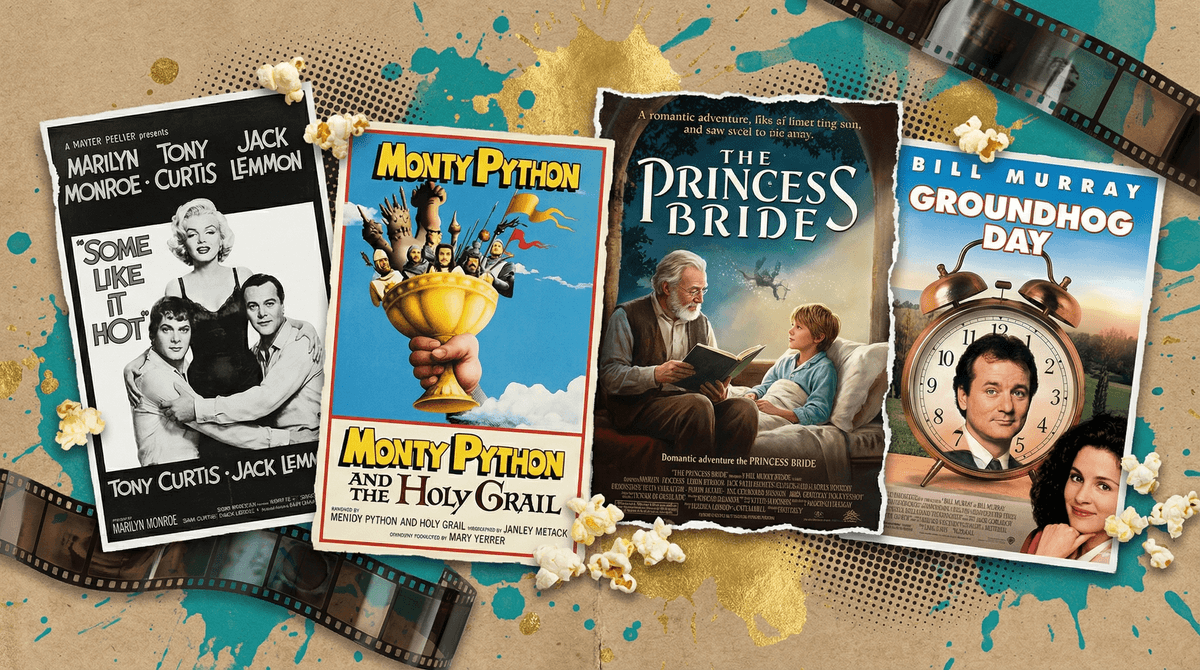
We're talking about the golden age of comedy here—films from the 1930s through the 1990s that defined what makes us laugh. Think The Marx Brothers, Buster Keaton, Some Like It Hot, Monty Python and the Holy Grail, The Princess Bride, Ferris Bueller's Day Off, and Groundhog Day. These are films that proved comedy could be art, that physical gags could be poetry, and that a well-timed one-liner could live in your family's vocabulary for decades.
Here's the thing about classic comedies: they're having a weird moment right now. Kids are growing up on YouTube creators who pump out content at the speed of their attention spans, algorithm-optimized TikToks, and shows specifically engineered to keep them watching. Then you put on a black-and-white Chaplin film or even a '90s Jim Carrey movie, and suddenly you're asking them to slow down, pay attention to setup and payoff, and appreciate humor that doesn't come with a million cuts per minute.
But when it works? It really works.
Classic comedies are basically a masterclass in media literacy disguised as family movie night. These films show kids that humor is constructed, that timing matters, that comedy can be visual, verbal, physical, or absurd. They learn that funny doesn't always mean loud or fast or referencing the latest meme.
Plus, there's something genuinely special about watching your kid crack up at the same joke that made you laugh when you were their age. Or better yet, watching them discover something you've never seen together. It's shared culture that isn't tied to a streaming algorithm or a content creator's upload schedule.
And let's be honest: in a digital landscape where kids are constantly consuming content designed to keep them scrolling, sitting down for a 90-minute movie with a beginning, middle, and end is practically revolutionary. Classic comedies teach patience, attention span, and the lost art of actually finishing something before moving on to the next thing.
Ages 5-8: Start with physical comedy
Young kids don't need dialogue to laugh. Start with silent film era stuff—Buster Keaton doing impossible stunts, Charlie Chaplin getting into trouble. The General (1926) is legitimately thrilling. These films are short, visually engaging, and teach kids that movies weren't always in color or filled with CGI.
Also great: Abbott and Costello Meet Frankenstein, early Pink Panther films with Peter Sellers' physical comedy, and The Great Race.
Ages 9-12: Wordplay and clever plots
This is prime time for The Princess Bride, Groundhog Day, Mrs. Doubtfire, and Home Alone. Kids this age can appreciate clever dialogue, running gags, and plots that actually twist. They're also old enough to understand some of the social commentary hiding in these films.
Ferris Bueller's Day Off hits different in middle school when kids are starting to question authority themselves. The Great Muppet Caper is full of meta-humor they'll finally get.
Ages 13+: Satire and sophisticated humor
Now you can break out Monty Python and the Holy Grail, Dr. Strangelove, Some Like It Hot, and The Big Lebowski. These films reward attention and repeat viewing. They're also great conversation starters about how comedy ages, what jokes land differently now, and why some humor feels timeless while other bits feel dated or even offensive.
Airplane! and The Naked Gun are perfect for teens who think they've seen everything—rapid-fire jokes that require actual focus to catch.
Not all classics age well
Let's not pretend every old comedy is perfect. Some jokes that killed in 1985 are cringeworthy now. Revenge of the Nerds? Yikes. Sixteen Candles? Has some seriously problematic stuff. Even Blazing Saddles, which is brilliant satire, requires context and conversation.
This is actually a feature, not a bug. Watching older comedies with your kids gives you a chance to talk about how humor evolves, why certain stereotypes aren't funny anymore, and what we can learn from how comedy has changed. These are media literacy conversations you can't have with brand-new content.
The attention span hurdle is real
If your kid is used to YouTube and TikTok, a 100-minute movie with slower pacing might feel like homework at first. Start with shorter films (many classic comedies are 80-90 minutes), make it special with popcorn and no phones, and don't force it if they're not into it.
But also? Don't give up after one try. Sometimes the second or third classic comedy is the one that clicks.
They're not on the algorithm
Classic films don't auto-play the next episode or recommend similar content designed to keep your kid watching forever. When the movie ends, it ends. This is actually wonderful. You get your evening back, and kids learn that entertainment can have natural stopping points.
Make it an event, not a chore
Don't present classic comedies as "educational" or "good for you." Frame it as a fun discovery: "I want to show you the movie that made me laugh so hard I cried when I was your age" or "Let's watch the film that basically invented the jokes every other movie copied."
Lean into the weirdness
Black and white? No CGI? Actors you've never heard of? That's part of the charm. Let kids know this is time travel—they're seeing what people thought was hilarious decades ago. Make it anthropological if they're into that.
Create traditions
Friday night classic comedy. Summer break film festival. Birthday person picks the vintage movie. Whatever works for your family, make it recurring so kids know it's coming and can even look forward to it.
Use the pause button
If a joke references something from 1955, pause and explain it. If a scene is dragging, skip ahead. You're not in film school—you're trying to have fun together. The Princess Bride literally has a grandfather reading a story to a sick kid who keeps interrupting, so there's precedent for this approach.
Classic comedy films are one of the best antidotes to the content overload of modern digital life. They're finite, they reward attention, and they prove that humor doesn't need to be loud or fast or constantly referencing itself to be funny.
Will every film be a hit? No. Will your kid sometimes prefer Bluey or their favorite YouTube creator? Absolutely. But the ones that do land become part of your family's shared language in a way that algorithm-driven content rarely does.
Plus, when your teenager drops a perfectly-timed "Inconceivable!" or "Life moves pretty fast," you'll know you've done something right.
Next Steps:
- Check out our guide to family movie night for more tips on making film watching a regular thing
- Browse alternatives to YouTube for kids if you're trying to diversify their comedy diet
- Explore our full list of classic family films across all genres