

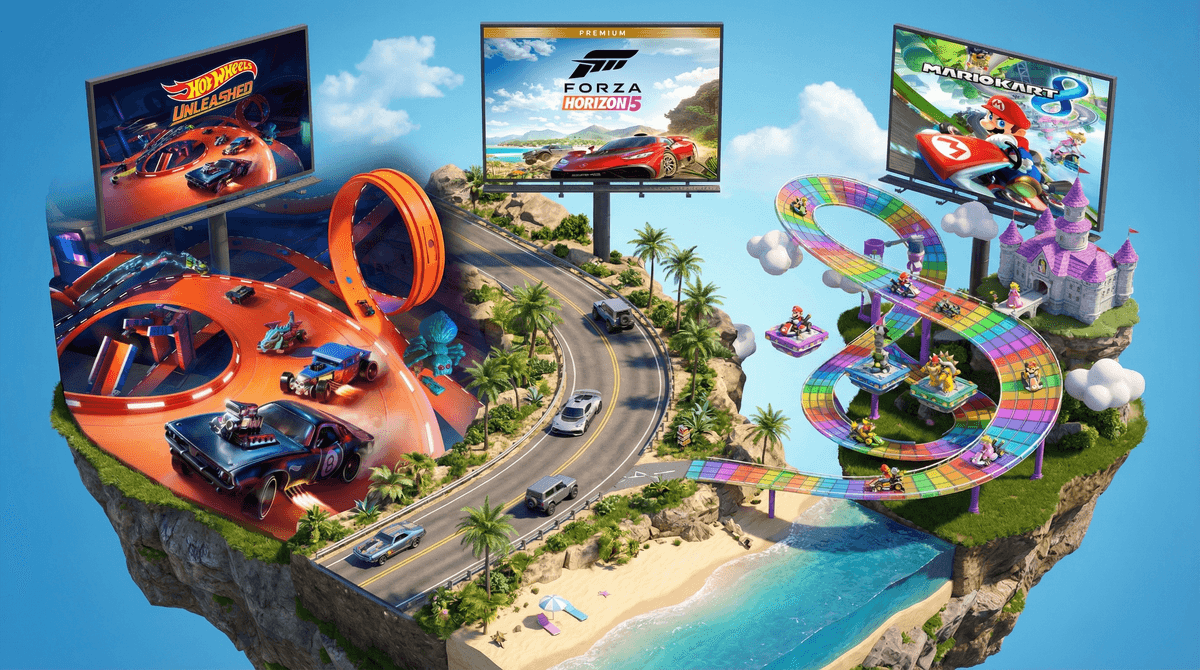
Car racing games are exactly what they sound like—video games where players race vehicles around tracks, through cities, or across wild terrain. They range from ultra-realistic simulators like Gran Turismo to cartoonish romps like Mario Kart where you can throw banana peels at your competitors (because that's definitely how real racing works).
These games span every platform—console, PC, mobile, even VR—and come in wildly different flavors. Some are solo time trials where kids chase their best lap times. Others are chaotic multiplayer demolition derbies. Some teach actual racing lines and physics. Others let you drive a hot dog car through a volcano.
The genre has been around since the dawn of gaming (shoutout to all the parents who played Pole Position in the arcade), but modern racing games have evolved into something much more complex than "press gas, turn left."
Racing games hit that perfect sweet spot of accessible but challenging. A 6-year-old can pick up a controller and have fun immediately—the basic concept of "go fast, don't crash" is intuitive. But there's also a genuine skill ceiling that keeps older kids engaged as they learn to master drifting, racing lines, and vehicle tuning.
There's also the customization factor. Many racing games let kids paint their cars, add decals, upgrade parts, and create a vehicle that feels uniquely theirs. For some kids, the garage customization screen is more engaging than the actual racing.
And let's be real—speed is thrilling. Racing games provide that adrenaline rush of going 200 mph without the whole "risking your life" thing. Plus, unlike many competitive games, racing feels less personal when you lose. Getting eliminated first in Fortnite feels like failure. Coming in 8th place in a race? Hey, you still finished.
The social aspect matters too. Racing games are perfect for couch multiplayer—everyone can see everyone's screen, there's no real advantage to screen-peeking, and the chaos of four kids all trying to navigate the same corner creates genuine laughter.
Not all racing games are created equal, and age appropriateness goes way beyond just "is there violence?"
Ages 5-8: Keep it cartoony and consequence-free
Games like Mario Kart 8 Deluxe are perfect here. The auto-steering and auto-acceleration options mean even kindergarteners can participate. Hot Wheels Unleashed is another solid choice—it's literally toy cars on toy tracks, and the physics are forgiving enough that crashes don't feel punishing.
What to avoid: Anything with realistic crash damage or games that require reading menus to progress.
Ages 8-12: Introducing skill progression
This is where kids can handle games with more depth. Forza Horizon 5 is surprisingly kid-friendly despite being a "realistic" racing game—it's set in an open-world Mexico, has a rewind feature for mistakes, and the difficulty scales beautifully. Rocket League (which is technically soccer with cars) is hugely popular with this age group and teaches genuine teamwork.
The catch: This is when in-game purchases start becoming a thing. More on that in a second.
Ages 13+: The full spectrum
Teens can handle everything from hardcore simulators like Gran Turismo 7 to the absolute chaos of Wreckfest (which is basically "what if racing games were also demolition derbies?"). The main parenting concern shifts from content to time management and social dynamics.
Here's where racing games can get expensive fast. Many modern racing games follow the "free-to-play" or "live service" model, which means the initial game might be cheap (or free), but there's a constant stream of new cars, tracks, and cosmetics to buy.
Forza Horizon 5 releases new cars weekly. Rocket League has a rotating item shop and a "Rocket Pass" each season. Mobile racing games like Asphalt 9 are basically designed to make you want to spend money to skip grinding.
The reality check: A $60 game can easily become a $200 game over a year if you're not paying attention. Kids will absolutely hit you with "but Dad, everyone has the new McLaren" or "this is the LAST season pass, I promise."
Some practical boundaries:
- Set a monthly gaming budget that covers all in-game purchases, not just racing games
- Distinguish between functional and cosmetic purchases—a new car that's actually faster is different than a sparkly paint job
- Use the "earn it" model—if they want the season pass, they can do extra chores or use birthday money
- Check if the game has a "complete edition" that includes DLC—sometimes it's actually cheaper to wait and buy that
Learn more about how in-game currencies actually work if you're feeling lost in the sauce here.
Online racing is different than couch racing
When your kids are racing against strangers online, the experience changes. Voice chat can get toxic (yes, even in racing games). Some kids will rage-quit. Others will intentionally crash into people or drive backwards on the track to grief other players.
Most racing games let you disable voice chat or limit online play to friends-only. Use these settings, especially for younger kids.
"Realistic" doesn't mean "inappropriate"
A game with realistic graphics and physics isn't automatically too mature. Gran Turismo is incredibly realistic but has zero violence or inappropriate content—it's just... racing. Meanwhile, Burnout Paradise is cartoonish but actively rewards you for causing massive crashes.
Check the ESRB rating, but also watch some gameplay footage on YouTube. You'll get a much better sense of whether it fits your family's vibe.
Racing games can actually teach good stuff
I know, I know—this sounds like the "video games teach hand-eye coordination" defense. But genuinely, racing games can teach:
- Cause and effect (take that corner too fast, you'll crash)
- Risk assessment (do I try to pass now or wait for a safer opportunity?)
- Graceful losing (you can't win every race, and that's okay)
- Spatial awareness (judging distances and speeds)
Some kids even get interested in real automotive engineering and physics because of racing games. Is it going to get them into MIT? Probably not. But it's not brain rot either.
The "just one more race" problem
Racing games are uniquely difficult to pause. A single race might only be 3-5 minutes, which sounds great until your kid is saying "just one more" for 45 minutes. Unlike a game with clear stopping points (end of a level, end of a match), racing games often have championships or series where stopping mid-way feels incomplete.
Set expectations upfront: "You can do this championship, but when it's done, you're done." And actually, many racing games DO have a pause function even in online races—the car just stops moving. It's not ideal, but dinner waits for no one.
Car racing games are one of the more parent-friendly gaming genres out there. They're intuitive, they scale well across ages, and they don't typically involve the violence or social toxicity of shooters or battle royales.
The main things to watch for:
- In-game purchases can add up fast—set clear boundaries
- Online play needs monitoring, especially voice chat
- Time limits are tricky because races are short but addictive
Start with something universally loved like Mario Kart for younger kids, graduate to Forza Horizon for the middle years, and let teens explore whatever interests them (within reason).
And hey, racing games are actually fun to play WITH your kids. You don't need to be good at video games to enjoy Mario Kart. It's one of the few gaming genres where family participation doesn't feel forced.
Want to explore specific racing games? Check out our guides:
Concerned about in-game purchases? Learn how to set up parental controls on different gaming platforms
Looking for alternatives to racing games? Explore other competitive games that aren't shooters