

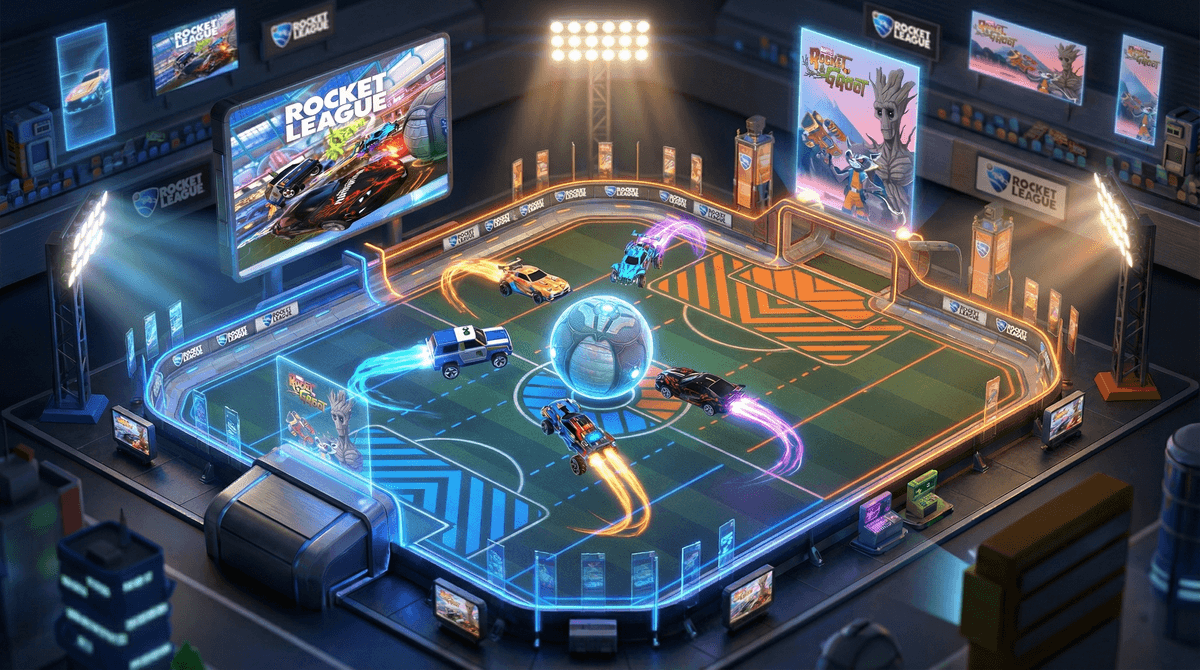
Rocket League is basically soccer with rocket-powered cars. That's it. That's the pitch. And somehow, it's absolutely brilliant.
Released in 2015, this game has players controlling customizable vehicles to hit a giant ball into the opposing team's goal. Matches are typically 5 minutes long, played in teams of 1v1, 2v2, or 3v3. The cars can jump, flip, boost through the air, and drive on walls and ceilings. It sounds chaotic (because it is), but there's genuine skill involved.
Here's what makes it different from a lot of other competitive games: it's rated E for Everyone by the ESRB. No violence, no gore, no questionable content. Just cars, soccer balls, and a whole lot of "WHAT A SAVE!" quick chats.
The game is free-to-play and available on pretty much everything: PlayStation, Xbox, Nintendo Switch, and PC through Epic Games. Given that 55% of families in our community have gaming consoles, there's a decent chance your kid either already plays or has friends who do.
The learning curve is real, but that's part of the appeal. Your first few matches? You'll whiff the ball constantly and probably score on your own goal. But there's something deeply satisfying about gradually getting better—landing your first aerial hit, making a clutch save, perfectly timing a demolition of an opponent's car.
It's genuinely competitive without being complicated. Unlike Fortnite where you need to master building mechanics, or League of Legends with its 160+ characters to learn, Rocket League has one simple objective: ball in goal. But the skill ceiling is incredibly high, which keeps kids engaged for years.
The customization is another huge draw. Players can unlock or purchase (more on that later) different car bodies, decals, wheels, boost trails, and goal explosions. It's like FIFA Ultimate Team but without the gambling mechanics that make that game so problematic.
And honestly? The competitive scene is legitimately exciting to watch. The Rocket League Championship Series has turned some players into actual esports celebrities, and watching high-level play is mesmerizing—these players are doing things with physics that seem impossible.
Here's where Rocket League actually shines as a parent-friendly option in the gaming landscape:
It teaches real sportsmanship. Because matches are short and the gameplay is so directly competitive, kids quickly learn that blaming teammates gets you nowhere. The best players are constantly rotating positions, communicating, and supporting each other. It's basically a crash course in teamwork.
The toxicity is manageable. Yes, online gaming communities can be rough, but Rocket League has pretty robust chat controls. You can disable text chat entirely, limit it to quick chat only (pre-set phrases like "Nice shot!" or "Defending..."), or restrict it to team-only. The game also has a solid reporting system, and Psyonix (the developer) actually bans toxic players.
It's physics-based learning. Kids are intuitively understanding momentum, trajectories, and timing. One parent in our community mentioned their 10-year-old started asking questions about acceleration and angles after getting into Rocket League. Not saying it replaces math class, but it's not rotting their brain either.
Cross-platform play works beautifully. Your kid on Switch can play with their friend on Xbox and their cousin on PC. In an increasingly fragmented gaming ecosystem, this actually matters for maintaining friendships.
The Money Situation
Rocket League is free-to-play, which means cosmetic items are how they make money. The game uses Rocket League Credits as currency, and yes, kids will want them.
Here's the thing: all purchases are purely cosmetic. A $0 car plays exactly the same as one from a $20 bundle. This is actually the right way to do free-to-play, unlike pay-to-win games where spending money gives competitive advantages.
That said, the Rocket Pass (their battle pass system) costs about $10 and runs for a few months. It unlocks additional cosmetic rewards as you play. If your kid is really into the game, this might be worth considering as a birthday or holiday gift.
The Item Shop rotates daily with new cosmetics, which creates FOMO (fear of missing out). Set clear expectations early about spending, or better yet, learn about how free-to-play games are designed to encourage spending .
.
Age Appropriateness
The ESRB rating is E for Everyone, but realistically:
Ages 7-9: Can play and have fun, but will struggle with the mechanics and might get frustrated. Casual matches with bots are fine. Voice chat should be disabled.
Ages 10-13: Sweet spot. Old enough to handle the competition and complexity, young enough to still be developing those teamwork skills. This is where you'll see the most engagement. Quick chat only is fine here.
Ages 14+: Can handle full communication if they're mature about it, though honestly, quick chat is often better for gameplay anyway.
Time Management
Matches are 5 minutes, but here's the catch: "Just one more game" is incredibly easy to justify. The quick match length actually makes it harder to find natural stopping points.
Consider setting expectations around number of matches rather than time. "You can play 5 matches" is clearer than "30 minutes" when matches can go into overtime.
The game also has a Tournaments feature that runs at scheduled times and takes about 30-45 minutes to complete. If your kid commits to a tournament, they really should finish it—leaving mid-tournament affects their teammates.
Voice chat: Can be enabled but isn't necessary for gameplay. Most competitive players use quick chat because it's faster anyway. For kids under 13, voice chat with strangers should be disabled.
Text chat: The profanity filter is decent but not perfect. Quick chat only is a solid middle ground that allows communication without exposure to toxic messages.
Friend requests: The game allows friend requests from other players. Talk with your kid about only accepting requests from people they know in real life.
Trading: Players can trade items with each other. This has created a whole economy and, unfortunately, some scam attempts. If your kid is interested in trading, learn about common Rocket League trading scams before they lose their favorite items.
In the landscape of competitive online games, Rocket League is genuinely one of the better options for kids. It's not educational software disguised as a game, but it's also not the dopamine-slot-machine design of many mobile games.
The skill development is real, the competitive element teaches resilience, and the teamwork requirements actually mirror youth sports in meaningful ways. Plus, with 55% of families in our community engaging with gaming, understanding what your kid is playing helps you stay connected to their interests.
Is it perfect? No. Will your kid sometimes rage-quit after a tough loss? Absolutely. But compared to Call of Duty or Grand Theft Auto, this is a pretty easy yes for most families.
If you're considering allowing Rocket League:
- Play a few matches yourself first (seriously, it's more fun than you'd think)
- Set up chat restrictions before the first match
- Establish clear boundaries around spending and time limits
- Consider playing together—the couch co-op and split-screen options are great for family gaming
If your kid already plays:
- Ask them to show you their best replay—they'll love sharing
- Review their chat settings together
- Talk about sportsmanship and how they handle losses
- Explore whether their gaming time is balanced with other activities
Want to see how your family's gaming habits compare to others in your community? Take the Screenwise survey to get personalized insights and recommendations.