

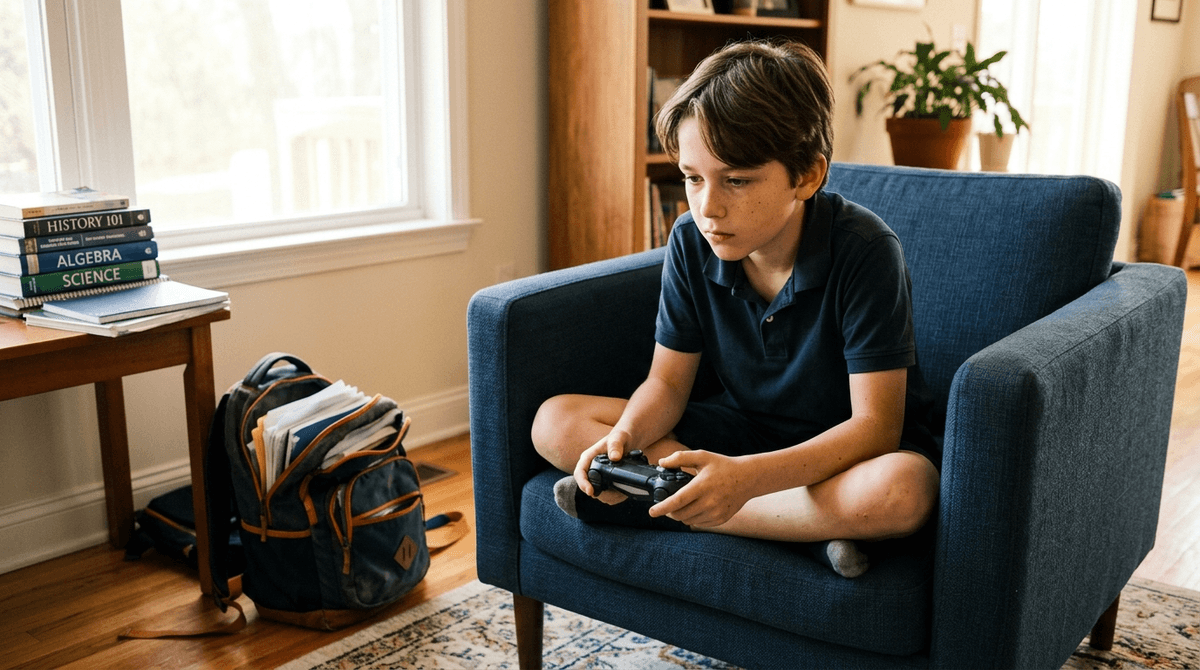
Gaming habits in late elementary school aren't fixed; they often shift significantly between 3rd and 6th grade, and the kids most at risk are those using games to escape bullying or compensate for low self-control. Sudden spikes in screen time during these years are frequently "canaries in the coal mine" for social isolation or school-based anxiety.
Gaming habits usually stabilize or improve by the end of elementary school, but children who use games to cope with bullying or anxiety face a "worsening" trajectory that eventually hurts their school performance. Identify the underlying social trigger or lack of self-regulation rather than simply seizing the console, as the gaming is often a symptom of a deeper struggle.
The "tween" window is a critical developmental bridge where casual play can calcify into a problematic habit. If a child’s gaming escalates in 4th or 5th grade, it is rarely just about the game itself—it is a signal of social or emotional distress. Catching this trend early is vital because "high-risk" gaming trajectories are directly linked to lower school well-being and disengagement by the time a child hits middle school.
Understanding that gaming is a regulatory tool helps parents move away from unproductive power struggles. When we treat the screen as the enemy, we often miss the fact that the child is using the digital world to find the competence or safety they feel they are missing in the classroom.
Researchers tracked the gaming habits of over 1,300 children for three years to understand why some kids outgrow heavy gaming while others spiral. They were specifically concerned with how "internalizing" symptoms—like depression and anxiety—and environmental stressors like bullying drive children toward problematic usage patterns. By following the same group from age 9 to 12, they were able to map distinct "paths" of behavior rather than just taking a one-time snapshot.
Most children fall into a "low and decreasing" pattern of gaming, but a distinct group of high-risk students sees their habits worsen significantly over three years.
- Peer victimization (bullying) is a primary engine for problematic gaming. Children who are picked on at school use games to find a sense of control and belonging.
- Self-control is the strongest internal predictor. Children who struggle to regulate their impulses in other areas are statistically much more likely to fall into the "worsening" or "persistently high" gaming groups.
- Autonomy-supportive parenting—which involves providing choices and explaining the rationale behind rules—correlates with lower-risk habits. Harsh or arbitrary punishment does not effectively curb long-term problematic gaming.
- School performance suffers as a result of the trajectory. By 6th grade, children in the high-risk gaming groups reported significantly lower levels of school well-being and engagement.
The findings suggest that "gaming addiction" isn't a standalone condition but a compensatory mechanism for a lack of agency. If school is a place where a child feels bullied or incompetent, the digital world offers a predictable, rewarding alternative. When parents punish the gaming without addressing the school environment, they are effectively removing a child's only coping mechanism without providing a replacement. This creates a cycle where the child feels further alienated, leading back to the screen.
The study focused on a specific population of Chinese migrant children. These families often face unique stressors, such as social marginalization or family instability, which might make their children’s gaming trajectories more extreme than those in the general population. Additionally, the data relies on self-reporting from the children, which can be less accurate than objective app-tracking data. Because the study is observational, we can see that heavy gaming and poor school performance happen together, but we cannot definitively prove that gaming causes the drop in grades.
- If your child’s gaming time suddenly spikes in 4th or 5th grade, investigate their social life at school for signs of bullying or exclusion before implementing a total hardware ban.
- If you are setting screen time boundaries, provide the rationale and offer choices (e.g., "We need an hour of physical activity; do you want to bike or play soccer while the console is off?") to help the child internalize the limit.
- If your child struggles with self-regulation in other areas, keep high-stimulus or "infinite" games out of the house early on, as these children are more vulnerable to a worsening gaming trajectory.
- If you notice your child becoming more anxious or withdrawn, view their gaming as a regulatory tool they are using to manage those feelings, and prioritize mental health support over simple time-policing.
Gaming is a symptom, not just a hobby. While most kids navigate digital play safely and eventually dial back their usage, those facing social hurdles use games as a shield—a move that eventually costs them their focus at school. Focus on the child’s social environment and their ability to regulate their own emotions, and the gaming habits will likely follow a healthier path.
Zhou J, Luo Y, Song J et al. (2026). Developmental Trajectories of Problematic Gaming among Chinese Migrant Children: Predictors and School Adjustment Outcomes. Journal of youth and adolescence. doi:10.1007/s10964-026-02375-0 — pubmed.ncbi.nlm.nih.gov