Chasing Vermeer

Chasing Vermeer

book

2005, Children's Books, Growing Up & Facts of Life

WISE
81%

WISE Score

4.6

Amazon

Art heist mystery meets geometric puzzles—smart and unusual, but not every kid will have the patience for it.

Amazon4.6
Common Sense Media

Where to Read

Our reviews and ratings are 100% unbiased, but as an Amazon Associate, Screenwise earns an affiliate fee if you buy a book or game by clicking one of our links. We don't get any credit if you just Google it instead :)

Screenwise Verdict

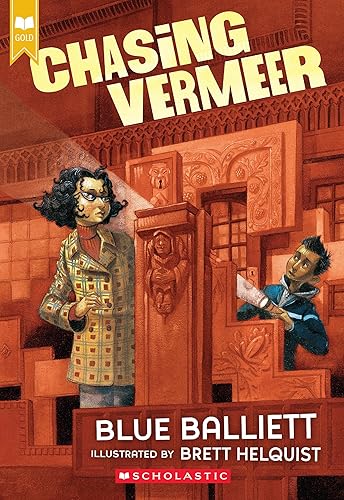
Chasing Vermeer is one of those polarizing middle-grade books—it's either 'the book that made me fall in love with mysteries' or 'the book I couldn't finish because nothing happened.' The concept is genuinely clever: a mystery about a stolen Vermeer painting, with hidden pentomino puzzles in the illustrations that readers can decode alongside the characters.

The art history angle is legitimately enriching without being preachy, and the two protagonists are smart kids who solve problems through observation and logic. But the pacing is deliberate (some would say slow), and the mystery's resolution leaves some readers feeling like the clues were more vibes than concrete evidence.

It's a book for patient, detail-oriented kids who like thinking while they read—not for kids who want fast-paced action. If your kid is the type who enjoys codes, puzzles, and noticing small details, this could be a hit. If they prefer their mysteries with more chase scenes and fewer art lectures, maybe not.
Age Fit

Best for ages 9-13, especially kids who like puzzles, codes, and thinking while they read. Younger kids might struggle with the vocabulary and abstract concepts; older middle schoolers might find it a bit young unless they're really into art or mysteries.

WISE Breakdown
Wholesome
82

Two middle schoolers form a genuine friendship while solving a mystery together. The story models collaboration, problem-solving, and intellectual curiosity without romance drama or mean-girl dynamics. The pacing is thoughtful rather than frenetic, though some readers find it slow. Models positive intergenerational relationships with an eccentric older woman character.

Imaginative
88

The book is structured as a puzzle within a mystery—readers are invited to decode visual clues hidden in Brett Helquist's illustrations throughout. Introduces kids to Vermeer's art and the concept of pentominoes (geometric puzzles). The narrative itself plays with coincidence, patterns, and intuition in ways that encourage active engagement rather than passive reading. It's genuinely unusual for a middle-grade mystery.

Safe
95

This is a classic middle-grade mystery with zero content concerns—no violence, no scary scenes, no inappropriate themes. The 'crime' is an art theft, not anything that would frighten young readers. The FBI is involved but in the most benign, procedural way possible. Completely safe for independent reading by kids who can handle the vocabulary.

Enriching
85

Introduces young readers to Johannes Vermeer, art history, and the world of art authentication and forgery in an accessible way. The pentomino puzzles build spatial reasoning skills. The mystery rewards careful observation and pattern recognition. That said, some kids find the art-history elements dry, and reviews suggest the mystery itself can feel convoluted rather than satisfying. Still, it's intellectually ambitious for middle grade.

Parent Info

Why It Might Be Great

  • Actually teaches kids about Vermeer and art authentication without feeling like homework
  • The illustrations contain hidden pentomino codes that invite active puzzle-solving alongside the story
  • Models two smart kids using observation and logic rather than luck or adult help
  • Introduces concepts like coincidence, pattern recognition, and trusting your intuition
  • Won multiple awards and was a bestseller—it connected with a lot of young readers who wanted something more cerebral

What to Watch For

  • Reviews are split: some kids find it brilliant, others find it confusing or slow-paced
  • The mystery's resolution doesn't satisfy everyone—some feel the clues don't quite add up
  • Best for kids who already like reading and don't mind a slower burn
  • The art history elements are a feature, not a bug—if your kid groans at museum visits, this might not land

Conversation Starters

  • "Do you think coincidences are just random, or do you think patterns mean something?"
  • "If you could solve a mystery about any stolen artwork, which painting would you choose?"
  • "What do you think makes a painting 'real' or 'fake'? Does it matter who painted it if it looks the same?"
  • "Would you rather solve puzzles with your brain like Petra and Calder, or with physical clues like a detective?"

Ask Anything

Get a personalized guide on any topic